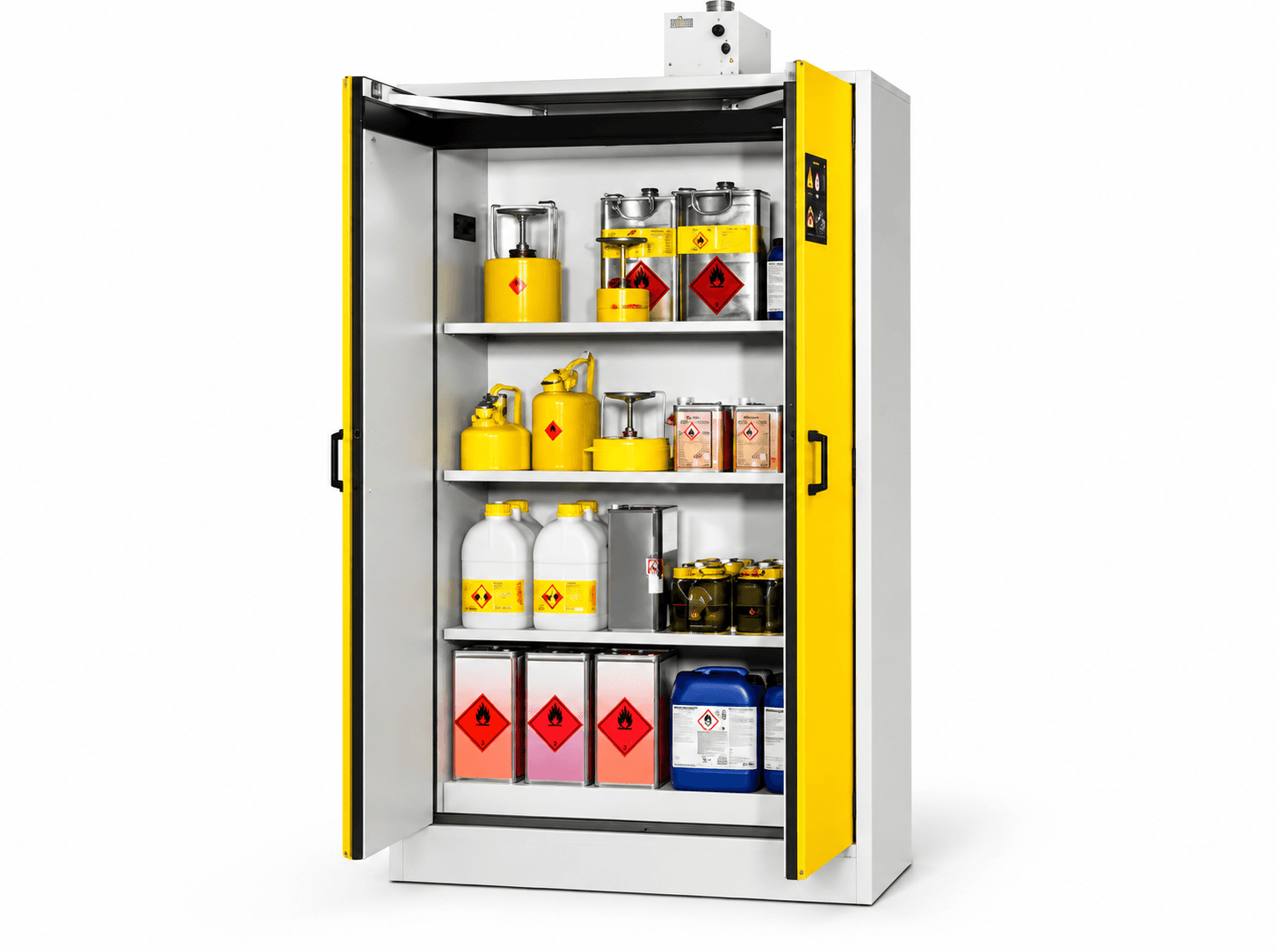
Storing corrosive and toxic substances is one of the biggest organizational challenges in a modern chemical, industrial, or research laboratory. Concentrated acids and bases generate vapors capable of damaging the respiratory tracts of personnel, as well as expensive measuring equipment and installations located in the room. Therefore, safe storage of chemicals requires more than just a standard storage cabinet. What is needed is a solution designed with chemical resistance, tightness, and effective vapor extraction in mind.
Construction and materials - the foundation of corrosion resistance
The choice of material from which an acid and base cabinet is made determines its actual usability throughout its entire service life. Ordinary steel, even when powder-coated, does not provide sufficient protection in contact with concentrated mineral acids. Vapors of hydrogen chloride, sulfuric, or nitric acid gradually penetrate micro-cracks in the paint coating, leading to corrosion of the substrate and loss of structural integrity in a matter of months, not years.
Professional laboratory furniture for storing aggressive chemicals is based on chemically resistant materials, such as solid polypropylene boards, HPL laminates with increased resistance, or special chemically resistant composites. These materials are chemically inert and do not react with acid or base vapors, which eliminates the risk of structural degradation in the areas of greatest exposure, i.e., the interior of the working chamber and the bottom of the cabinet.
Equally important is the absence of metal elements in the zone of direct contact with chemicals. Hinges, shelf runners, and locking mechanisms made of unprotected metal are among the first elements to undergo corrosion, which in practice leads to jamming of doors or damage to drawers. Therefore, in professional solutions, all components coming into contact with the interior of the chamber are made of plastics or coated with vapor-resistant materials.
Effective ventilation and vapor extraction - a priority for health and safety
The chemical resistance of the casing alone is not enough if the vapors of volatile substances accumulate inside the cabinet and escape into the room every time the door is opened. Therefore, every acid and base cabinet should be permanently connected to an efficient laboratory ventilation system, ideally with a constant and monitored airflow. Such a system not only removes vapors but also maintains a slight negative pressure in the chamber, limiting their emission into the environment.
When designing the ventilation of laboratory cabinets, it must be taken into account that the vapors of many acids are heavier than air and tend to accumulate at the bottom of the chamber. An extraction system designed exclusively in the upper part of the cabinet will not remove them effectively, so the ventilation ducts should allow air to be drawn from every storage level, and not just from the upper zone of the structure.
No less important is the control of the airflow itself. Systems with airflow sensors allow for real-time monitoring of whether the ventilation is working properly and signal a failure before uncontrolled vapor release into the room occurs. In high-risk laboratories, such a solution is an essential element of a comprehensive safety strategy, and not just additional equipment.
Separation of substances - why don't we store acids and bases together?
The joint storage of acids and bases in a single, undivided space carries serious technological risks. In the event of packaging leakage or accidental mixing of the vapors of both groups of substances, a violent exothermic reaction may occur, accompanied by the release of heat and toxic, irritating gases. The scale of such a reaction depends on the concentration and quantity of the substances, but even small amounts can pose a real threat to personnel in the vicinity.
For this reason, advanced structural solutions are based on the physical division of the cabinet into two separate, hermetically isolated chambers. Each of them is intended exclusively for one group of substances and equipped with an independent ventilation duct, which eliminates the possibility of vapors mixing even in the event of a failure in one of the chambers.
Such separation also organizes daily work in the laboratory. Personnel using clearly marked, separate storage zones make fewer mistakes resulting from haste or inattention, which further reduces the risk of unintended contact between incompatible chemical substances.
Internal equipment and work ergonomics in the laboratory
Daily work with chemicals requires solutions that minimize the risk of human error and facilitate the handling of even heavy containers. Pull-out shelves mounted on reinforced runners allow a bottle of chemicals to be safely removed without having to reach deep into the chamber, which reduces the risk of spilling the substance during manipulation.
A key element of this type of laboratory equipment are leak-proof drip trays placed at the bottom of the cabinet. In the event of packaging damage or a minor leak, the drip tray contains the substance within the controlled zone, preventing it from spreading onto the floor and coming into contact with other materials.
The functionality is complemented by smooth, self-closing door systems. They eliminate the risk of leaving the cabinet open after work is finished, which could lead to an uncontrolled emission of vapors into the room. This is a seemingly small detail that in practice significantly affects the safety level of the entire workstation.
Under-bench or freestanding? Adapting the cabinet to the laboratory layout
Acid and base cabinets differ not only in material, but also in dimensions and installation methods, which allows them to be adapted to the layout of the laboratory. Spacious, tall freestanding cabinets work well as the main handy storage for larger supplies of reagents.
An alternative are under-bench models, with a lower height and compact design. Such an acid and base cabinet can be integrated under a fume hood or under a wall bench, for example with Renggli wall benches, so that the most frequently used reagents are located directly at the workplace.
The modular construction of laboratory furniture allows both solutions to be combined within a single workstation. Appropriate selection of the size and location of the cabinet shortens the movement paths of personnel and improves the ergonomics of the laboratory equipment.
Safety without compromise with Renggli solutions
A properly designed acid and base cabinet combines a chemically resistant structure, effective ventilation, substance separation, and practical internal equipment into one coherent system for protecting personnel and apparatus. Renggli, as a Swiss manufacturer of laboratory furniture, offers chemical cabinets compliant with these principles and current safety standards.
September 10, 2026