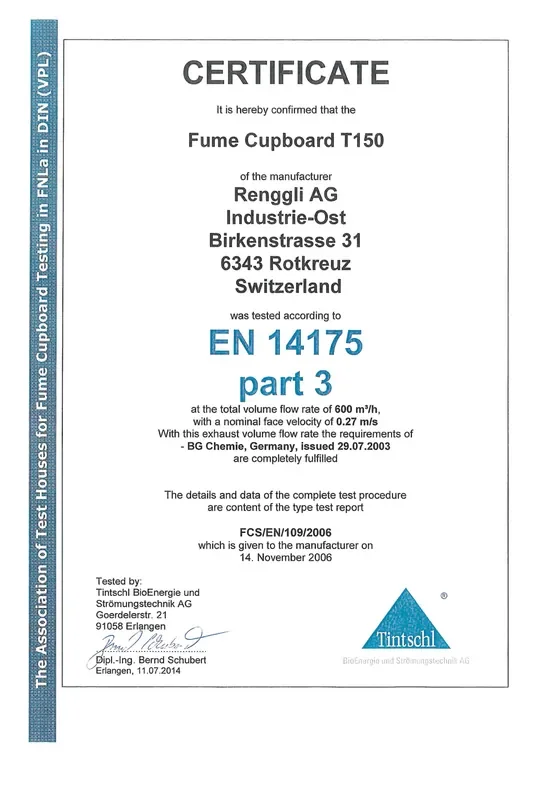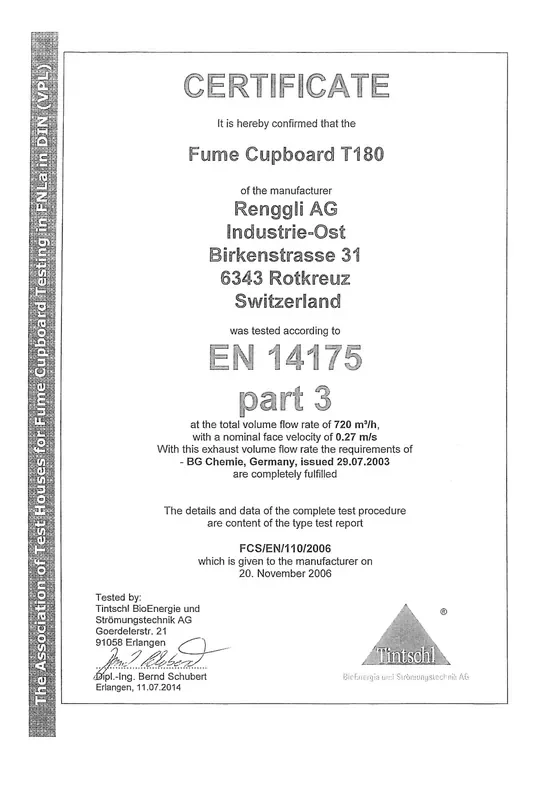
Type test EN 14175-3
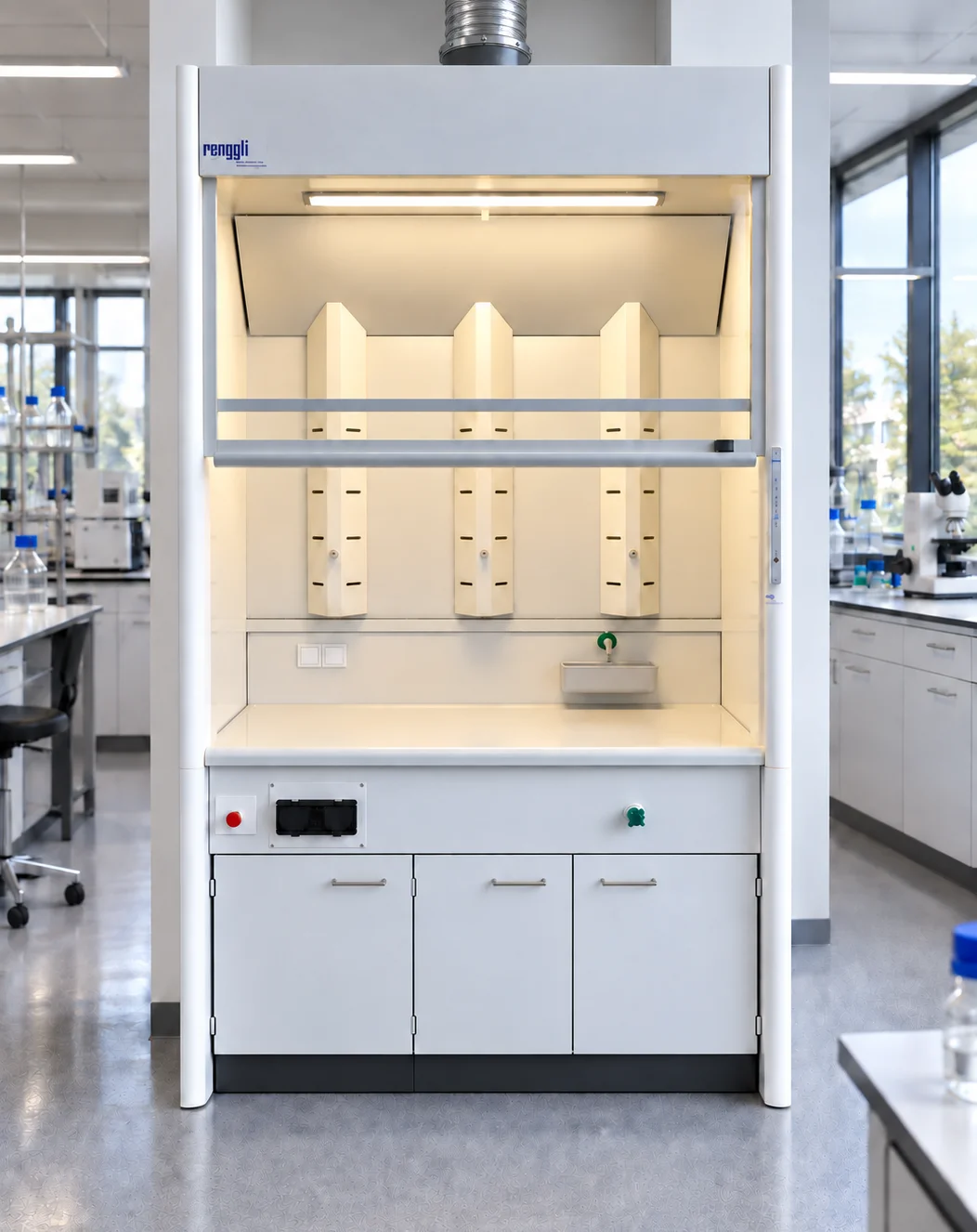
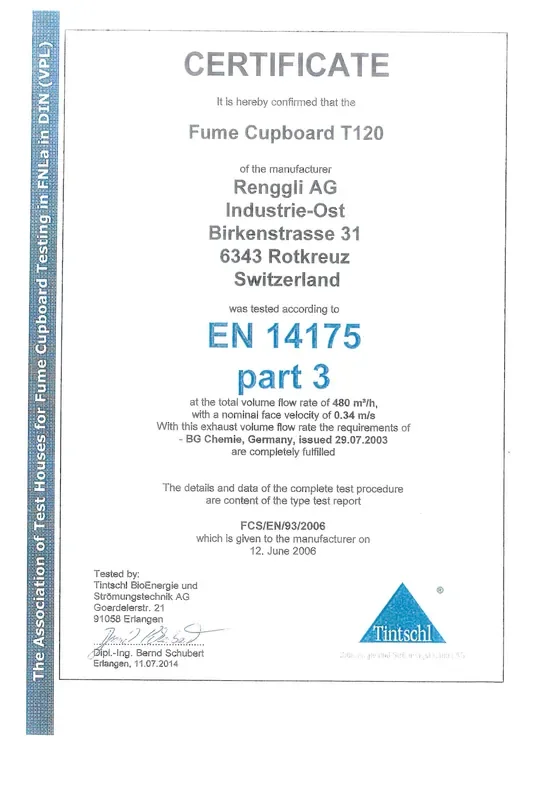
Fume cupboard T120 (1200 mm)
- Issued by
- Tintschl BioEnergie und Strömungstechnik AG, Erlangen
- Reference
- FCS/EN/93/2006
- Test date
- Issued
- Exhaust airflow
- 480 m³/h
- Face velocity
- 0.34 m/s
Laboratory fume hoods
A laboratory fume cupboard, known in the US as a fume hood, is a ventilated enclosure that draws vapours, gases and dust away from the operator and removes them through a duct or a filter.
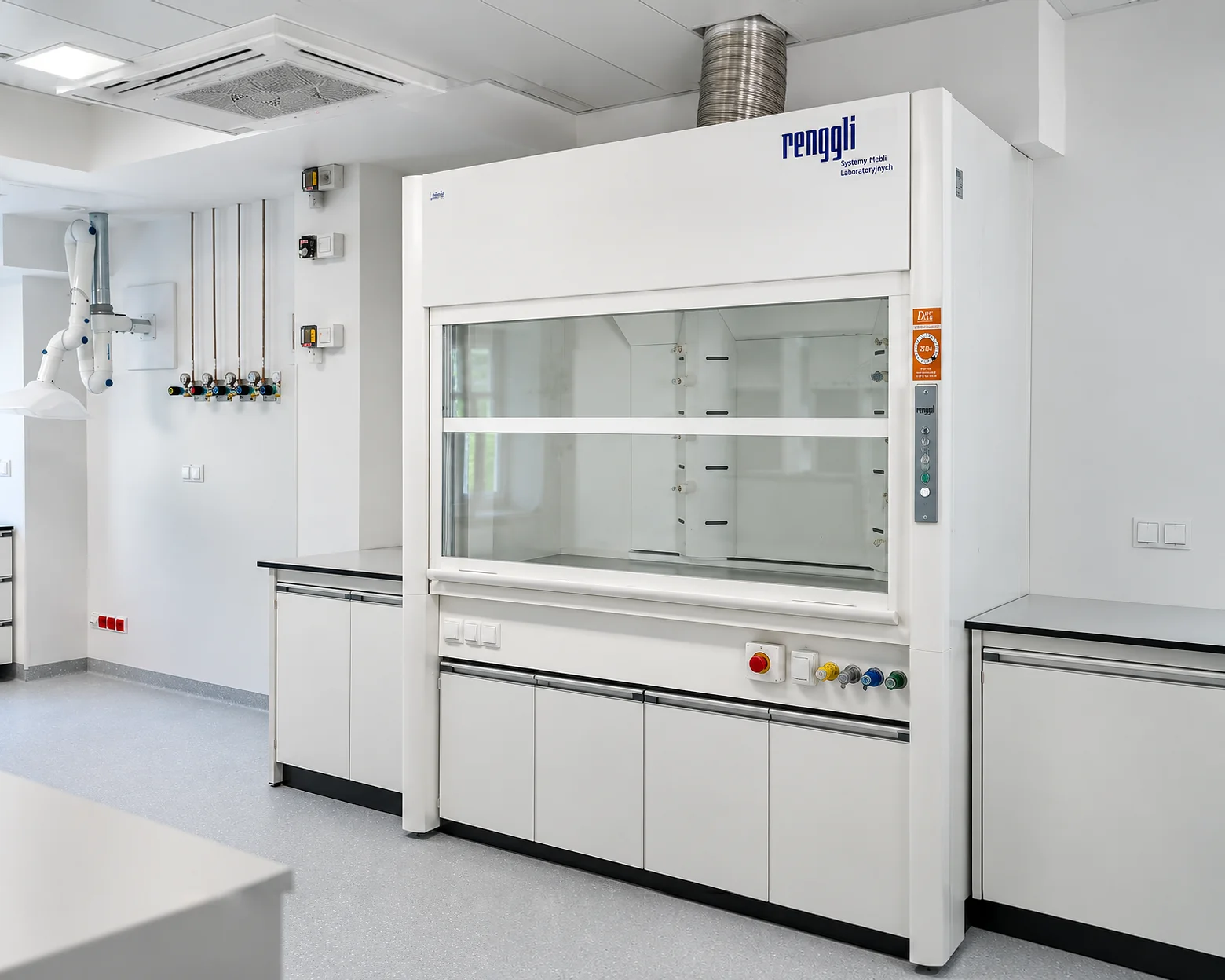
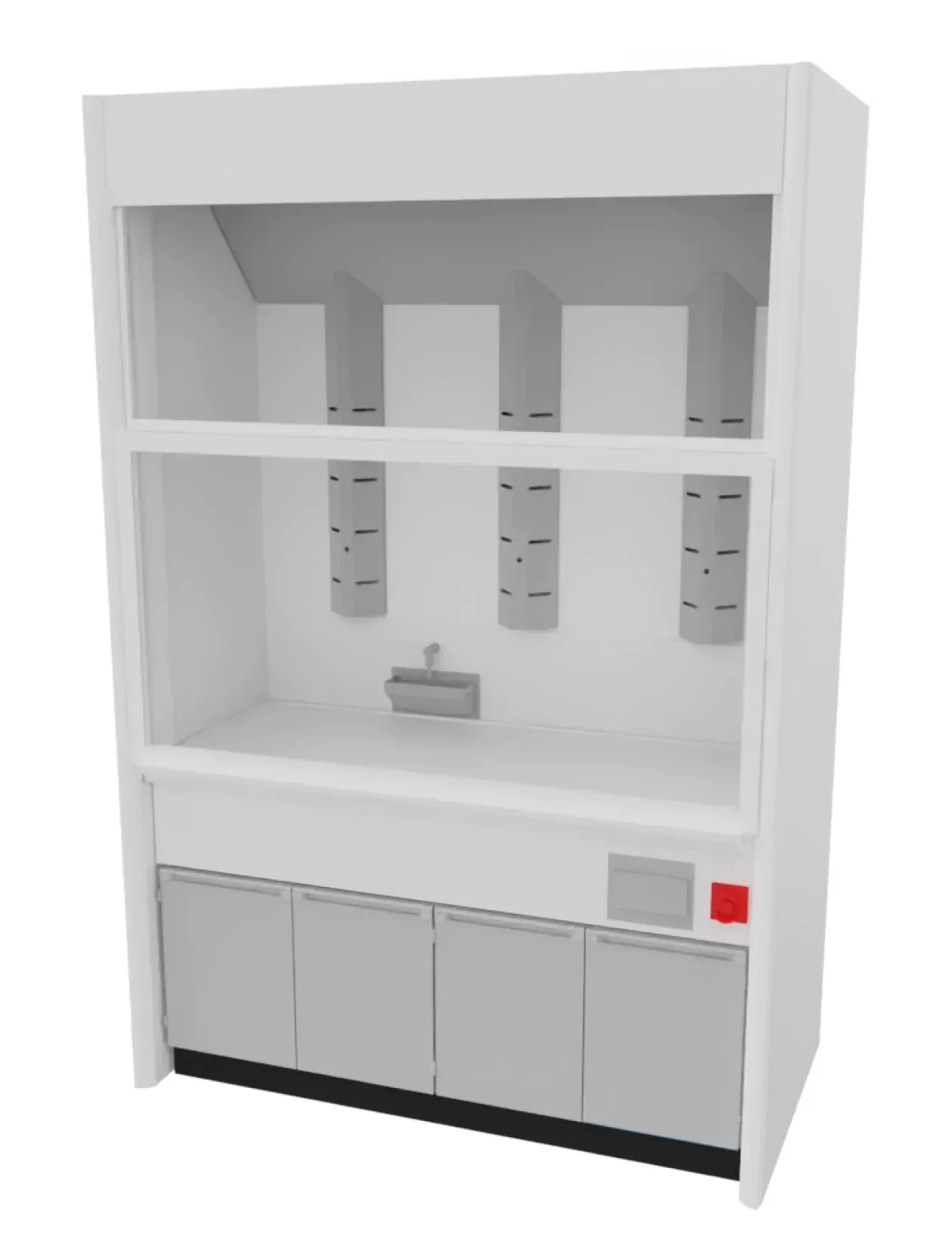
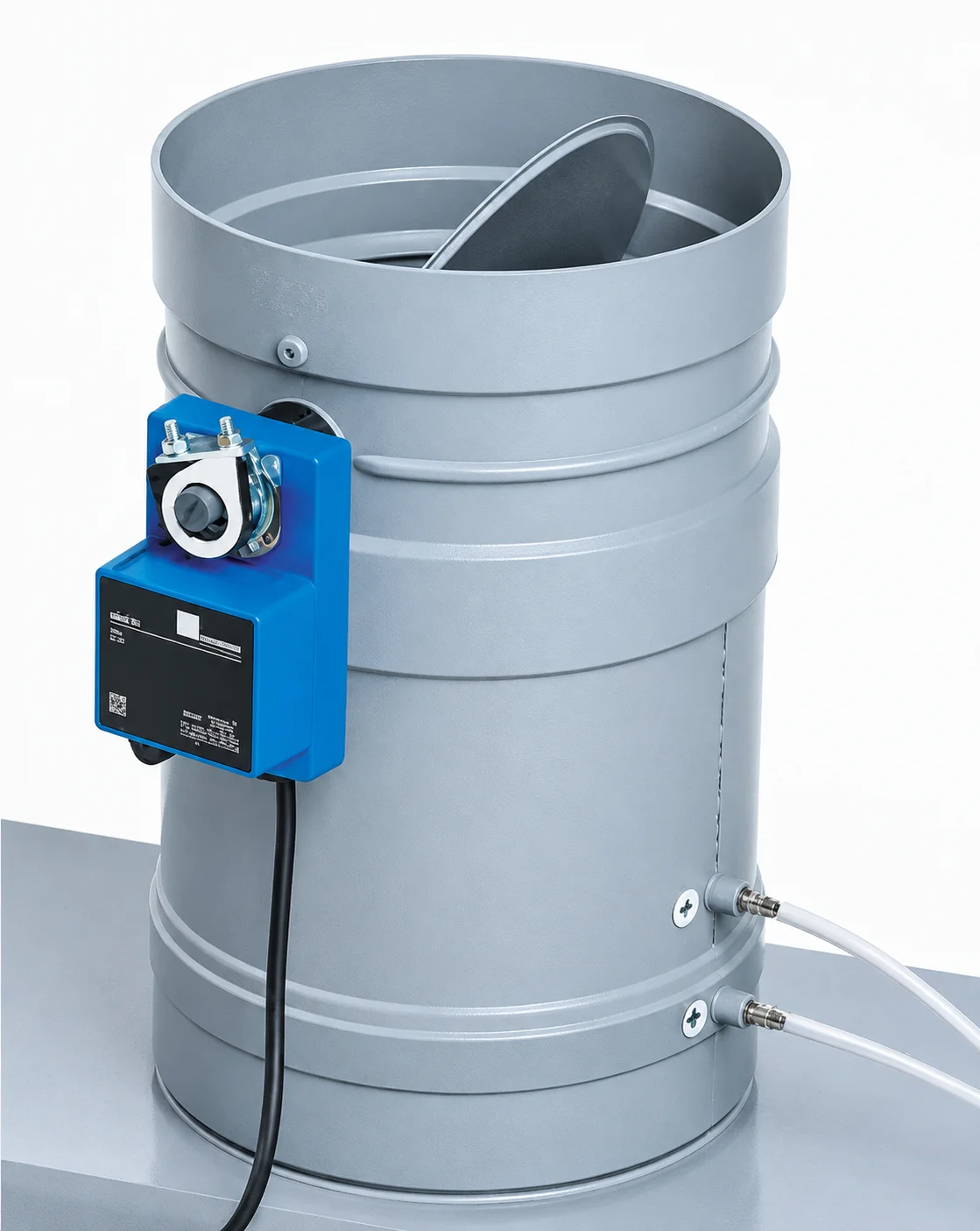
The airflow from the fume hood is maintained at a constant level, ensuring greater safety and cost reduction.
The airflow from the fume hood is maintained at a constant level, ensuring greater safety and cost reduction.
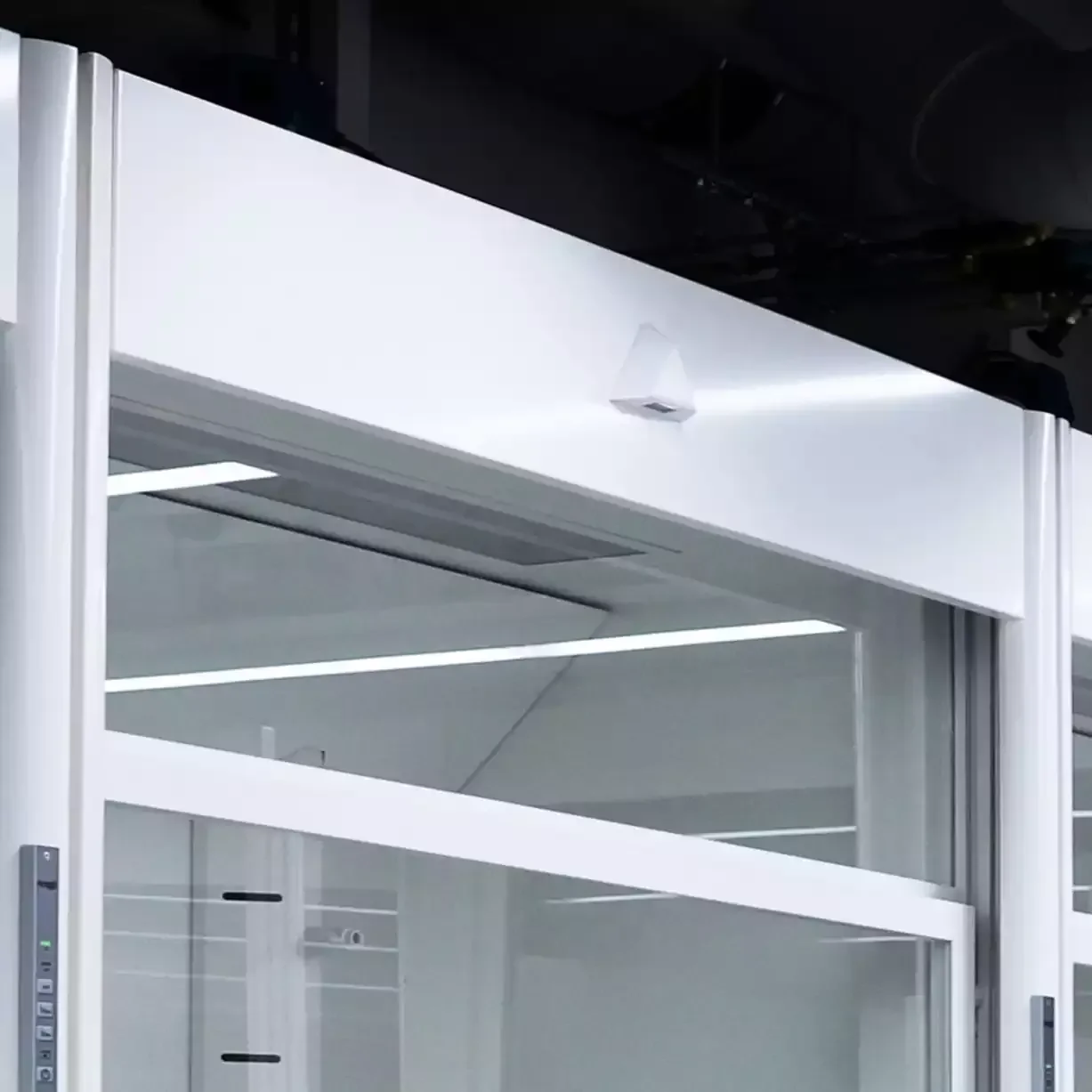
The motion sensor closes the front window of the fume hood when no user is present, ensuring safety and cost savings.
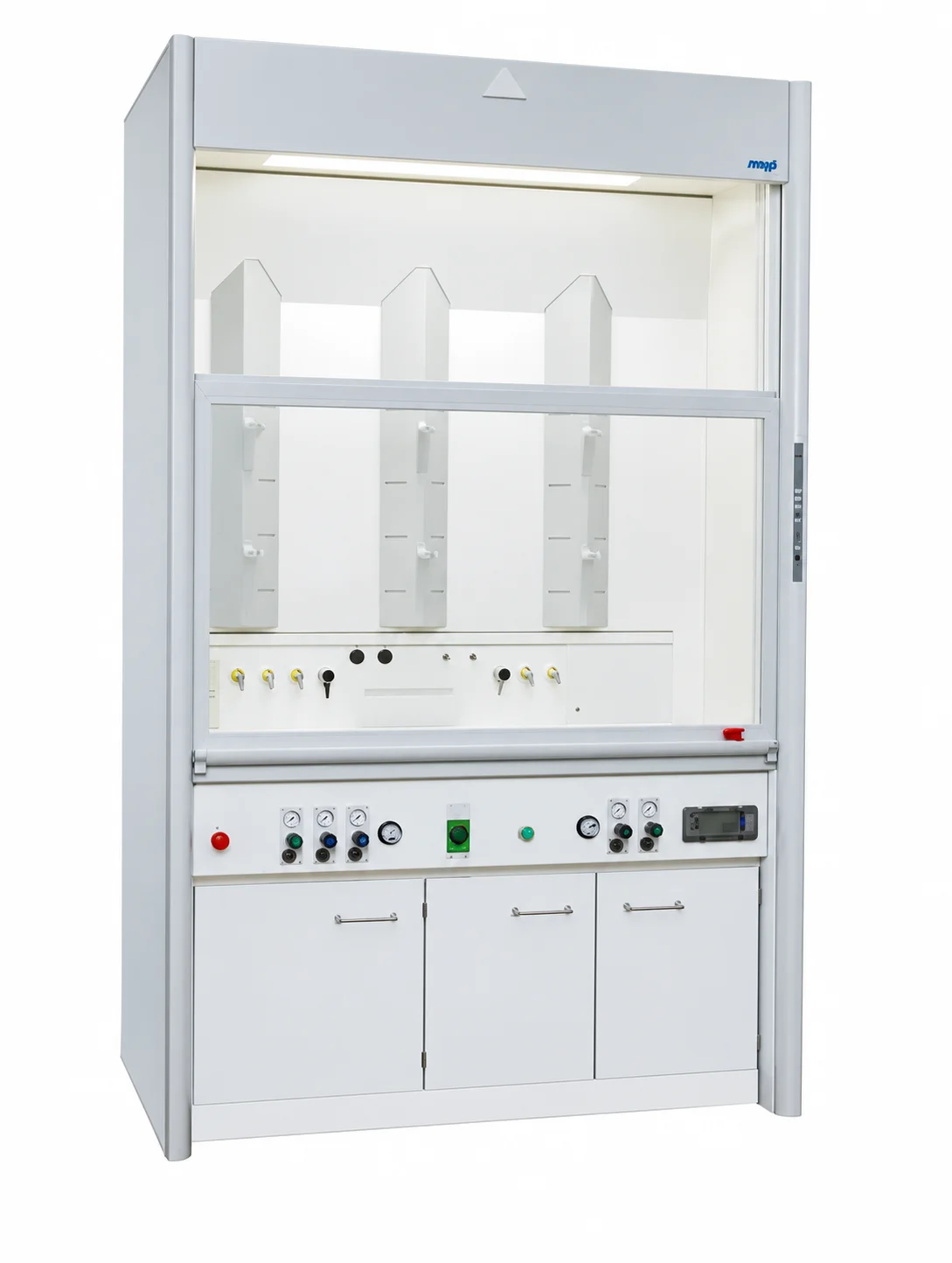
Control functions and the Bypass system are integrated into the frame, facilitating media installation and maintenance. Modern design.
The patented system increases airflow efficiency, improves emission removal, and simplifies module disassembly for decontamination.
An easy-to-use monitoring system at eye level provides intuitive control and enhances user safety.
The Bypass system with air inlets ensures laminar flow, window regulation, reduces costs, and increases safety.
Airflow control through window position and automatic closure significantly reduces operating costs.
The media drawer ensures safe installation and use, contains control valves, and is easily removable for upgrades.
The front window stops when an obstacle is detected and opens hands-free when the user’s hands are occupied.
Fans in the front aluminum frame actively support the airflow.
Type test EN 14175-3
Type test EN 14175-3
Type test EN 14175-3
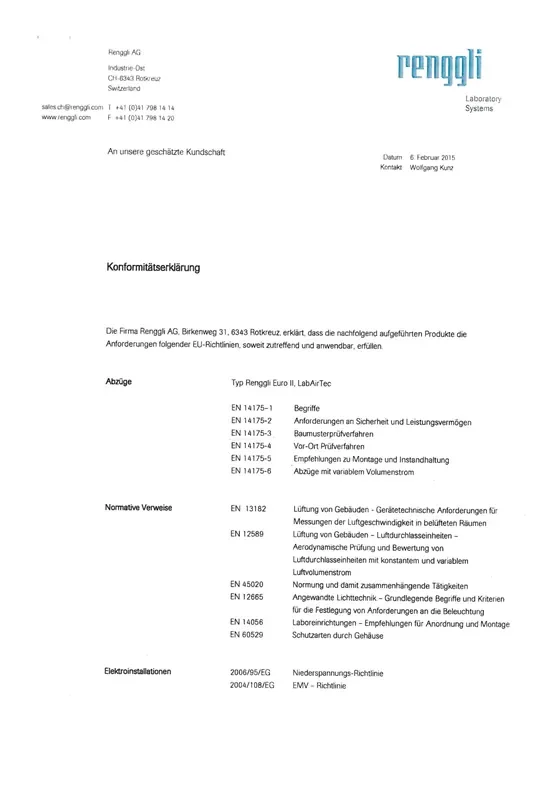
EN 14175
Manufacturer's declaration of conformity with EN 14175, parts 1 to 6, issued on 6 February 2015.
| Model | Widthmm | Airflowm³/h | Face velocitym/s | Test report |
|---|---|---|---|---|
| T120 | 1200 | 480 | 0.34 | FCS/EN/93/2006 |
| T150 | 1500 | 600 | 0.27 | FCS/EN/109/2006 |
| T180 | 1800 | 720 | 0.27 | FCS/EN/110/2006 |
The type tests were carried out by the independent Tintschl laboratory in Erlangen; the certificates were issued on 11 July 2014. The report number opens the PDF report, and the certificates are in the documents section below.
About the category
A laboratory fume hood (also known as a fume cupboard or chemical fume extractor) is an enclosed workstation with forced airflow that draws vapours, gases and dust away from the working area before they reach the operator. Air from the room enters through the open sash of the chamber at 0.3 to 0.5 m/s, and slots in the rear wall carry it to the building's ventilation system or through a filter. The chamber is kept under slight negative pressure, so contaminants cannot escape. For more on the operating principle, see our guide on what a fume hood is.
In the UK and Ireland the usual name is fume cupboard; in the US, and in most international catalogues, it is fume hood. Both describe the same enclosure, and the European standard EN 14175 uses the term fume cupboard. You will also see “chemical fume hood”, “lab fume cupboard” and the one-word spelling “fumehood”, which is not a technical term. In German-speaking countries the same unit is called a Laborabzug or Digestorium.
Fume cupboards are covered by the European standard EN 14175, published in the UK as BS EN 14175. Part 2 sets the safety and performance requirements, part 3 the type-test methods, including a tracer-gas containment test, part 4 the on-site tests after installation and part 6 variable air volume (VAV) fume cupboards. Recirculatory filtration fume cabinets have a separate standard, EN 17242. In day-to-day use the figure that matters most is the face velocity at the working sash opening, typically 0.3 to 0.5 m/s with the sash raised to a working height of 500 mm. The standards for laboratory furniture and fume cupboards, and the Renggli products they relate to, are listed on our standards and certificates page.
LabAirTec fume hoods operate with a VAV (Variable Air Volume) system, which matches the volume of extracted air to the sash position. A flow sensor accurate to 0.01 m/s triggers visual and audible alarms when the velocity falls below the safety threshold. Our article on how to calculate fume hood airflow shows how to work out the air volume required for a room. All laboratory furniture standards, together with the products they apply to, are collected on the standards and certificates page.
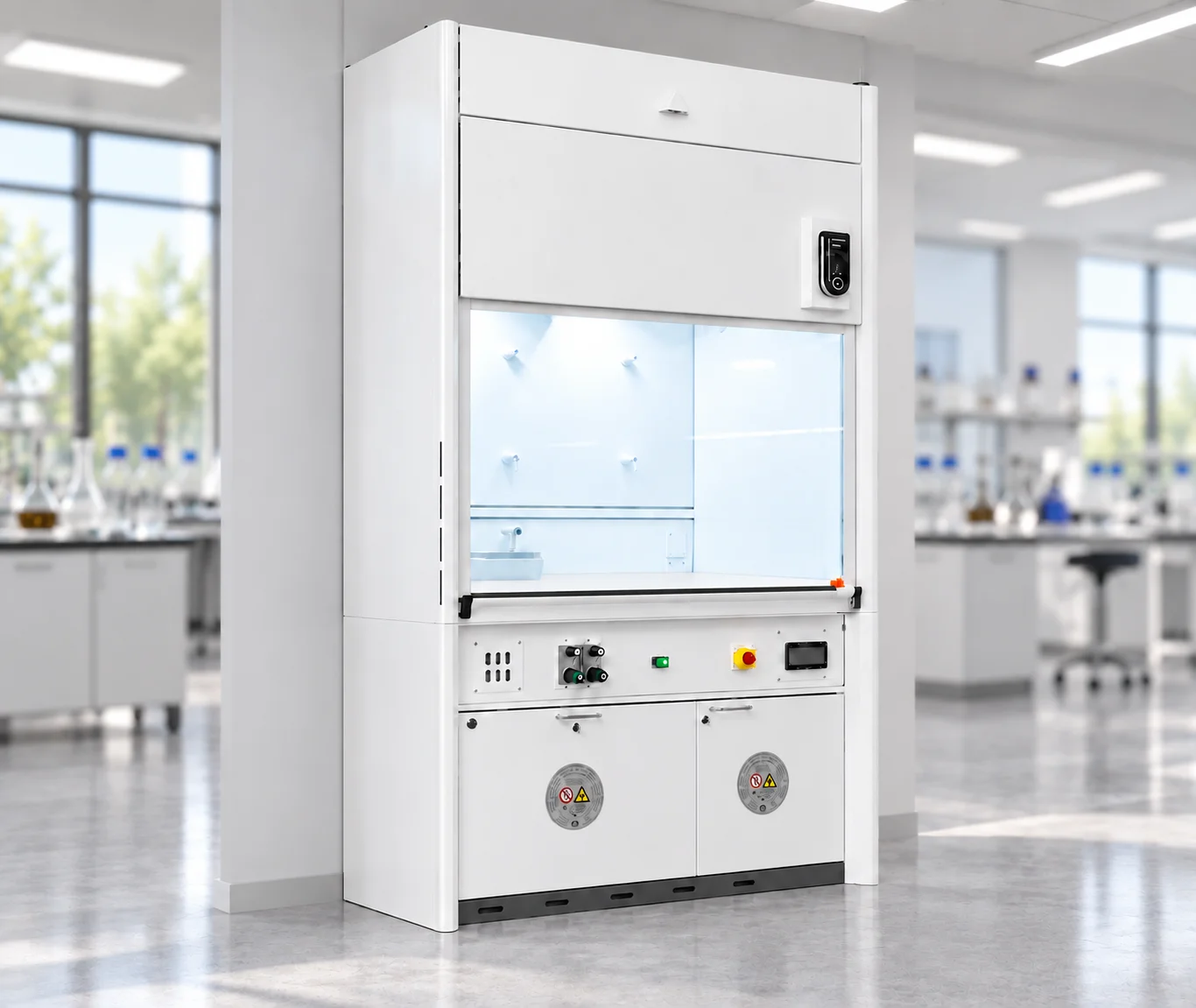
The choice depends on whether the room has an extract duct and which substances go into the chamber. A ducted fume hood connects to central ventilation with a capacity of 400 to 1200 m³/h per workstation; it discharges air outside the building and is suitable for a wide range of reagents. We supply the fume cupboard with its extract ducts, ready for connection; the extract fan is not part of the delivery and is planned as part of the building's ventilation system. The LabAirTec „green” ductless fume hood cleans the air with a carbon or HEPA filter and returns it to the room, so it needs no ducting. It works well for repeatable processes with a known, limited set of substances.
Two parameters determine the design: the space available and the required extraction capacity. Eight fume hood types, including ones outside our range, are scored in our laboratory fume hood comparison. Fume hood suppliers operating in Poland, Renggli included, are compared in our fume hood ranking. Our range covers four main variants:
The order of decisions when buying (substances, dimensions, services, controls) is set out in our guide on how to choose a fume hood.
Services are routed into the chamber, while valves and switches are placed on an external panel so that the operator can shut them off without reaching inside. The standard specification includes:
The chamber and worktop material is selected to suit the reagents and temperatures involved. Our standard fume hoods are available in five variants:
The laboratory worktops on the benches next to the fume hood come in the same materials, so the entire workstation can share one resistance class.
A standard chemical fume extractor is not suitable for hydrofluoric acid (HF) or for potentially explosive atmospheres (ATEX). For these applications we offer special versions:
Perchloric acid is a separate case: its vapours deposit explosive perchlorates in the duct, so the chamber and duct must be fitted with a washdown system. The requirements are described in our guide to selecting a perchloric acid fume hood.
In a school chemistry laboratory, a fume hood protects the teacher and pupils during demonstrations involving gases and vapours. What matters is a chamber that is visible from several sides, a sash lock, a simple control panel and a position in the room that does not block the board. For more on what to look for, see our article on choosing a fume hood for a school laboratory.
A fume hood protects the operator from chemical vapours: it draws in air from the room and removes it along with the contaminants. A laminar flow cabinet protects the sample from contaminants in the surroundings by supplying it with sterile air. A biological safety cabinet (BSC) protects the product, the operator and the environment from biological agents. These units are not interchangeable.
A fume hood retains its protective properties only if it is regularly cleaned and checked. Day-to-day care requires no more than:
Our guide on how to maintain a fume hood covers this step by step.
In Great Britain the interval is set in law: regulation 9 of the COSHH Regulations requires local exhaust ventilation to be thoroughly examined and tested at least once every 14 months, and HSE guidance HSG258 classes a fume cupboard as a partial enclosure of that kind. In Germany, DGUV Information 213-850 requires a test at least once a year. A typical examination covers:
The price of a fume hood is set for a specific configuration, because it depends on several factors at once:
Prices from Polish price lists and awarded public tenders are collected in our guide how much does a fume hood cost. At Renggli we usually price a fume hood together with the rest of the workstation, meaning the laboratory furniture, worktops and laboratory taps and valves, because these determine the connections and the volume of air in the room.
A fume hood (in the UK a fume cupboard) is an enclosed laboratory workstation with forced airflow. It draws vapours, gases and dust away from the working area before they reach the operator and discharges them through a duct or a filter. The requirements for ducted fume cupboards are set out in EN 14175, published in the UK as BS EN 14175. How it works and the main types are explained in our article what is a fume cupboard.
A fan creates a slight negative pressure in the chamber, so air from the room flows in through the open sash at 0.3 to 0.5 m/s. Slots in the rear wall extract both light and heavy vapours, and the air is discharged outside the building or passed to a filter. The VAV system matches the air volume to the sash position, and a sensor raises an alarm if the airflow drops.
Both. Fume cupboard is the British term and the one EN 14175 uses; fume hood is the American term and the one most catalogues use. Suppliers also write “chemical fume hood” or “lab fume cupboard”. In Germany the unit is a Laborabzug, and in Austria it is often called a Digestorium.
A ducted fume cupboard is connected to an extract duct and discharges the contaminated air outside the building, so it copes with changing substances and larger quantities. A ductless fume cupboard (recirculating, filtered) passes the air through filters and returns it to the room; it suits repeatable work with a known, limited list of substances, and its filters must match those substances. EN 14175 covers ducted fume cupboards and EN 17242 covers recirculatory filtration fume cabinets. We offer both: the ducted LabAirTec and the ductless LabAirTec green.
A fume hood is an enclosed chamber with a sash that complies with EN 14175 and protects the operator with its entire enclosure. Laboratory extraction is a broader term: it also covers extraction arms and hoods above the workstation, which capture vapours at a single point only. Both solutions are compared in our article on laboratory extraction vs fume hoods.
Free-standing fume hoods are most often 1200, 1500 or 1800 mm wide. The Renggli AG bench fume cupboards T120, T150 and T180 come in these three widths, and their EN 14175-3 type-test reports give airflows of 480, 600 and 720 m³/h at face velocities of 0.34, 0.27 and 0.27 m/s. Depth and height depend on how the chamber, worktop and base cabinet are configured.
Fume hood prices from Polish price lists and awarded public tenders are collected in our guide how much does a fume hood cost. We price Renggli fume hoods for a specific configuration and prepare a standard quote in 1 to 5 days.
Fume cupboards come with a 24-month warranty, which can be extended for an additional fee. Our service responds within 48 hours, and we carry out inspections and repairs after the warranty period as well. The exact scope for a given order is stated in the quote.
No. We supply the fume cupboard with its extract ducts, ready for connection; the extract fan is not part of the delivery and is planned as part of the building's ventilation system. Where no duct can be run, a ductless fume cupboard with a filter is used instead.
In Great Britain at least once every 14 months: regulation 9 of COSHH sets this maximum for local exhaust ventilation, and HSE guidance HSG258 treats a fume cupboard as a partial enclosure of that kind. In Germany DGUV Information 213-850 requires a test at least once a year. The examination measures the face velocity at the sash and checks the fan, the extract system, the sensors and alarms and, in filtered models, the filters. Repeat it after any change to the room ventilation or after the fume cupboard is moved. Who may carry out each test and what the report should show is covered in our guide to fume cupboard testing.
Ask for a type-test report to EN 14175-3 for the model you are buying, and check its date. Also ask about on-site testing to EN 14175-4 after installation, what the delivery includes (ducts, fan, airflow control), how long a quotation takes and whether the service includes an inspection at least once a year. We publish the type-test reports for the Renggli AG models T120, T150 and T180 from 2006 and the Renggli AG manufacturer's declaration from 2015 on the downloads page.
A carbon filter fume hood cleans the air and returns it to the room, an extraction one vents fumes outside. When to choose which, and what standards?
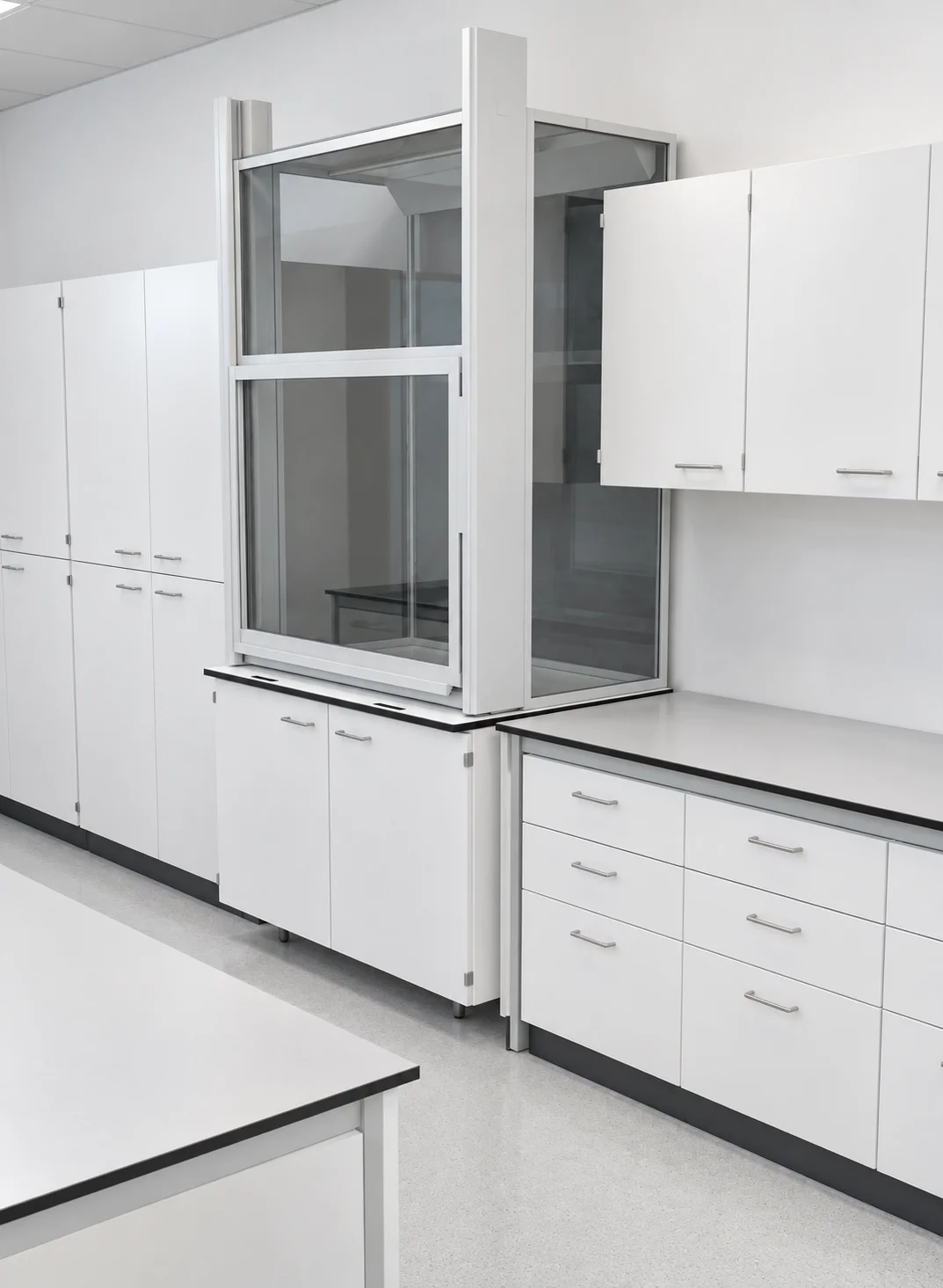
Essential work in any modern chemical, analytical, or biological laboratory is inextricably linked to daily exposure to hazardous vapors, toxic gases, and harmful aerosols. In such conditions, appropriately selected laboratory equipment is the absolute foundation for protecting the health of all research personnel. The first and most important line of employee defense in this case is the laboratory exhaust system, commonly called a fume hood. It should be clearly emphasized that choosing the right device of this type is not just a matter of everyday operational convenience. Above all, it is a guarantee of meeting strict technical standards that genuinely build safety in the laboratory.
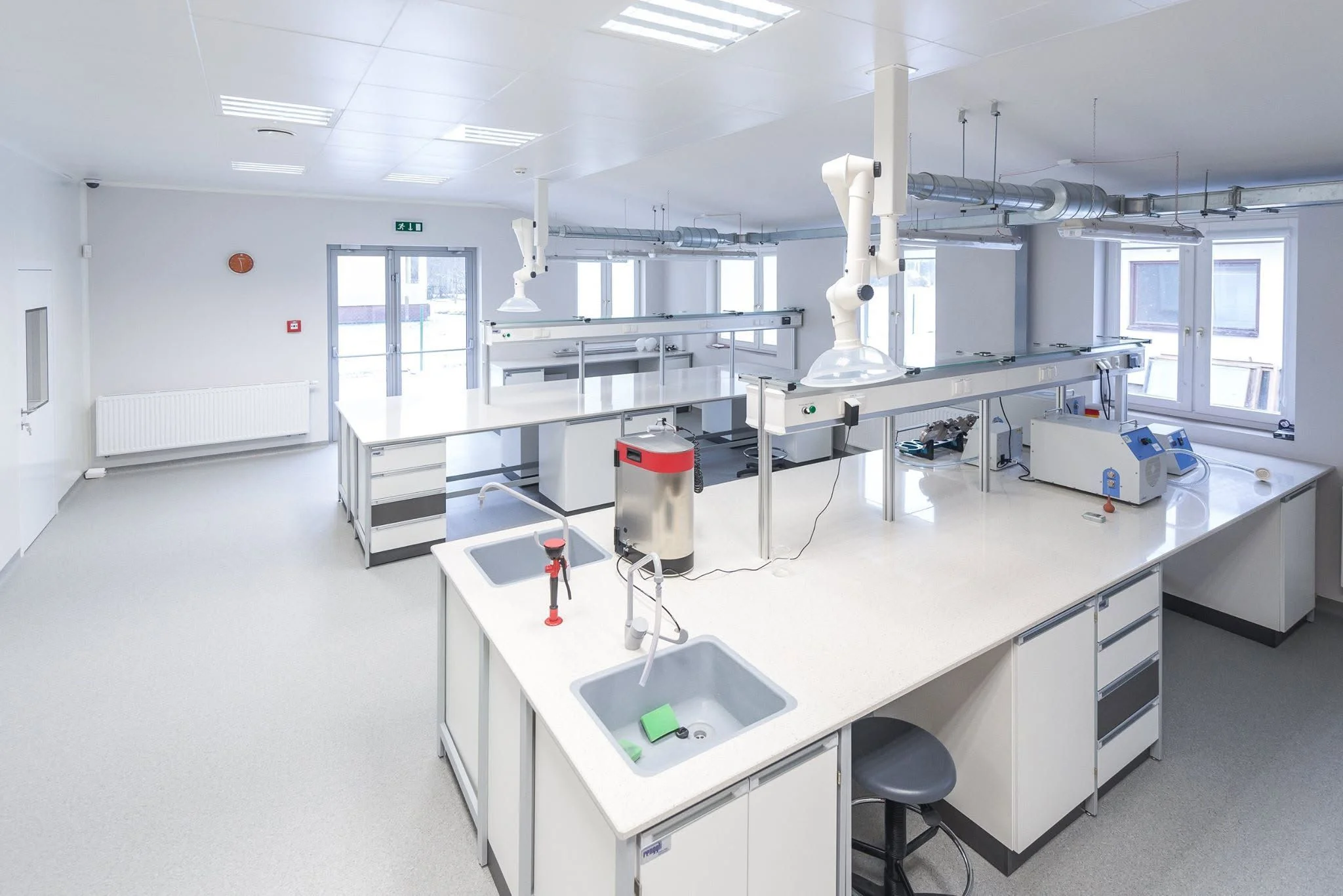
Precise measurements are the foundation of any modern laboratory's work. Although standard laboratory tables are excellent for everyday tasks, analytical balances and microbalances require absolute stability. Find out how a weighing table differs from a standard worktop.
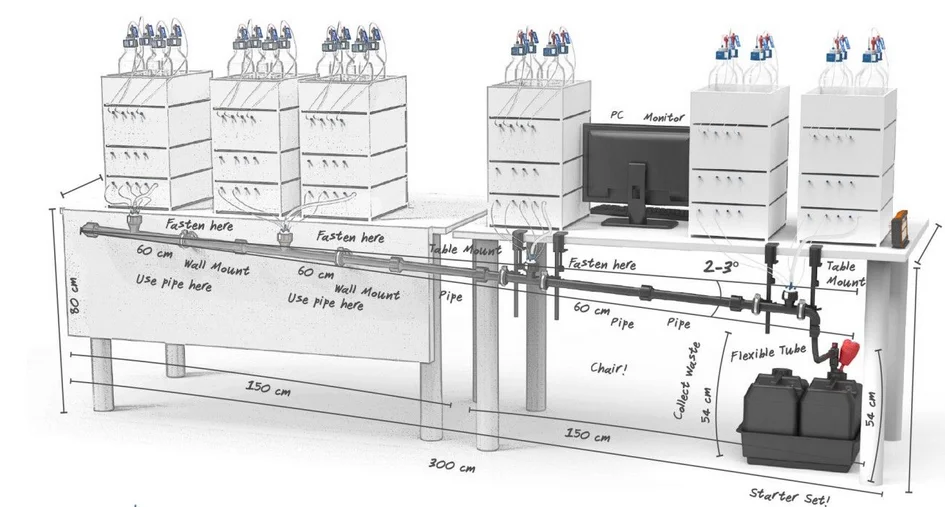
SymLine is a state-of-the-art, modular solvent disposal system that easily and safely connects multiple workstations - such as HPLC systems or fume cupboards - and centrally discharges liquid waste. Whether the system is installed in an existing laboratory or already considered at the design stage of a new facility, we offer flexible solutions perfectly suited to your needs. Safety first All components made of conductive plastics are grounded and TRGS 727 compliant, preventing dangerous electrostatic charges. Innovative pipe connectors can withstand tensile forces of up to 400 N, guaranteeing lasting tightness and maximum safety for users and the environment. Thought through in every detail The SymLine system is designed to ensure optimal fluid flow - smooth pipe ends direct waste down to threaded joints, eliminating the risk of blockages and leaks. Flexible configuration SymLine is a set of compatible components that can be configured in any way you like, from funnels and HPLC connectors to table passes and central collection points. Our Safety Waste Caps create a secure connection to the piping system, and a wide selection of sensors enables precise monitoring of fill levels. SymLine - because safety and functionality can go hand in hand.
New projects, products and guides on laboratory furniture, in one place.
Contact our experts for professional advice and to choose the optimal solution.