The role of a weighing table in a modern laboratory
An analytical balance is among the most sensitive measuring devices in a laboratory. The primary task of a weighing table is the absolute isolation of the device from the environment - the elimination of factors that could disturb the mass reading. Without such separation, even the most accurate balance will not guarantee reproducible results.
In pharmaceutical and chemical laboratories, as well as research and development units, analytical microbalances with microgram accuracy are becoming the standard. Working on such equipment requires rigorously controlled environmental conditions, including the complete elimination of mechanical vibrations.
Therefore, a weighing table is not just an ordinary piece of furniture, but a research infrastructure element of key importance. Its design directly affects the quality and reliability of the data obtained, and thus the credibility of the entire research process.
The invisible threat - sources of vibration in a laboratory environment
Mechanical vibrations accompany laboratory work continuously, although they are rarely noticeable to the naked eye. Internal sources include, among others, personnel footsteps, centrifuge operation, opening of fume hoods, as well as the operation of ventilation and air conditioning (HVAC) systems.
External sources include traffic near the building, the operation of industrial equipment in the vicinity, and vibrations transmitted through the building's structure. These micro-vibrations propagate through floors and walls, ultimately reaching the work surface.
As a result, even a seemingly quiet laboratory is actually an environment full of constant micro-movement. These frequencies are too low to be felt by the senses, but for a sensitive analytical balance, they constitute a real disturbance.
A standard worktop, made of typical furniture materials, does not have the dampening properties to eliminate these types of frequencies. Therefore, a dedicated structural solution is necessary in laboratory practice.
Consequences of a lack of proper stabilization during analysis
The lack of proper vibration isolation manifests itself in many ways in the daily work of a laboratory technician. The most characteristic symptom is the "drifting" of the result on the balance display. The mass indication does not settle at one point but oscillates, making unambiguous reading difficult.
The consequence is extended measurement stabilization time, and often the need for frequent recalibration of the device, which additionally burdens the laboratory's work schedule. These technical inconveniences translate into tangible business costs.
An analytical error resulting from unstable measurement conditions can lead to the rejection of an entire research or production batch. This means financial losses associated with repeating analyses and delays in project implementation.
How does an anti-vibration table work? Construction and materials
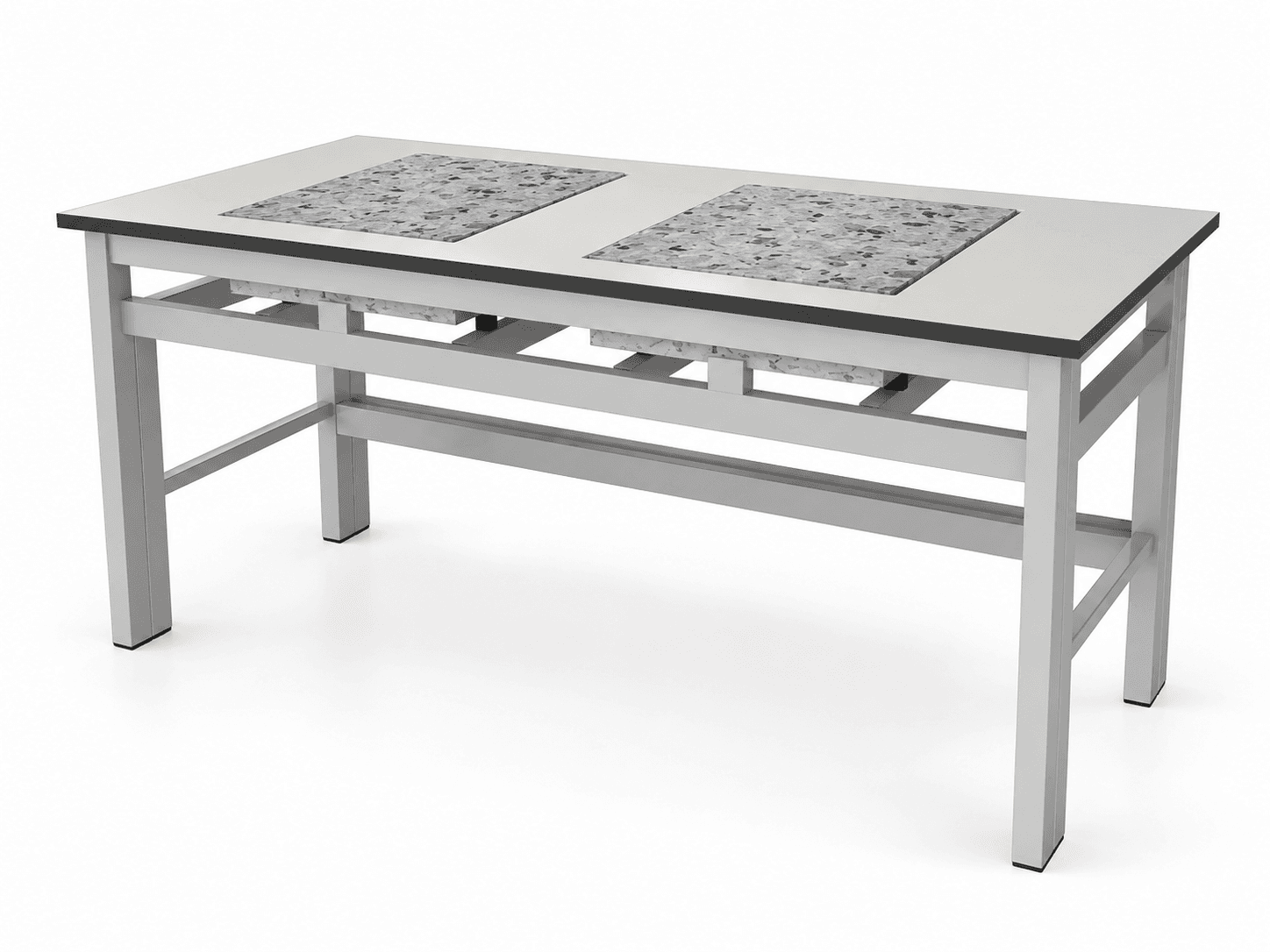
The operating principle of a professional weighing table is based on the "table within a table" concept. The external frame is equipped with its own worktop, on which the laboratory technician can rest their hands, put down notes or samples, without the risk of transferring vibrations to the balance.
Independently of this structure, a separate, much heavier weighing top functions, on which the balance is placed. It is most often made of solid granite or specialized vibration-isolating concrete.
The key element of the construction is the shock absorption system on which the weighing block rests. Specialized vibration isolators and vibration absorbers dissipate the kinetic energy coming from the environment before it reaches the surface on which the balance stands.
By separating the worktop and the independent weighing top, it is possible to simultaneously ensure working comfort and full measurement isolation, even for balances with microgram accuracy.
Choosing a table for the type of balance and specifics of research
The choice of a suitable weighing table should be closely related to the type of equipment used. A technical balance with an accuracy of 0.01 g has different isolation requirements, and completely different ones apply to an ultra-sensitive analytical microbalance operating in the microgram range.
The basic selection criterion is the table's load capacity, corresponding to the weight of the balance and additional equipment. The dimensions of the granite slab are also important. The surface should provide a comfortable workspace without losing its anti-vibration properties.
The properties of the external worktop surface are not without significance. Depending on the nature of the analyses, epoxy resin tops, resistant to solvents and reagents, or acid-resistant ceramics, which work well in contact with corrosive substances, are used.
Comprehensive infrastructure and laboratory technician's work ergonomics
A weighing station is a place where a laboratory employee often spends many hours a day. Therefore, the technical aspects of vibration isolation should go hand in hand with concern for ergonomics; a properly selected worktop height has a direct impact on comfort and work efficiency.
Adequate legroom is also important, allowing for a comfortable position during long measurement sessions. Weighing stations are also increasingly integrated with extensions enabling the installation of lighting or electrical installations.
The combination of vibration isolation technology with ergonomic solutions translates into less personnel fatigue during long analytical sessions, which is of direct importance in reducing the risk of human error.
Integration of weighing tables with laboratory furniture systems
A modern weighing station should not function as an element isolated from the rest of the laboratory equipment. Its coherent integration with other laboratory furniture systems, in terms of aesthetics, functionality, and construction, is becoming increasingly important.
The modular design of the infrastructure allows for easy reconfiguration of the laboratory layout in the future, without having to give up the anti-vibration properties of the weighing stations.
Quality standards and cleanliness - key aspects
In advanced environments, such as clean rooms or microbiological laboratories, furniture must meet rigorous hygiene requirements. This also applies to weighing stations, which are exposed to frequent contact with samples.
A key structural element is the absence of gaps and hard-to-reach joints where contaminants could accumulate. A design with smooth, continuous surfaces significantly facilitates decontamination and maintaining the hygiene of the station.
Equally important is the resistance of materials to aggressive cleaning agents, disinfectants, and chemical reagents used in everyday laboratory work; low surface resistance leads to its degradation over time.
Meeting these standards is a prerequisite for research safety and maintaining the quality certifications required in many areas of laboratory activity.
Summary - an investment in precision that always pays off
An anti-vibration weighing table should not be perceived as an additional cost, but as a strategic investment protecting the reliability of research results and laboratory certifications. Measurement stability translates directly into data credibility and the reputation of the facility.
September 15, 2026