Precise measurements are the absolute foundation of work in any modern laboratory. Even the most expensive analytical balance will fail if you do not provide it with appropriate conditions. Micro-vibrations falsify results, generating losses. Check why a weighing table is a guarantee of analytical reliability.
The role of a precision balance in everyday analytical work
Even the most modern, most expensive analytical balance will not guarantee a correct and reliable result if it is placed on a standard office desk. Measurement precision requires appropriate environmental conditions, in which a professional weighing table becomes the foundation of reliable procedures. It is this table that determines whether an advanced device will be able to reach its full potential.
It should be firmly emphasized that a laboratory weighing table is not just another "piece of furniture" in the research space. It is a crucial, even integral part of the entire measuring system, without which obtaining meaningful, repeatable, and fully reliable results is physically impossible.
What are the risks of lacking stability during laboratory measurements?
The lack of proper stabilization of the measurement workstation involves continuous micro-movements and vibrations, which pose a direct threat to the correctness of the results. Vibrations transmitted through the floor, caused by the daily footsteps of personnel, heavy traffic outside the window, as well as the operation of other devices (such as centrifuges or autoclaves) can instantly falsify the readings of a sensitive analytical balance.
One of the most common and severe consequences of such disturbances is the phenomenon of "floating" results. An error generated at the very beginning of the analytical procedure cascades onto all subsequent stages of advanced research. This leads to the necessity of repeating analyses multiple times, wasting extremely valuable reagents, and, in the long term, to very tangible financial losses for the entire unit.
Instability during weighing is also a huge threat from an OHS perspective. When working with highly dangerous or toxic chemical substances, any uncontrolled shock increases the risk of spilling powders or hazardous samples, directly endangering the health of laboratory personnel.
Furthermore, the lack of required consistency and repeatability of measurements is a straight path to serious systemic problems. An unstable weighing environment is an extremely common reason for failing rigorous quality audits, which can be an obstacle to maintaining the certification or accreditation of a facility.
Anti-vibration construction - how do weighing tables eliminate vibrations?
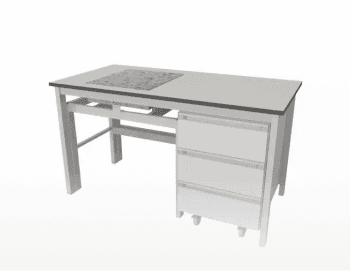
Success in completely eliminating vibrations lies in a rigorous and engineering approach to the physical construction of laboratory furniture. The key technological solution here is the principle of full "separation", i.e., intentional dilation of the worktop from the weighing zone itself.
Thanks to such designed mechanical separation, the balance placement zone is completely independent of the rest of the table. If a laboratory technician accidentally leans on the edge of the tabletop or puts a heavy notebook on it during work, the generated vibrations will not be transferred to the sensitive weighing pan of the device.
The stability of the entire system is supported by exceptionally rigid, thick-walled load-bearing frame structures. The appropriate profile of the elements and precise connections ensure that these frames do not undergo the slightest deformations, even when loaded with very massive or large-scale analytical equipment.
The sum of these advanced solutions means that the engineering approach of Renggli completely neutralizes the destructive impact of the external environment on the measurement process. The precision balance gains an absolutely motionless, safe space, allowing researchers to focus 100% solely on the conducted experiment.
Adapting to the space: Systems and workstation configuration variants
Professional laboratory design requires the choice of a weighing table to perfectly harmonize with the overall spatial layout of the room. Planned technological sequences must be logical, support ergonomics, and ensure optimal workflow. For this reason, the measurement workstation should be naturally integrated into the sequence of analytical operations, without disrupting the safe movement of personnel.
A significant convenience improving daily work ergonomics is the use of a mobile container. This solution allows for convenient storage of necessary documentation or auxiliary accessories right at the operator's fingertips. Most importantly, the freestanding nature of the container guarantees no interference whatsoever with the stabilization zone of the anti-vibration plate.
Single-station vs. double-station tables - what to choose?
The decision regarding the size of the workstation depends mainly on the intensity of analytical processes and the available room space. A single-station table is an optimal solution for facilities where the balance complements the main research station, or the process requires full, uninterrupted operator isolation.
On the other hand, a double-station table is directly dedicated to intensely exploited research environments, such as commercial laboratories or R&D departments. Wherever optimizing every square meter of valuable space plays a strategic role, a double module allows for the seamless realization of multiple tasks simultaneously.
It should be firmly emphasized that the advantages of the Renggli construction, thanks to its design, allow for the free work of two laboratory technicians at the same time. Modularity preserves full, rigorous shock absorption properties in a completely independent manner for each of the measuring devices working on the tabletop.
Structural durability and long-term investment profitability
From the perspective of the management staff of modern research units, laboratory equipment must be characterized not only by the highest precision but above all by an above-average lifespan.
The key to maintaining this durability is advanced anti-corrosion protection. All metal load-bearing frames are factory-coated with highly specialized protective coatings, exhibiting extreme resistance to aggressive chemicals. Possible contact with acids, bases, or solvents used during routine sample preparation does not damage the structure of the workstation.
The economic aspect of choosing professional solutions is indisputable. A solid hardware investment immediately eliminates the risk of unplanned service downtime, malfunctions, and the need for premature furniture replacement. In a multi-year perspective, the lack of failures and the guarantee of stable operation generate huge savings for the budget of the entire facility.
Guarantee of precision with a proven furniture manufacturer
The absolute stability of a weighing table is a technological factor that directly determines the quality, reliability, and safety of analytical work. Designing and implementing a proper workstation is the foundation for a laboratory - without a solid base, even the most sensitive measuring instruments will not fulfill their task.
When deciding to modernize equipment, it is worth betting on proven solutions and the many years of experience of Renggli. As a manufacturer, the brand perfectly understands the individual requirements of industry clients, being able to flexibly and precisely adapt the equipment to the specific nature of the conducted research.
August 17, 2026