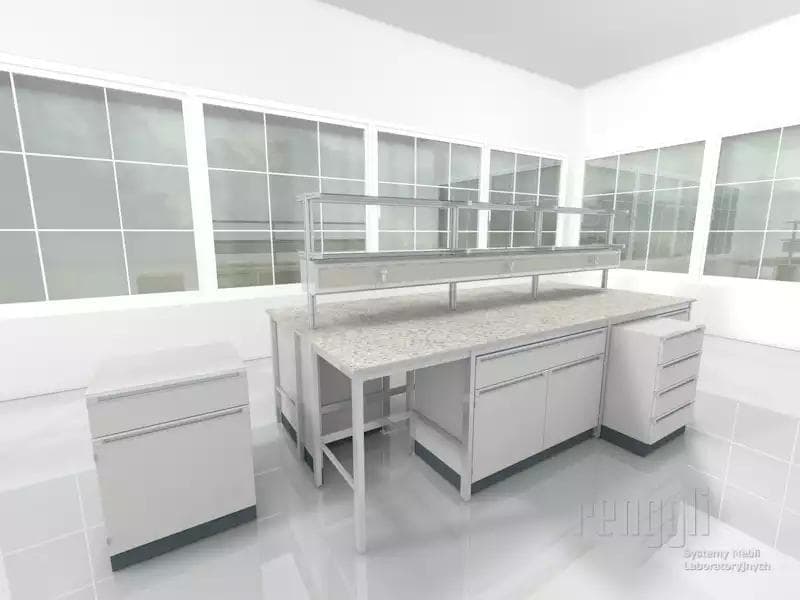
Ceramic worktop and HPL laminate are the two most commonly used solutions in laboratories, differing primarily in the level of chemical resistance and the range of applications. Monolithic ceramics provide virtually complete chemical inertia and thermal resistance of up to 1000°C, while HPL provides a lighter and more economical alternative for less aggressive working environments.
The role of worktops in ensuring safety and health and safety
The laboratory workbench acts as a passive protective barrier in the research environment, reducing the risk of personnel coming into contact with aggressive chemicals. A properly selected certified laboratory worktop prevents acids from spilling and penetrating deep into the furniture, protecting both the cabinet structure and the floor.
The PN-EN 13150 standard specifies the requirements for laboratory tables in terms of structural safety, stability and load resistance, while PN-EN 438 refers to the properties of laminated boards used in laboratory equipment. In practice, this means that materials with controlled chemical and mechanical resistance must be used throughout the furniture system.
The worktop also acts as a disaster mitigation element – its properly profiled edge can trap liquid within the laboratory technician's workstation, minimizing the risk of contamination of the workspace. In Renggli's designs, these solutions are integrated into laboratory furniture systems as early as the workplace concept.
Methodology for testing chemical resistance according to SEFA 3 standard
The laboratory worktop is subjected to chemical resistance tests according to the SEFA 3 standard, which assumes long-term exposure to reagents, including acids and bases such as NaOH. The tests include the assessment of surface changes after contact with substances and the classification of damage.
In practice, methods compliant with EN 13722 are also used, where the material is exposed to 24-hour chemical exposure. The chemical resistance class is then determined, taking into account changes in color, gloss and surface structure.
It is also crucial to interpret the results according to EN 12916, which allows you to compare the behavior of different materials under identical test conditions. This allows for an objective assessment of how the chemical resistance of the laboratory worktop performs in practice.
With Renggli solutions, the test process includes a full simulation of operating conditions, which allows you to predict the behavior of the material in real laboratory applications.
Use of worktops in various types of test laboratories
The choice of material from whichthe worktop for the laboratory is made depends on the nature of the work and the level of exposure to chemical and biological agents. Ceramic worktops work well in highly acidic and high-temperature environments, while HPL is used where hygiene and ease of cleaning are crucial.
In chemical laboratories, chemical countertops with high resistance to acids and alkalis are mainly used, often in the form of ceramics or epoxy resin. In microbiology and medical laboratories, on the other hand, non-porous HPL surfaces are preferred, which limit the growth of bacteria and mold.
In practice, the laboratory table top for the laboratory must be adapted to the specifics of the test process – different requirements apply to organic synthesis and different to biological diagnostics. In B2B projects carried out by Renggli, the selection of material always takes into account real operating conditions and health and safety requirements.
Which lab table is best and most durable for daily reagent work
For the most demanding chemical applications, the monolithic ceramic worktop, which combines very high scratch resistance with virtually complete chemical insensitivity, remains the best choice. In everyday work with acids and solvents, it maintains surface stability even with prolonged exposure.
In terms of mechanical durability, ceramics outperform most materials used in laboratories – they are resistant to abrasion, point impact, and organic dyes and solvents such as acetone. Thanks to its compact structure, it does not absorb substances and does not discolor.
In comparison, a typical home kitchen worktop based on chipboard or laminate is not adapted to contact with chemicals – it quickly swells, detaches layers and is permanently damaged. Also, the low-density plastic table top does not provide dimensional stability or resistance to aggressive reagents.
Cleaning and decontamination of work surfaces in the laboratory
Proper decontamination of the laboratory table after contact with acids is critical for personnel safety and equipment durability. In the first step, remove the excess substance with absorbent, disposable material, avoiding rubbing the spill. A chemical neutralizer tailored to the type of reagent is then used, and only after the reaction is completed, washing with demineralized water is carried out.
For HPL surfaces such as Trespa TopLab, only use soft cloths and mild detergents. Aggressive agents can compromise the protective layer and weaken the structure of the laminate. Particular attention should be paid to the joints wherethe edge of the laboratory table and the mounting elements may be more susceptible to liquid penetration.
Sinks are also increasingly being integrated seamlessly into the work surface. Such laboratory sinks eliminate gaps in which biological or chemical contaminants could accumulate, which makes it much easier to maintain sterility.
Comparison of physicochemical properties of ceramic and HPL worktops
The ceramic worktop is distinguished by almost complete chemical and thermal resistance – it does not degrade under the influence of concentrated acids, such as sulphuric acid H2SO4 or hydrochloric acid HCl, and can withstand temperatures of up to approx. 1000°C thanks to the compact structure of sinter and ceramic glaze.
Basedon a phenolic core and a high-pressure compressed layered structure (approx. 70-90 bar), the HPL Trespa laboratory worktop provides good resistance under standard operating conditions, but is more sensitive to prolonged contact with strong reagents and requires protection of polyurethane-acrylic edges and welds.
HPL is approximately 60% lighter than ceramics, which makes it easier to install and reduces the requirements for the substructure in test equipment systems, while ceramic remains a heavier material, but much more durable in aggressive environments.
In practice, the monolithic ceramic worktop is suitable for high-intensity reagent chemistry laboratories andthe HPL Trespa laminate worktop forbiological, educational and technical applications with moderate chemical loads.
How is the HPL Compact Worktop Different From Standard Laminate As A Lab Worktop
The HPL compact worktop has a homogeneous, self-supporting phenolic core made of multiple layers of kraft paper soaked in phenolic resins, making it fully waterproof and dimensionally stable.
In contrast, a standard laminate worktop is based on a chipboard core (approx. 28-38 mm) covered with a thin layer of HPL laminate (0.6-1.5 mm), which increases susceptibility to moisture and leads to a phenomenon such as edge delamination.
The compact version of the laboratory table is therefore a self-supporting structure rather than a layered structure, which eliminates the risk of swelling and damage in contact with water or chemical reagents.
Is HPL lab table cheaper than quartz conglomerate?
The HPL laboratory table top is significantly cheaper and lighter than quartz conglomerate, which reduces the cost of transport, assembly and the entire investment.
Quartz conglomerate, consisting of 90–95% quartz and 5–10% polyester resin, has a high hardness (approx. 7 on the Mohs scale), but is a heavier and more expensive material to machine.
HPL is approx. 60% lighter and easier to cut on site, which further reduces the cost of laboratory workstations.
In operation, the conglomerate requires periodic impregnation, while HPL does not require such treatments.
When ceramic sinter as a laboratory worktop surpasses conglomerate in properties
Ceramic sinter and monolithic stoneware surpass quartz conglomerate in terms of chemical and thermal resistance because they are non-flammable materials and resistant to direct flame contact.
Conglomerate, bonded with polyester resin, can degrade at temperatures above approx. 150°C, limiting its use in environments with high thermal and chemical risks.
Ceramic sinters are also better able to withstand rapid temperature changes, i.e. thermal shock, without losing the integrity of the surface structure.
Does scratching the surface of the HPL laboratory worktop reduce its protective properties?
Scratches on the surface of the HPL lab table do not compromise its waterproofing or stability, as the phenolic core remains non-absorbent and non-swelling.
The construction based on kraft paper soaked in phenolic resin is resistant to moisture, so that even mechanical damage does not lead to degradation of the structure or the phenomenon of delamination.
Chemical Restrictions and Critical Substances for Ceramic Countertops
Laboratory ceramic worktops are characterized by a very high chemical resistance class, but their key limitation is contact with hydrofluoric acid (HF). HF reacts with silicon dioxide (SiO₂) present in the structure of monolithic ceramics and in the ceramic glaze layer, leading to the formation of volatile silicon fluorides and permanent surface damage. As a result, the structure of the material is irreversibly degraded, even with a short exposure.
In practice, this means that despite being resistant to most acids, such as hydrochloric acid HCl, ceramics cannot be used in HF working environments without additional material protection. In such cases, alternatives are used, e.g. polypropylene countertops, which show stability against fluorine compounds.
Thermal and mechanical resistance of worktops in harsh environments
The monolithic ceramic worktop remains stable at temperatures up to approx. 1000°C and is non-flammable, so it can be used in direct contact with the burner flame.
In contrast, a standard HPL laminated worktop is thermally degraded above approx. 180°C, which is due to the limited resistance of the resin layers. Under conditions of rapid temperature changes, the phenomenon of thermal shock can occur, leading to micro-cracks in the surface.
Ceramic solutions often usea "marine edge" type of laboratory worktop, which reduces the flow of liquids onto the frame and cabinets, increasing the safety of work in the laboratory environment.
Damage and degradation of the worktop structure under the influence of reagents
Prolonged contact with aggressive reagents, such as sulfuric acid H2SO4, can lead to degradation of the surface of the HPL laminate and weakening of its layered structure. As a result, the phenomenon of delamination may occur, i.e. delamination of the material and loss of tightness of the protective coating.
In addition, laminates with a polyurethane-acrylic coating are susceptible to discoloration and degradation under the influence of UV and strong oxidizers. Monolithic ceramics remain in most cases resistant to such factors, maintaining chemical and aesthetic stability even in long use.
Criteria for selecting worktops for laboratory managers and investors
The choice of a professional laboratory worktop should primarily result from an analysis of the total cost of ownership (TCO), not just the purchase price. In this view, the solid monolithic ceramic worktop offers the highest level of safety and durability in reagent-intensive chemical laboratories, resulting in many years of trouble-free operation.
On the other hand, the Max Resistance phenolic resin table top and HPL solutions work better in environments with lower chemical aggressiveness, such as microbiological or physical laboratories, where ease of hygiene and lower weight of the entire test equipment are crucial.
Ceramics and stoneware countertops are distinguished by their resistance to high temperatures and strong acids, while laminates offer a more favorable cost-performance ratio in standard applications.
The final choice should take into account the profile of the laboratory's work, the intensity of contact with chemicals and the investment strategy adopted by the manufacturer in the design of furniture systems.
FAQ - Frequently Asked Questions
1. How long does the ceramic worktop retain its properties and chemical resistance?
The monolithic ceramic countertop retains full chemical and mechanical resistance for more than 25 years, thanks to its sintered, homogeneous structure that does not undergo aging or UV degradation.
2. What causes permanent discoloration of laboratory tables?
Discoloration is mainly due to contact with strong organic or UV dyes. Ceramics are resistant to them, while HPL countertops can turn yellow over time without a protective layer.
3. Why are marine edging used?
The marine edge keeps spills on the surface of the countertop, protecting cabinets and installations from contact with acids and solvents.
3. Can the HPL table top be cut during assembly?
Yes, the HPL compact worktop can be easily machined and cut on site, unlike ceramics and conglomerates that require specialized machining.
June 30, 2026