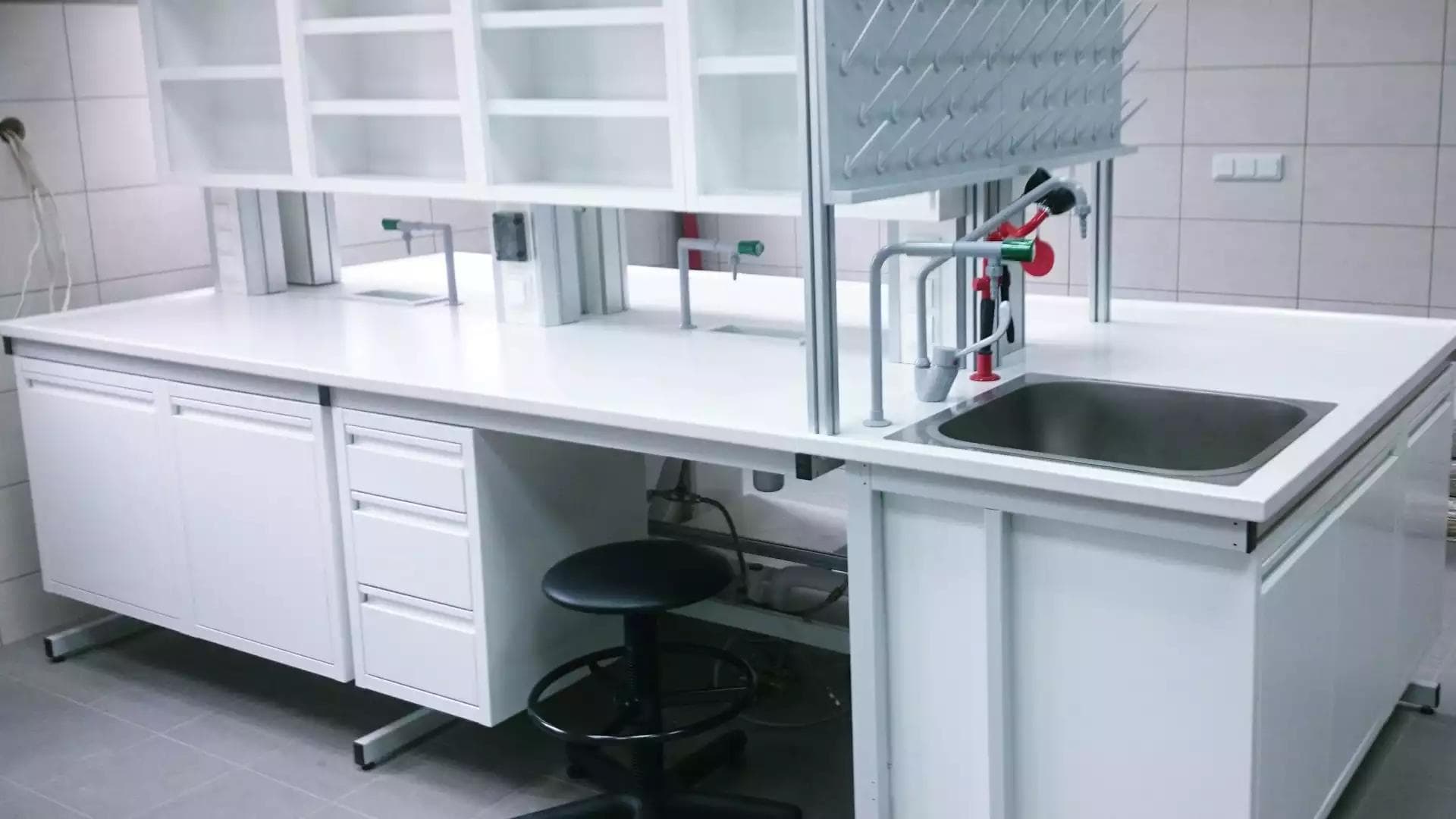
Safe laboratory furniture requires the selection of countertops with proven chemical and mechanical resistance. Studies indicate that certified construction can extend the life of workplaces by more than 30%.
Proper arrangement of the workplace in the laboratory affects safety, comfort and efficiency of work. A well-planned space facilitates the organization of research processes, reduces errors and allows you to make better use of the available space.
What are the characteristics of certified chemical-resistant laboratory furniture?
Chemical-resistant laboratory furniture is equipment designed to work in environments where aggressive chemicals are used. Their task is to reduce the risk of damage to the structure and ensure the safety of users in accordance with health and safety requirements.
Chemical resistance is determined not only by the material of the tabletop, but by the entire structure of the furniture. Tight welds, properly protected edges and materials resistant to acids, alkalis and solvents are important. Thanks to this, chemical fumes do not cause accelerated degradation of surfaces and load-bearing elements.
Chemical-resistant fume hoods and chemical reagent cabinets are also used in laboratories to reduce personnel contact with hazardous substances and help maintain safe working conditions. It is complemented by elements of OHS equipment, adapted to the nature of the processes carried out.
Laboratory design begins with an analysis of research processes and user needs. On this basis, it is planned toplace laboratory workstations, work zones and media connections. Ergonomics is also an important element, which affects the comfort and efficiency of everyday work.
Properly designed bodies are more durable, easier to maintain and generate lower operating costs in the long run. Thanks to this, the investment translates not only into safety, but also into the optimization of the costs of using the laboratory.
Requirements for laboratory furniture in pharmacy
In pharmaceutical and medical laboratories, furniture must meet particularly stringent hygiene requirements. Non-porous surfaces that do not absorb contaminants and allow effective surface decontamination are crucial.
A gapless design is also important, which reduces the places where microorganisms accumulate and facilitates regular cleaning. Furniture should retain its properties despite frequent contact with disinfectants and sterilizing agents.
A well-designed laboratory infrastructure supports the maintenance of high standards of purity, safety and compliance with the requirements of the pharmaceutical environment.
Requirements and standards for laboratory tables
Laboratory tables must meet the safety and ergonomics requirements specified in the PN-EN 13150 standard, which regulates, among m.in, the stability of the structure, dimensions and conditions of use in the laboratory environment. In addition, the PN-EN 14727 standardapplies to box furniture and defines its durability and safety of operation within the laboratory infrastructure.
The standard working height is approx. 750 mm for seated work and approx. 900 mm for standing work. The minimum load capacity of the workbenches is 200 kg, and in the case of heavy equipment even up to 300 kg, while maintaining the stability of the entire structure.
Laboratories also use chemical safety cabinets with a fire resistance of 30 or 90 minutes, equipped with spill trays to reduce the risk of leakage of hazardous substances.
The high quality standards are also confirmed by the SEFA guidelines, including the SEFA 8 tests, which test the durability, stability and resistance of laboratory furniture under intensive operating conditions. In practice, solutions such as installation extensions that integrate media and equipment into the workspace are also important.
Legal requirements for laboratory rooms and furniture
Laboratory rooms must meet the requirements for appropriate volume, lighting and effective mechanical ventilation. Health and safety regulations require constant air exchange and the elimination of chemical fumes, which directly affects work safety.
It is also important to match the equipment to the ventilation systems. Chemical-resistant fume hoods must be integrated into the exhaust system in order to effectively remove contaminants from the work area. Equally important are the installation extensions, which allow for the management of utilities and cooperation with mechanical ventilation without disturbing the ergonomics of the workstations.
Proper connection of furniture with the technical infrastructure of the laboratory ensures compliance with legal requirements and stable working conditions.
How to choose laboratory furniture for the reagents you use
The selection of laboratory equipment should result directly from the analysis of the reagents used and their concentrations. It is crucial to match the worktop material to the chemical groups: organic and inorganic acids, alkalis and solvents.
For most standard applications, HPL high-pressure laminate works well and tolerates contact with mild acids and alkalis. When working with more aggressive substances such as nitric acid (V) or sulphuric acid (VI), surfaces with increased chemical resistance, such as resins or epoxy composites, are necessary.
Particular attention should be paid to hydrofluoric acid (HF), which destroys silica present in ceramics and glass. Standard countertops are not recommended for these applications, with polypropylene (PP) or fluoropolymer surfaces being safer choices.
The system is complemented by chemical-resistant fronts and acid-resistant laboratory batteries, which ensure the durability of the installation in zones exposed to intensive chemical exploitation.
Which laboratory furniture to choose for heavy chemistry
To work with intensive chemical reagents, specialist furniture with increased chemical and mechanical resistance should be used. The choice of table top material and the stability of the entire structure are crucial.
Two solutions are most often used: monolithic ceramics and epoxy resins. Ceramics provide very high resistance to acids, high temperature and abrasion, which is why it works well in the most demanding conditions. Epoxy resins are more flexible and tolerate contact with a wide range of reagents well, while maintaining good mechanical resistance.
In the case of heavy analytical equipment, the design of the frames is also important. Industrial furniture and laboratory island tables must provide high load capacity and minimal vibration to maintain measurement stability and operational safety.
How to care for and maintain laboratory furniture
In everyday work, the most important thing is to clean the laboratory tables regularly immediately after use. A mild detergent with a neutral pH and a soft cloth are usually enough – it's more about regularity than complicated agents.
Each material reacts differently. HPL countertops are sensitive to strong oxidizers and solvents, so it is better to avoid them. Ceramics and epoxy tolerate more, but it is still not worth leaving aggressive substances on them. Particular care must be taken with hydrofluoric acid – it can permanently damage many common surfaces.
Different types of tables also require a different approach. Laboratory wall-mounted tables, laboratory island tables and sink tables differ in function, but they have one thing in common: regular inspection of the condition of the countertops and joints helps to avoid costly repairs.
For precise measurements, weighing tables are important to dampen vibrations and improve the stability of the results.
Well-maintained laboratory furniture simply works longer without problems and does not require frequent replacements.
Stainless steel in laboratory furniture
AISI 316 stainless steel is a material often used in environments with high hygienic and chemical requirements. Thanks to its molybdenum content, it shows high corrosion resistance, especially in contact with acids, salts and moisture, which makes it a standard in areas requiring sterility.
Compared to other materials, AISI 316 acid-resistant steel tolerates intensive use and frequent cleaning with disinfectants well. Its smooth, non-porous surface facilitates surface decontamination, which is important in maintaining sterile operating conditions.
Overview of Chemical Resistant Materials Used in Laboratories
The most durable laboratory furniture tops are made of three groups of materials: ceramics, epoxy resins and stainless steel. Each of them has different properties in contact with aggressive chemicals and high temperatures.
Monolithic ceramics are distinguished by their homogeneous, non-porous structure, so they do not absorb chemicals and are easy to decontaminate. Unlike tile ceramics, it does not have welds that could be a place of degradation or penetration of reagents.
Epoxy resins offer very good chemical and mechanical resistance, especially when working with acids and alkalis. They work well in intensively used research laboratories.
AISI 316 acid-resistant steel provides high corrosion resistance and full surface sterility, which is why it is used in environments that require frequent decontamination, such as pharmacy and microbiology.
This is complemented by modern laminates that work well in less aggressive working conditions.
The choice of material in laboratory furniture systems depends on the type of processes and the level of chemical exposure. In practice, specialist furniture is designed to combine resistance with ease of cleaning.
Comparison of Trespa TopLab and Durcon worktops
Trespa TopLab Plus, an advanced HPL high-pressure laminate, is characterized by high hardness and good resistance to scratches and most organic solvents. It is a versatile material, easy to maintain and often chosen for analytical laboratories, where repeatability of work and fast surface maintenance are important.
Durcon epoxy resin has higher mechanical and, above all, thermal resistance. It better withstands intense chemical loads and prolonged contact with aggressive reagents, which is why it is more commonly used in petrochemical laboratories and high-intensity process environments.
Benefits of Laboratory Furniture Ergonomics
Ergonomics in the laboratory has a direct impact on the health and performance of personnel, especially with hours of analysis. Properly designed laboratory stations reduce the strain on the musculoskeletal system and reduce the risk of overload.
Height adjustment is crucial. Tables based on the C-frame support rack structure allow you to adjust the height of the table top to work sitting or standing. In combination with adjustable chairs and laboratory stools, they allow you to maintain proper posture throughout the working day.
The mobility of the equipment also plays an important role. Under-counter cabinets on wheels make it easy to organize space and quickly change the layout of workstations without interfering with the installation. This makes it easy to adapt the lab to new research tasks.
For investors, this means greater flexibility and the possibility of future expansion without costly conversions. Ergonomic solutions combine working comfort with efficient use of space and long-term functionality.
FAQ - Frequently Asked Questions
1. Which safety cabinets to choose for flammable reagents?
Cabinets must have a Type 30 or 90 fire resistance, a spill tray and compliance with EN 14470-1. Integration with ventilation is also important.
2. How to ensure tightness at a laboratory sink?
Epoxy resin bonding and undercounter or recessed sinks are used. It is crucial to eliminate gaps and leaks.
3. Why do discoloration of countertops appear?
Most often, it is the result of too long contact with aggressive chemicals or a lack of quick neutralization of the substance.
4. What furniture for high humidity?
Structures made of AISI 316 steel or resins, as well as corrosion-resistant frames, work best. Particle board should be avoided.
5. What is the difference between a chemical laboratory and a microbiological laboratory?
Chemical requires high resistance to reagents, microbiological – sterility and easy decontamination of surfaces.
June 11, 2026