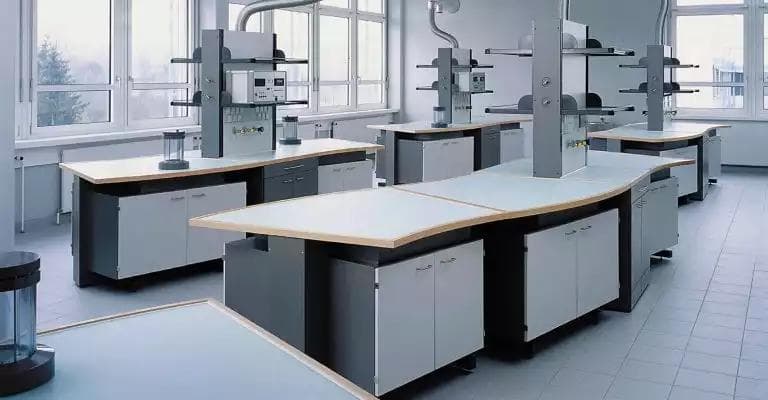
What criteria should professional laboratory furniture meet?
Professional laboratory furniture is the foundation for safe and effective work. Their choice cannot be accidental, as it directly affects the hygiene of work, the durability of equipment and compliance with health and safety regulations. The key criteria are chemical resistance, mechanical durability and ease of disinfection.
Laboratory countertops should be smooth, non-porous, and resistant to chemical absorption, which allows you to effectively maintain sterility. Structures based on steel frames, most often madeof powder-coated steel, are standard, which ensures high corrosion resistance and stability of the structure even under heavy loads.
In practice, it is worth striking a balance between price and quality. A low price often means compromises in terms of stability, fit of components and safety of use, which is unacceptable in the laboratory.
How to match the worktop material to the type of analysis performed?
The choice of a laboratory table should result directly from the specifics of the research work.
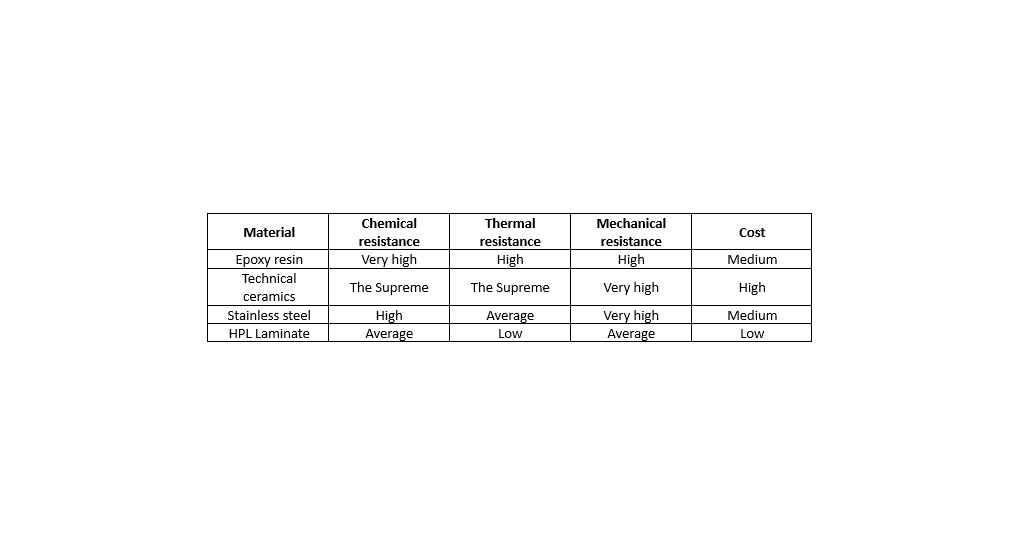
- Epoxy resin – very high resistance to acids, alkalis and solvents, no welds, good mechanical resistance; a popular choice in chemical laboratories.
- Technical ceramics (solid ceramics) – the highest chemical and thermal resistance, ideal for aggressive processes and high temperatures.
- Stainless steel / acid-resistant steel – excellent hygiene, corrosion resistance, easy to disinfect; preferred in medical and microbiological laboratories.
- HPL laminate – a cost-effective solution for educational laboratories and laboratories with low chemical load.
- Alternatives: ceramic sinter, quartz-granite conglomerate, phenolic resin.
Which lab benches to choose to optimize your workspace?
Laboratory tables are the heart of every laboratory. Their arrangement affects ergonomics and work organization.
- Island tables – access from all sides, ideal for teamwork and research labs.
- Wall-mounted tables – space-saving, easy integration into installations.
- Anti-vibration (weighing) tables – necessary for precise measurements and work with analytical balances.
- Mobile solutions: laboratory trolleys, mobile tables.
Each table should be equipped with laboratory media:
- water,
- gas,
- electrical sockets,
- sewage disposal systems, which increases the functionality and safety of the site.
What to look for when choosing fume hoods and ventilation systems?
Fume hoods are key mass protection devices in the laboratory. They ensure safe work with fumes, gases and volatile substances. Their interior must be made of chemically resistant materials, such as technical ceramics or polypropylene.
Depending on the application, the following are used:
- chemical extracts,
- laminar flow chambers,
- glove chambers.
Effective mechanical ventilation, airflow monitoring and appropriate tempered glass in the work covers are essential.
Check the offer: laboratory fume hoods
In which safety cabinets should acids, alkalis and flammable materials be stored?
Safe storage of chemicals requires the right solutions:
- Reagent cabinets – ventilated, for everyday use.
- Safety cabinets (fireproof) – designed for flammable substances.
A key requirement is compliance with the EN 14470-1 standard, which defines fire resistance classes:
- type 30 – 30 minutes,
- type 90 – 90 minutes.
For strong acids, corrosion-resistant polypropylene cabinets are recommended. Safety locks, spill trays and dedicated cabinets for gas cylinders are also standard.
What safety standards and approvals are required for laboratory equipment?
Certified equipment is a guarantee of legal safety and health of employees. The most important standards are:
- PN-EN 13150 – laboratory tables,
- EN 14470-1 – fireproof cabinets,
- PN-EN 14727 – storage furniture.
In addition, the following are required:
- PZH Certificate / PZH Certificate,
- compliance with health and safety regulations,
- hygiene class E-1.
Meeting these requirements is in line with the principles of Good Laboratory Practice (GLP).
Check the offer: medical furniture.
How do ergonomics and modularity of furniture affect work efficiency?
Modern laboratories focus on modularity, which allows for easy reconfiguration of the space along with the change of research processes. Modular furniture allows you to expand your workstations without costly renovations.
Ergonomics includes:
- height-adjustable chairs and laboratory stools,
- easy-to-clean surfaces,
- antistatic (ESD) solutions in technology laboratories.
Well-designed storage (undercounter cabinets, hanging cabinets, glass cabinets) improves workflow and reduces staff fatigue.
See also: ventilation in the laboratory.
Investor's checklist before buying laboratory furniture
- What chemicals will be used?
- Is sterility or high temperature resistance required?
- What standards and certificates must furniture meet?
- Will the laboratory be expanded in the future?
- What media must be brought to the positions?
March 01, 2026