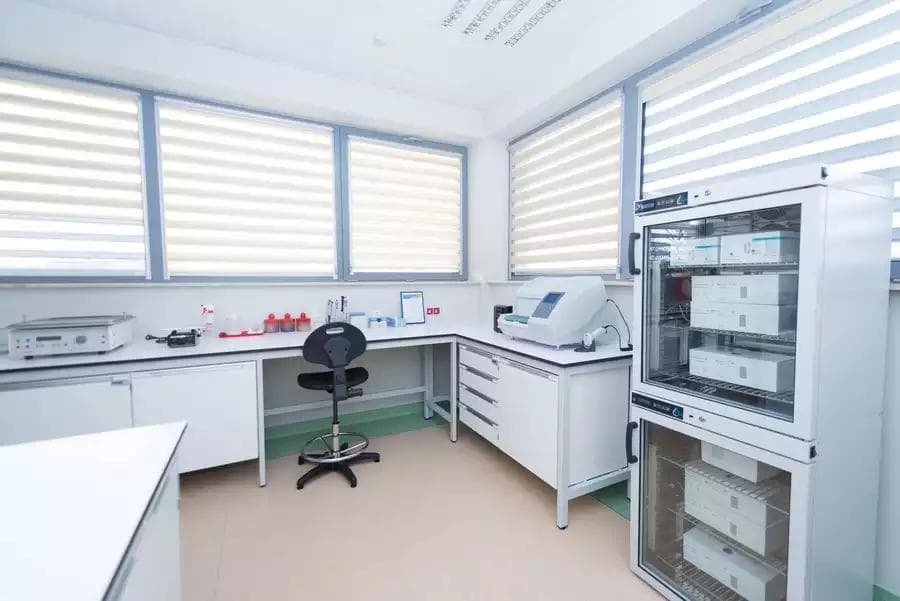
The choice of laboratory furniture has a direct impact on the safety, ergonomics and future functionality of the laboratory. One of the most important decisions is the choice between custom-made and ready-made modular systems. Each of these solutions has its advantages, but they differ in costs, implementation time and the possibilities of later expansion and reorganization of the space.
System Laboratory Furniture - Definition and Comparison
Laboratory furniture systems are modular solutions that can be easily expanded, repositioned and adapted to the changing needs of the laboratory. Unlike classic permanent construction, they allow for quick reconfiguration of workstations without costly renovations.
Although custom-made laboratory furniture allows for a perfect fit to a specific room, ready-made modular systems often turn out to be more flexible in the long run. They can be supplemented with new elements, such as mobile under-counter cabinets, without the need to replace the entire body.
From a cost-of-ownership perspective over many years, modular systems tend to generate lower expenses for modernization and redesign of the laboratory. This is one of the reasons why positive reviews about modular laboratory furniture often relate to their flexibility and ease of adaptation.
A good example is industrial laboratories using HPLC equipment. In such projects, the height of the worktops and the layout of the workstations can be adjusted to specific devices, and later the configuration can be changed without major problems as the infrastructure develops. Thanks to this, specialized furniture does not limit future technological changes.
Certifications and legal standards governing the safety of laboratory furniture
When choosing equipment, it is worth paying attention to compliance with the PN-EN 14056 and PN-EN 14727 standards, which specify the requirements for the safety, durability and functionality of laboratory furniture.
Before buying, it is worth checking whether the manufacturer:
- has documentation confirming compliance with standards,
- offers certified fume hoods and furniture for storing reagents,
- uses elements that increase stability, such as level controls,
- provides full technical documentation of the project.
In the case of new investments, the project should be verified by authorized specialists in health and safety, hygiene and fire protection before the start of installation. Thanks to this, the laboratory meets safety requirements and is prepared for technical acceptance.
The role of the PN-EN 14056 standard in the safe installation of laboratory furniture
PN-EN 14056 defines the rules for the design and assembly of laboratory furniture, taking into account, m.in example, appropriate communication routes, access to workstations and safe placement of equipment. This ensures that the laboratory remains functional and meets ergonomic requirements.
The standard also pays attention to the stability of the structure, which is why level regulators are used, m.in, which allow you to properly level furniture even on uneven ground.
In practice, the requirements of PN-EN 14727 and PN-EN 14056 complement each other, helping to create a safe working environment and ensure the patency of escape routes.
Arrangement of laboratory furniture in various types of facilities
The way the furniture is arranged depends primarily on the nature of the test. In chemical laboratories, the priority is a robust laboratory body, access to media and safe work with reagents. In biological and microbiological laboratories, on the other hand, ease of disinfection and surface hygiene are of greater importance.
For small labs, it's a good idea to choose compact lab furniture that makes the most of the available space. Anti-vibration tables designed for analytical balances are also a good solution, as they effectively reduce the impact of vibrations on the accuracy of measurements.
Modern laboratory furniture equipment is increasingly being integrated with IT systems and LIMS software. Ducts for cable routing and solutions for organizing the cabling of workstations help with this.
When planning, it is worth considering not only the laboratory equipment, but also the entire research infrastructure, including media distribution systems, washing stations and other technical systems. This makes it easier to maintain high laboratory ergonomics and prepare the space for further development. If you are wondering how to choose laboratory furniture, it is best to match it to the specifics of the test, the available space and the planned equipment. It is this approach that allows us to create functional and durable equipment for scientific facilities.
Necessary equipment and laboratory furniture
The selection of furniture should take into account the type and weight of the equipment used in the laboratory. The more advanced the laboratory equipment, the more important stable frames and appropriately durable tabletops are.
When designing workstations, it is also worth taking care of access to utilities. Properly placed media distribution systems make it easier to connect devices and increase operational safety.
In medical and diagnostic laboratories, laboratory washing stations and emergency safety showers are also an important element of equipment, which allow you to react quickly in the event of contact with hazardous substances.
Chemical and mechanical resistance of cabinets and laboratory tables
In the laboratory, it is not only the layout of the stations that counts, but above all the durability of the materials. Laboratory worktops and supporting structures must be resistant to acids, alkalis, high temperature and mechanical loads resulting from the operation of heavy equipment.
Depending on the function, different types of tables are used: wall-mounted, island and pass-through, often integrated with sinks and media systems. Each of them must provide stability and easy service access, without the risk of weakening the structure.
Equally important are safety cabinets for chemicals, which are available in the 30 or 90 minute classes in fire protection versions. They are equipped with double walls, a spill tray and an automatic door closing system. In the case of storing acids and alkalis, ventilation is additionally used, which reduces the accumulation of fumes.
Quality requirements also include SEFA standards and PCA requirements for ease of cleaning and disinfection. In educational laboratories, additional attention is paid to the safety of users – rounded edges and high stability of the structure.
In practice, well-selected laboratory tables and cabinets as well as durable metal laboratory furniture allow you to work safely even in an environment with high chemical aggressiveness. This is why the questionof which laboratory furniture to choose for working with aggressive chemicals so often arises – the answer always depends on the environmental conditions and the type of research being conducted.
Manufacturer Selection and Engineering Design of Laboratory Furniture
Today, the design of modern laboratories is based on digital BIM models, which allow you to accurately plan the layout of the installation and avoid installation errors. As a result, the design of modern laboratory furniture takes into account ergonomics and user safety as early as the concept of the media connection.
In high-purity laboratories (cleanroom), it is crucial to reduce particle emissions and use materials that are easy to decontaminate. Therefore, the entire design process should be carried out by an experienced laboratory furniture manufacturer that ensures compliance with technical requirements and industry standards.
The quality of workmanship can be assessed, m.in, by certificates, load tests and technical documentation confirming the performance parameters. This approach avoids investment errors and ensures a long service life of the equipment.
Worktop materials and their impact on laboratory furniture
The choice of table top material determines the durability and resistance of the entire stand. In a laboratory environment, acid, alkali, temperature and ease of cleaning are key.
1. Monolithic ceramics
Very high chemical and thermal resistance. It works well with strong mineral acids, but is hard and less resistant to point impacts.
2. Epoxy
resin High chemical resistance and good mechanical strength. Often used in analytical and chemical laboratories, where the stability of operating parameters is important.
3. Laminate
Good resistance to most chemicals and easy to clean. More often chosen for biological and educational laboratories than for work with very aggressive chemistry.
Tempered or laminated glass is also used in some applications, especially where process visibility and control of the course of experiments are important.
Each of the materials has different physical properties, so the choice should result from real working conditions, and not only from universal parameters.
Design and assembly and stability of laboratory furniture
The stability of laboratory furniture depends largely on the type of supporting structure. The most commonly used are C-frame frames and A-frame frames.
The C-frame provides more freedom of space under the countertop, making it easier to access the workstation and installation. The A-frame, on the other hand, gives higher rigidity of the structure, which is important for heavier equipment.
The integration of utilities (gas, water, electricity) is most often carried out by installation extensions or guidance systems in the so-called technological bridges. Depending on the project, under-counter cabinets are also used – hanging or mobile.
Tall buildings and chemical racks require additional anchoring to the floor to ensure stability and safety of use.
The Impact of Laboratory Furniture on Auditing and Certification
In GLP certification processes, equipment that can be easily cleaned and disinfected is crucial. Therefore, non-porous surfaces and materials resistant to chemicals are often used.
Stainless steel plays a major role, especially in environments that require high hygiene and corrosion resistance. Plastics, on the other hand, work well where there are very aggressive reactants.
FAQ - Frequently Asked Questions
1. How to prepare the room before assembling laboratory furniture?
The floor needs to be leveled, utilities must be brought to the points from the project and the load-bearing capacity and dimensions of the communication routes must be checked. This is a prerequisite for correct installation.
2. What is the average lifespan of laboratory furniture?
Usually 15-20 years, depending on the design and type of countertops and regular maintenance.
3. What are the requirements for the load capacity of the apparatus tables?
Standard tables can withstand approx. 200 kg/m, and heavy equipment requires reinforcements of up to 500 kg and structures with increased stability.
4. What ergonomic solutions are most important in the laboratory?
Adjustable height of the tops, ergonomic chairs, adequate legroom and correct placement of media.
June 18, 2026