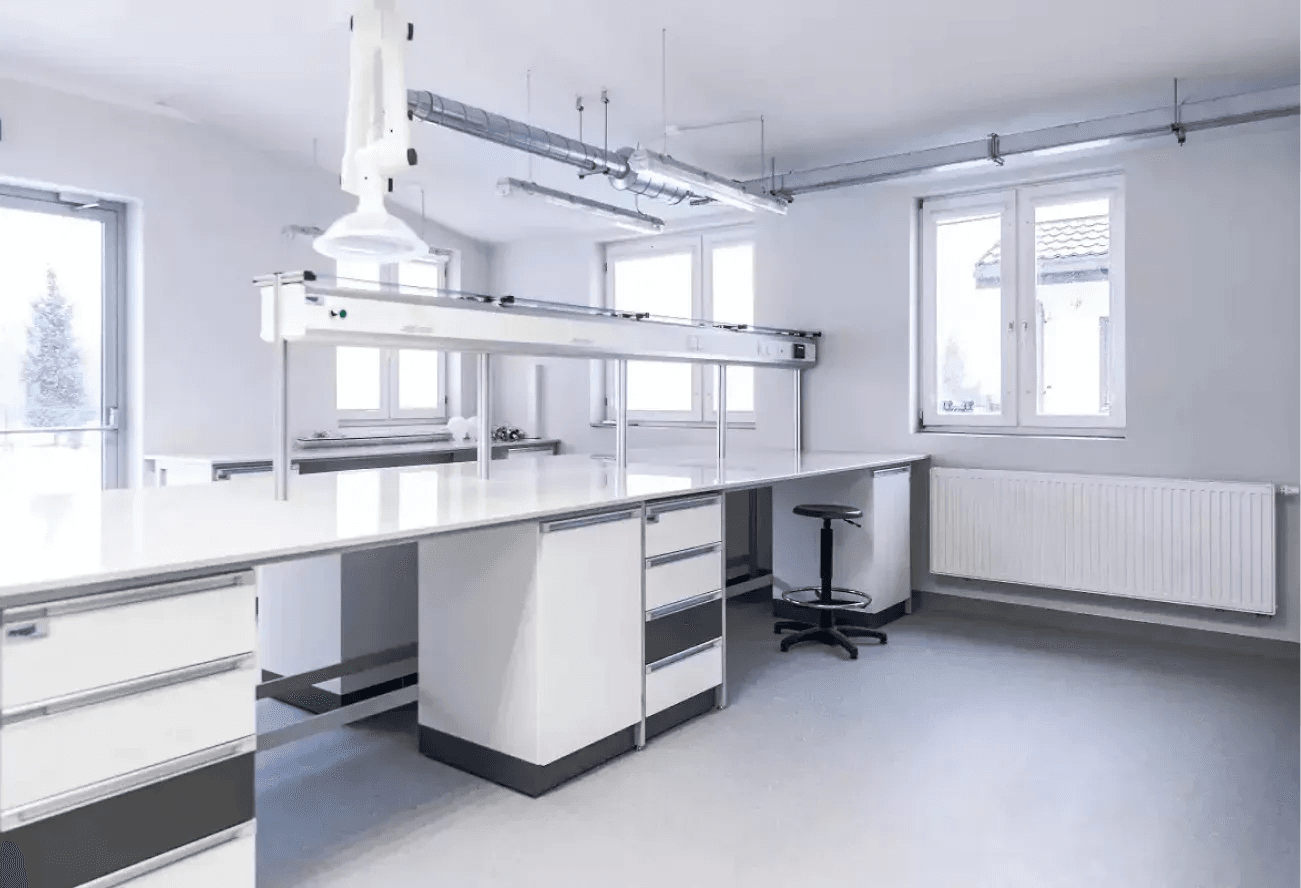
What is the development of a technological design for a laboratory?
The technological design of the laboratory is the foundation of the entire investment and is much more important than the aesthetics of the facility itself. It determines the functionality, safety and the possibility of developing the laboratory in the future. Laboratory design requires the integration of engineering, chemical, biological and architectural knowledge, referred to as LMT – Laboratory Technological Method.
At this stage, the following are analysed:
- the specificity of the research conducted (chemical laboratory vs microbiological laboratory),
- mass and energy balance of processes,
- demand for utilities (gas, water, compressed air, HVAC),
- biosecurity and chemical safety levels.
Close cooperation between the technologist, designer and end user is crucial so that the project meets real operational needs, and not just formal assumptions.
What are the key stages of the investment process and project documentation?
The investment process begins withthe URS (User Requirements Specification), which defines the goals, scope and constraints of the project. It is a parent document, on the basis of which the concept is created, and then the construction and detailed design.
Modern laboratory planning uses:
- BIM modeling, allowing to detect plant collisions,
- CAD documentation and 3D visualizations,
- feasibility studies and investor's cost estimates,
- Risk Analysis (RA) and Project Qualification (DQ).
This approach minimizes the risk of errors at the stage of construction and operation of the facility.
See also: Ventilation in the laboratory.
What legal requirements and safety standards must a modern laboratory meet?
The design of the laboratory must comply with stringent regulations and standards, including:
- PN-EN ISO/IEC 17025 – accreditation of laboratories,
- ISO 14644 – clean room,
- health and safety and fire protection regulations.,
- guidelines of the Sanepid and the Regulation of the Minister of Health.
In biological laboratories, PCL levels 1–4 are used to affect the building structure, ventilation systems and biosecurity. GLP and GMP procedures are also increasingly required, especially in the pharmaceutical and biotechnology sectors.
Why are ventilation and zoning critical for the functioning of a facility?
One of the key aspects of design isthe division into clean and dirty zones and the proper logistics of personnel, materials and waste movement. Errors in this area lead to cross-contamination and health and safety risks.
Laboratory ventilation (HVAC) is responsible for:
- appropriate air exchange rates,
- maintaining the pressure gradient,
- control of the air purity class.
The central element of the system are laboratory fume hoods, which remove contaminants at the source. Spaghetti charts are increasingly used in the design process to optimize workflows and ergonomics.
For more information, see dygestory sets.
How to choose ergonomic furniture and specialized research equipment?
Modern laboratory furniture must combine durability, ergonomics and flexibility. Modular solutions and mobile systems are increasingly used, which allow for quick changes in arrangement.
Worktop materials:
- monolithic ceramics – the highest chemical resistance,
- quartz sinters – aesthetics and durability,
- epoxy resins – universal use,
- Stainless steel – wet and medical laboratories.
The necessary equipment includes m.in:
- reagent cabinets and fireproof cabinets,
- eye washers and safety showers,
- lighting in accordance with PN-EN 12464-1.
It is worth getting acquainted with the offer:
laboratory furniture
medical furniture
When is it worth deciding to adapt and modernize an existing building?
Adapting a laboratory in an existing facility can be cost-effective, but it is associated with numerous technical challenges:
- load-bearing capacity of ceilings,
- storey height,
- availability of installation shafts,
- the need to comply with current fire protection regulations. and health and safety.
Reliable inventory, measurements and analysis of compliance with the construction law are crucial. In many cases, retrofitting turns out to be more restrictive than building a new greenfield facility, especially for high-risk laboratories.
What ESG innovations and standards affect the energy efficiency of the laboratory?
The year 2026 brings a dynamic development of the Smart Lab concept, including the integration of:
- LIMS (Laboratory Information Management System),
- IoT (Internet of Things),
- environmental monitoring and BMS automation.
VAV fume hoods, energy recovery systems and paperless laboratories are becoming increasingly important. These solutions support ESG goals, reduce energy consumption and improve the comfort of work, in line with the idea of healing environment.
Today, modern laboratory design is evidence-based design – decisions based on data, process analysis and real user needs, and not only on diagrams. This approach allows you to create facilities that are safe, flexible and ready for the challenges of the future.
Learn more: which laboratory furniture to choose?
March 05, 2026