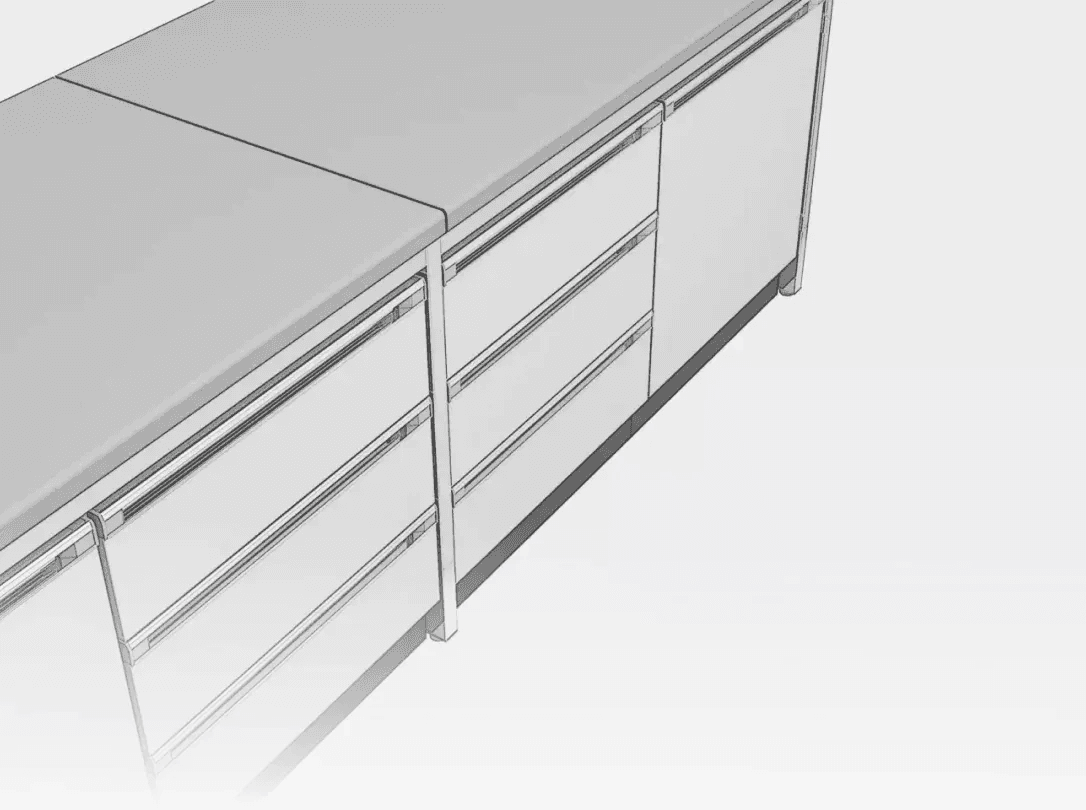
The epoxy resin table top is one of the most commonly used solutions in chemical laboratories, where high resistance to aggressive substances and stability of operation in the long term are important. With its monolithic structure and low water absorption, it performs well in environments that require chemical safety and easy cleaning.
What is an epoxy resin laboratory table top and its parameters
Laboratory epoxy resin countertop is a monolithic epoxy resin board that does not contain a wood-based core. The whole is made asa thermosetting plastic, which ensures a uniform structure without joints and places of potential chemical degradation.
Unlike decorative solutions or simple boards available in DIY stores, a certified laboratory worktop is designed to work with aggressive chemicals and technological loads. It differs not only in composition, but also in the controlled cross-linking density of the polymer, which limits the penetration of liquids and gases.
The standard thickness of an epoxy resin worktop is 15, 19 or 25 mm, depending on the application and the required load capacity. The material achieves a hardness of 100–115 on the Rockwell M scale and a very low water absorption of less than 0.05%.
Fire resistance is also important, confirmed bythe fire classification EN 13501-1, where the material exhibits self-extinguishing properties. This makes the epoxy resin laboratory worktop suitable for environments with increased chemical safety requirements.
What distinguishes an epoxy worktop with a raised marine edge?
The epoxy table top with raised edging has an integrated rim that stops spills on the work surface. Such an anti-spill edging reduces the risk of acids and alkalis getting onto laboratory cabinets and floors.
The uniform design means that there are no gaps in which contaminants could accumulate. This solution improves occupational hygiene and makes it easier to maintain cleanliness in everyday use.
How does the installation of an epoxy worktop with an integrated sink work?
The installation of an epoxy countertop with an integrated sink consists of seamless connection of elements using a chemically resistant epoxy adhesive. Thanks to this, the entire sink and countertop zone retains homogeneous physicochemical properties.
This eliminates areas where chemical corrosion or deposits could develop, which is especially important in intensively used laboratory workstations.
When to choose an epoxy resin worktop for a chemical laboratory?
The epoxy resin worktop is chosen wherethe work surface comes into contact with highly aggressive reactants and zero water absorption is required.
It is best suited for environments where laboratory equipment must provide full resistance to cross-contamination and stability of operation under prolonged chemical exposure. The monolithic design reduces the risk of substance penetration and makes it easier to maintain a high level of safety.
Certification and chemical resistance of epoxy worktop
Epoxy worktops are used where the work surface is in constant contact with aggressive reactants and must remain stable for a long period of use.
The material exhibits very high chemical resistance, including concentrated sulfuric acid (98%), nitric acid (65%), hydrochloric acid (37%) and sodium hydroxide solutions. The performance parameters are confirmed by tests in accordance with the PN-EN 13150 standard and the SEFA 3 standard, used in laboratory equipment.
In addition, it refers to the chemical resistance requirements of EN 438-2, especially in the context of the comparative of different work surface systems used in laboratories.
The essence of durability is the tight, non-porous structure of the polymer, which reduces the penetration of liquids and minimizes the risk of reactions deep into the material. This ensures that the surface remains stable even in repetitive contact with reagents.
In the case of hydrofluoric acid, dedicated variants with increased resistance to HF are used, as standard composites can degrade in contact with this compound.
It is also worth remembering that the effectiveness of the material depends on the way it is used – quick removal of spills and proper cleaning agents significantly extend its life.
Thermal Endurance and Temperature Shock Physics
The epoxy worktop in the laboratory version operates in a wide temperature range and remains stable under constant thermal load up to approx. 180°C. For a short time, it can be exposed to higher values, reaching approx. 240°C, without losing its basic functional properties.
The difference between certified material and cheap resins lies primarily in the crosslinking structure. In low-quality products, the deflection temperature under load (HDT) is exceeded, leading to deformation, micro-cracks and permanent surface damage.
Thermal shock occurs when the temperature changes rapidly, such as when hot dishes come into contact with a cool countertop. Well-designed systems take into account expansion joints and appropriate work zones at heating devices and sinks.
The epoxy surface tolerates typical laboratory conditions well, however, direct contact with the open flame of the gas burner should be limited as it can lead to local changes in structure.
Maintenance Procedures: How to Clean and Remove Scratches from Slabs
Daily care of epoxy worktops consists of wiping the surface with a soft, damp cloth using mild, neutral detergents. In many laboratories, antistatic preparations are additionally used, which reduce the settling of impurities and make it easier to maintain cleanliness.
In the case of contact with chemical reagents, rapid laboratory decontamination is important. The surface should be cleaned immediately to avoid prolonged exposure of the material to aggressive substances and potential discoloration.
Professional methods based on mechanical processing are used to remove scratches. The process begins with wet sanding with papers with a grit of approx. 120–400, and then gradually moves up to 800–1000 and above. In the final phase, 2000-5000 aqueous abrasives and felt disc polishing are used to restore the uniform structure and gloss of the epoxy resin surface.
Amateur solutions such as PPF film or hard protective waxes such as Osmo are not used, as they do not meet the hygienic requirements of laboratories and can degrade under the influence of temperature and chemicals. Also, polyurethane varnish is not suitable for areas with increased cleanliness requirements, where full chemical resistance and the possibility of decontamination without disturbing the surface structure are crucial.
Regular maintenance based on proper treatment methods allows you to maintain the functionality and aesthetics of the worktop for a long time without the need to replace it.
Installation locations and benefits for research personnel
Epoxy countertops are used in industrial, pharmaceutical, medical laboratories and facilities with high biological cleanliness requirements, including BSL-3 and BSL-4.
The monolithic, seamless surface reduces the risk of accumulation of contaminants and pathogens, which significantly facilitates decontamination and maintenance of the sanitary regime. For personnel, this means more predictable and safe working conditions and less risk of contact with biological material.
The use of personal protective equipment such as nitrile gloves, safety glasses and ABEK1 protective mask is required during assembly, especially for on-site machining and fitting of components.
The absence of welds and joints also translates into greater comfort of work – surfaces are easier to clean and more resistant to intensive use in a laboratory environment.
Comparison: epoxy worktop vs phenolic resin worktop
Epoxy and phenolic worktops differ primarily in their construction and range of operational resistance.
In the case of epoxy, we are dealing with a monolithic structure without carrier layers, which ensures high chemical resistance and the possibility of surface regeneration. Phenolic worktops (HPLs), such as Trespa TopLab, have a layered structure, where the performance properties depend on the thin top layer.
Epoxy tolerates contact with strong acids and high temperatures better, while HPL works well in lighter applications where chemical loads are lower.
A significant difference also applies to repairability – an epoxy surface can be mechanically renewed by grinding and polishing, while HPL laminates have limited regeneration capabilities.
As a result, epoxy countertop remains the better choice in chemical laboratories with a high risk of spillage and heavy use, while HPL is used in less demanding research environments.
Durcon Monolithic Casting vs. Alternative Manufacturing Methods
Durcon and Durcon Classic worktops are created as homogeneous, monolithic epoxy resin castings, which means no bearing layers and no weakening points in the structure of the material.
This technology eliminates the risk of delamination even in prolonged contact with aggressive chemical reagents. The entire thickness of the board has identical physicochemical properties, thanks to which the material remains stable throughout the cross-section.
In comparison, alternative solutions based on an MDF core or OSB 3 covered with a layer of resin are more susceptible to damage. If the protective coating leaks, moisture can ingress, leading to swelling of the core and gradual degradation of the structure.
The greatest risk of such structures is delamination, i.e. the separation of the top layer from the substrate, especially in an environment with high humidity or when in contact with chemicals.
For professional solutions, only monolithic epoxy worktops with a controlled thickness (up to 25 mm) are used, which do not contain wood-based materials.
In practice, this means greater durability, predictable behaviour in operation and no risk of hidden structural degradation, typical of low-end composite panels.
FAQ - Frequently Asked Questions
1. Why can a laboratory epoxy resin worktop turn yellow when exposed to UV radiation?
Yellowing results from the photodegradation of polymer bonds under the influence of UV. In production, this is limited by HALS stabilizers and UV absorbers. The countertops are designed mainly for indoor work where exposure to sunlight is limited.
2. How is the seamless joining of epoxy resin panels performed during assembly?
The boards are joined with a chemically resistant epoxy binder, which, after hardening, forms a uniform structure. The joint point is then ground and polished to produce a smooth, continuous surface with no gaps.
3. What can damage a professional epoxy resin countertop when working in a laboratory?
Damage can occur in contact with hydrofluoric acid (HF), at temperatures above approx. 240°C and in the event of intense mechanical damage, e.g. cutting directly on the surface. Improper cleaning agents and metal cleaners can further compromise the structure of the material.
June 21, 2026