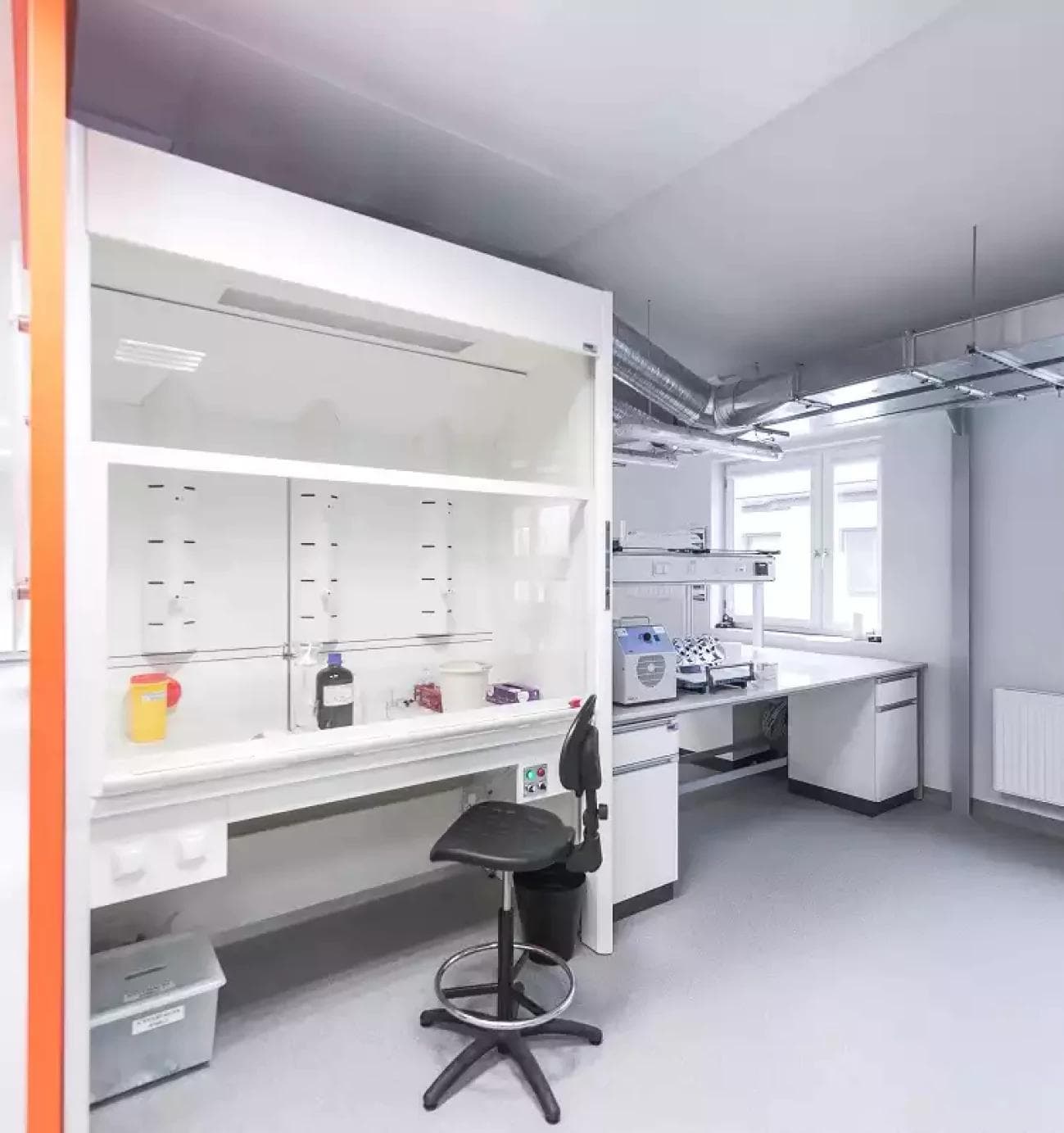
A safe school laboratory requires appropriate equipment, and one of the key elements is a fume hood. The right choice of model affects the comfort of work, the safety of students and the effectiveness of conducting chemical experiments. When buying, it is worth paying attention to the type of construction, the materials used and compliance with the standards, so that the extractor works well in everyday work in the school workshop.
What is a school fume hood and what role does it play in a chemical laboratory?
A school fume hood is a specialized laboratory extractor that allows chemical experiments to be carried out safely in the laboratory. Its main role is to ensure operational safety by effectively removing toxic gases, fumes and dust that may be generated during chemical reactions. As a result, it protects both students and teachers, minimizing the risk of contact with harmful substances.
The fume hood also acts as a physical barrier against accidental splashes of chemicals and reduces the risk of fire, making it an irreplaceable element of any chemical laboratory. At the same time, it allows for the observation of experiments in a safe way, which is crucial for the educational process – students can independently analyze chemical reactions, and the teacher controls the course of experiments.
With this combination of protection and visibility, a school fume hood not only supports occupational safety, but also develops practical skills and awareness of chemical hazards, which is essential for teaching chemistry in secondary and primary schools.
What types of laboratory fume hoods are dedicated to schools?
In a school laboratory, it is worth choosing a laboratory fume hood so that it is both safe and comfortable in everyday work. A stationary fume hood is a classic – firmly attached, connected to ventilation and ready to use every day. When it comes to shows for the whole class,glazed or panoramic fume hoods work great, which allow you to observe experiments from all sides, acting as a demonstration fume hood.
For those who need a little flexibility, there are mobile fume hoods on wheels – they are easy to move to another place when the layout of the studio changes. In smaller rooms, tabletop fume hoods are perfect, as they do not take up much space and still allow you to work in complete safety. Metal, laminated or larger walk-in versions allow you to adjust the fume hood to the appearance and needs of a particular room. All these solutions perfectly complement school furniture, creating a coherent and functional space where children and young people can safely experiment and learn chemistry.
Ready-made fume hood kits are also available, which include all the necessary elements: work chamber, ventilation system, countertop, media and undercounter cabinets, facilitating quick installation and safe use.
What materials are worktops and handling chambers made of?
Choosing the right materials for worktops and handling chambers is of great importance for the safety and durability of the equipment in the workshop. The highest standard is solid technical ceramics (LCT), often referred toas solid technical ceramics (CLT) – its chemical and thermal resistance makes it able to cope well even with strong acids and high temperatures. Polypropylene (PP) is increasingly used in handling chambers, which is acid-resistant and ideal for working with aggressive substances.
An alternative to ceramics areepoxy resin or phenolic resin HPL worktops, which also show high chemical and mechanical strength and are easy to clean. The entire supporting structure of the fume hood and the handling chamber is usually made of powder-coated steel, most often with epoxy paint, which protects it from corrosion and increases the durability of the furniture. Thanks to the appropriate selection of materials, both the ceramic table top and the elements of the handling chamber can serve in the laboratory for years, ensuring maximum work safety.
How do the ventilation system and air flow sensors in the fume hood work?
Safety in a laboratory fume hoodlargely depends on a well-designed ventilation system. The vacuum generated by the duct fan or the chemical resistant fan causes the chemical vapors to be effectively drawn out of the work chamber. Modern models use slotted fume hoods with a double back wall, which allows both light and heavy fumes to be discharged.
An air flow sensor is used to monitor safety, which constantly monitors the airflow and activates an acoustic alarm and an optical alarm in the event of irregularities, in accordance with the requirements of the standards. In addition, a safety flap in the ceiling reduces overpressure in emergency situations, such as an explosion, which increases the protection of users. The entire aerodynamics of thefume hood and the presence of an exhaust port guarantee effective extraction of harmful substances from the work area.
What installations and utilities should a safe workstation be equipped with?
A safe workstation in a school laboratory should have a complete plumbing system, equipped with a ceramic sink or polypropylene sink, along with a laboratory faucet and siphon. A gas system is required to work with gases– valves located on the front panel and a laboratory spout in the working chamber provide convenient and safe access.
No less important isthe electrical installation, including IP-54 hermetic electrical sockets and IP-65 LED lighting, guaranteeing adequate visibility and safety. All utilities are often controlled by systems placed in under-counter cabinets, allowing for easy monitoring of water, gas and electricity without the risk of accidental damage or flooding of the station.
What safety standards and certificates must a school fume hood have?
Occupational safety in school laboratories requires that the school fume hood meets certain standards and has the necessary certificates. The most important is the PN-EN 14175 standard, especially its part PN-EN 14175-2, which specifies the requirements for the design and operation of laboratory extractors. For educational institutions, it is also necessary to have a certificate from the National Institute of Health (PZH), which confirms the safety of use in schools.
Each fume hood should also havethe CE marking, proving compliance with European directives, including the LVD Directive 2014/35/EU on the safety of electrical equipment. A very important element is safety glass (VSG) or tempered glass in the sliding window, which provides a protective barrier against splinters and accidental contact with chemicals. By meeting these requirements, users can be sure that the safety of work in the school laboratory is maximally ensured and the fume hood functions in accordance with the highest standards.
When is it worth deciding on a mobile or ductless fume hood?
In schools that do not have the possibility to expand or modify the existing ventilation in the laboratory, mobile or ductless fume hoods are an excellent solution. The latter, also known as filter fume hoods, operate independently of the mechanical ventilation system – the air is purified internally and recirculated back into the room. This process is based on special filters: a carbon filter removes chemical fumes and a HEPA filter traps dust and biological particles, ensuring a safe working environment.
An additional advantage is mobility – the fume hoods on wheels can be easily moved between rooms, depending on the needs, which increases flexibility and allows experiments to be carried out in different parts of the school. Thanks to this, both mobile and ductless fume hoods serve as safe workstations, even where there is no classic external ventilation.
What to look for when choosing a fume hood for a school laboratory?
When choosing a fume hood for primary or secondary school, it is worth paying attention to several practical aspects that affect the safety and comfort of work. As with medical furniture, laboratory furniture in school fume hoods must be resistant to chemicals and easy to clean, providing a safe working environment for students.
First of all, the sliding window should be equipped with a counterweight system, allowing smooth opening and closing, and a lock to prevent accidental falling.
A ventilated cabinet under the countertop is also useful , in which chemical reagents can be safely stored. The finishing materials of the fume hood should be selected in terms of the planned experiments, so that they are resistant to acids and other chemicals. Not to forget the leveling feet and the sturdy steel frame, which allow you to position the fume hood evenly on an uneven surface and increase its stability.
A well-selected device, combined with proper use and compliancewith health and safety rules in the chemical laboratory, ensures safe and comfortable working conditions for students and teachers, minimizing the risk of accidents and damage to the equipment.
March 13, 2026