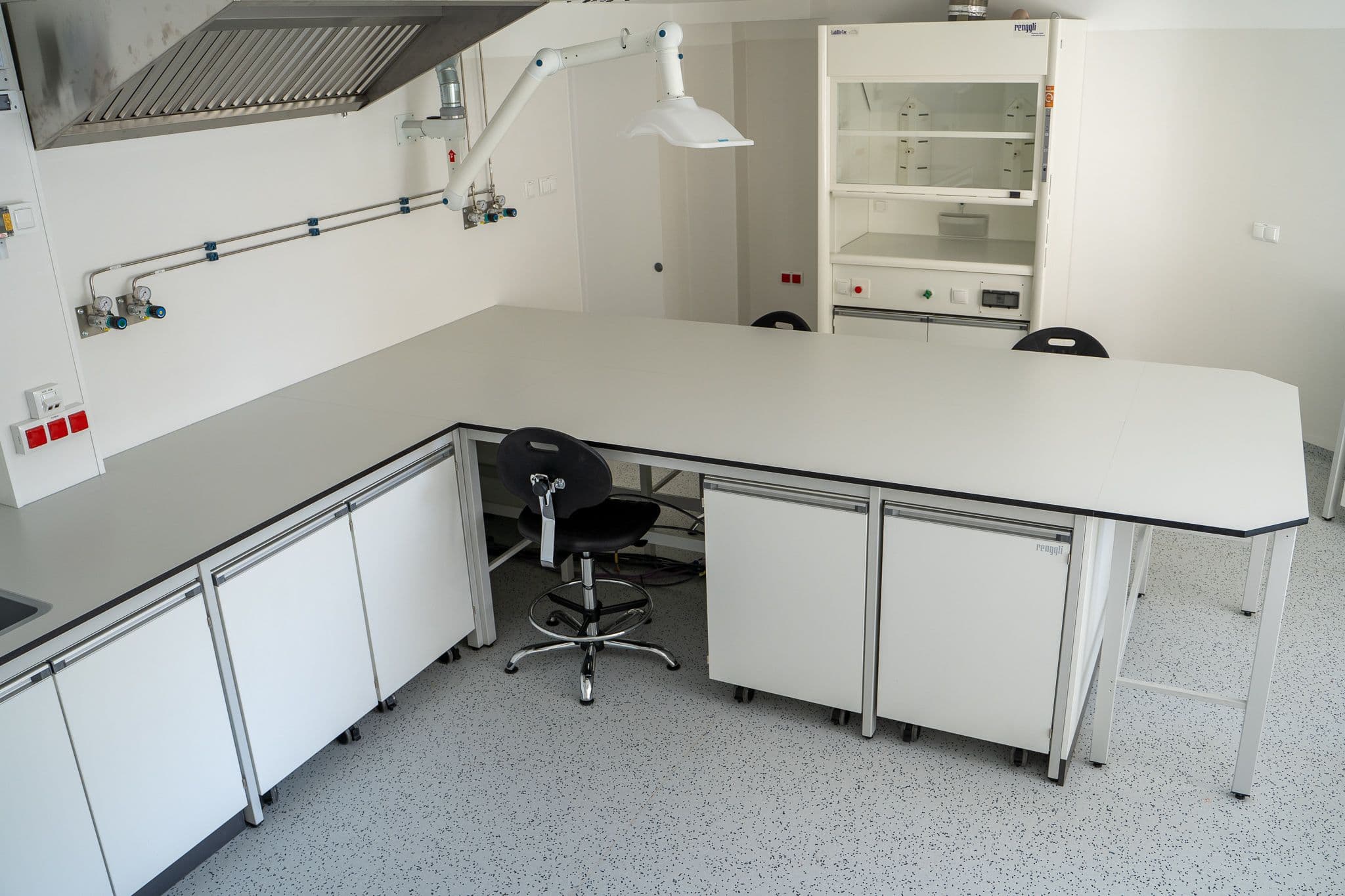
Proper care of laboratory worktops significantly extends their durability and allows you to maintain stable working conditions for many years. It is crucial to adjust the cleaning methods to the type of material and the intensity of use of the workstation.
What destroys the lab table and how its resistance works
Chemical resistance is the ability of a laboratory worktop to come into contact with chemicals without permanently changing the structure of the material. In practice, this means that the laboratory surface can retain its properties despite the action of aggressive factors.
The most common destructive factors include aggressive reagents such as concentrated acids, bases and organic solvents (acetone, xylene), as well as high temperature. These substances can weaken the protective layer and lead to gradual degradation of the surface.
Particularly sensitive are the joints where the core of the worktop connects to the top layer. Damage to polyurethane and silicone welds causes microcracks and loss of tightness, which increases the risk of contamination and contamination of samples.
The resistance of a material is also determined on the Mohs scale, which describes hardness and scratch susceptibility. The lower the resistance, the easier it is to cause microdamage, which can accumulate in laboratory conditions.
How to Maintain a Resin and Laminate Lab Table
Regular maintenance extends the life of the lab table and allows you to maintain its performance for years. It is crucial to match the care method to the material from which the laboratory work surface is made.
The Durcon epoxy resin worktop requires gentle cleaners without abrasive substances so as not to disturb the monolithic structure. Phenolic resin worktop is more sensitive to high temperature and intense chemistry due to its layered construction.
The stainless steel worktop should be cleaned without the use of chlorine, while the polypropylene and quartz-granite conglomerate countertop require regular, gentle washing without harsh detergents. Wooden elements must be additionally oiled or waxed and periodically renewed in case of damage.
The condition of the worktop edging and the stability of the cabinet base have an impact on the durability of the entire system and its resistance to intensive use.
How to Maintain HPL Laminated Lab Table
The HPL Max Resistance Laminated Lab Worktop requires regular cleaning with soft microfiber cloths and mild detergents. Thanks to this, the surface remains resistant to dirt and does not lose its functional properties.
It is particularly important to protect elements such as the worktop edging, which is the first barrier against moisture. Leaks in this place can lead to penetration of the liquid and gradual swelling of the core of the material.
Polyurethane joints are also important, as they must remain tight to prevent moisture from penetrating the board structure. Regular inspection of these zones allows you to maintain the durability of the entire working system. Proper care extends the life of the laboratory table and the stability of its surface.
How to care for tables and anti-vibration lab tops
Maintenance of laboratory tables includes the inspection of frames made of powder-coated metal or anodized aluminum profiles. Regular cleaning and checking of joints affects the stability of the entire structure of laboratory furniture.
For weighing tables, it is crucial to maintain anti-vibration properties that eliminate vibration and ensure precise measurements. Each laboratory table in such a system must remain perfectly level, so periodic adjustment is necessary.
Laboratory equipment should be inspected for clearances and wear, as even slight deviations can affect the accuracy of measuring equipment.
What destroys the lab table and how its resistance works
Chemical resistance refersto the ability of a laboratory workbench to work in contact with reagents without loss of structure and tightness. Damage is mainly caused by aggressive reagents: concentrated acids (HCl, H₂SO₄, HNO₃), organic solvents and high temperature.
The most vulnerable are places with disturbed material continuity – the core of the worktop and joints, where joints are degraded, and the chemically resistant coating. Microcracks also occur in multilayer designs, which can lead to contamination of samples over time.
The resistance of a material is described, m.in, on the Mohs scale – the higher the hardness, the lower the susceptibility to scratches, although this does not always mean chemical resistance. Therefore, the laboratory surface must be evaluated comprehensively: mechanically and chemically.
The SEFA 3 standard specifies how materials are tested for chemical resistance and loads, allowing different types of worktops to be compared in a laboratory setting.
How to Maintain a Resin and Laminate Lab Table
Maintenance of laboratory tables depends on the material. Epoxy resin requires soft cloths and detergents with a neutral pH, without abrasives.
Phenolic laminate is more sensitive to moisture, so it is crucial to protect components such as the countertop edging and polyurethane joints, which can allow water to pass through and cause swelling.
Stainless steel requires chlorine-free agents to avoid corrosion. Quartz conglomerates, on the other hand, require regular removal of deposits to maintain aesthetics and performance parameters.
Every laboratory worktop requires appropriate care – incorrect cleaning agents can significantly shorten its lifespan and worsen its operating parameters.
Manufacturer Guidelines and Standards for Laboratory Worktops
Maintenance of laboratory worktops in accordance with EN 14727 is crucial to maintain their performance throughout their life cycle. This standard specifies the requirements for construction, resistance and safety of use, including the method of operation and cleaning of furniture systems used in laboratories.
In practice, this means that procedures in accordance with Good Laboratory Practice (GLP) must be used, where maintaining the cleanliness of the workstation has a direct impact on the reliability of test results. The laboratory worktop must be cleaned in a controlled manner, using agents with confirmed chemical compatibility.
The manufacturer's recommendations, including Rengli engineers, indicate the need to verify detergents in SDS cards each time. Incorrectly selected agents can compromise the surface structure and shorten the life of the laboratory table, despite its high material resistance.
What to avoid when caring for your lab worktop
When maintaining laboratory worktops , it is imperative to avoid substances and tools that can damage the chemical-resistant coating. Particularly dangerous are strong acids (e.g. hydrofluoric), aggressive solvents and highly abrasive agents.
It is unacceptable to use sharp steel brushes or scouring pads, which cause micro-damage to the surface. Preparations intended for other applications – such as office worktops, home kitchen worktops, workbenches, lacquered wooden worktops or standard laminated worktops – also do not meet laboratory requirements and can permanently damage the structure of the material.
The consequence of incorrect care may be the loss of chemical resistance, the development of corrosion and the need to replace entire elements of equipment, including even workstation modules. As a result, the laboratory worktop loses its functional properties and ceases to meet the requirements of the test environment.
FAQ - Frequently Asked Questions
1. What are the rules for assigning responsibilities related to cleaning laboratory worktops?
Daily cleaning is carried out by the personnel working at the station, while periodic maintenance can be carried out by specialized services. A clear division of responsibilities in SOP procedures is crucial, which reduces the risk of errors and damage.
2. How often should professional countertop maintenance be carried out in a chemical laboratory?
Cleaning is carried out after each series of work. Technical inspection and inspection of the condition of the surface, usually once a year. Wooden elements require additional periodic care in accordance with the manufacturer's recommendations.
3. What should I do immediately after spilling concentrated acid on the lab table?
A suitable neutralizer should be used and then the surface should be rinsed with demineralized water. Do not dry wipe the acid without neutralizing it, as this may damage the surface and increase the risk of burns.
June 27, 2026