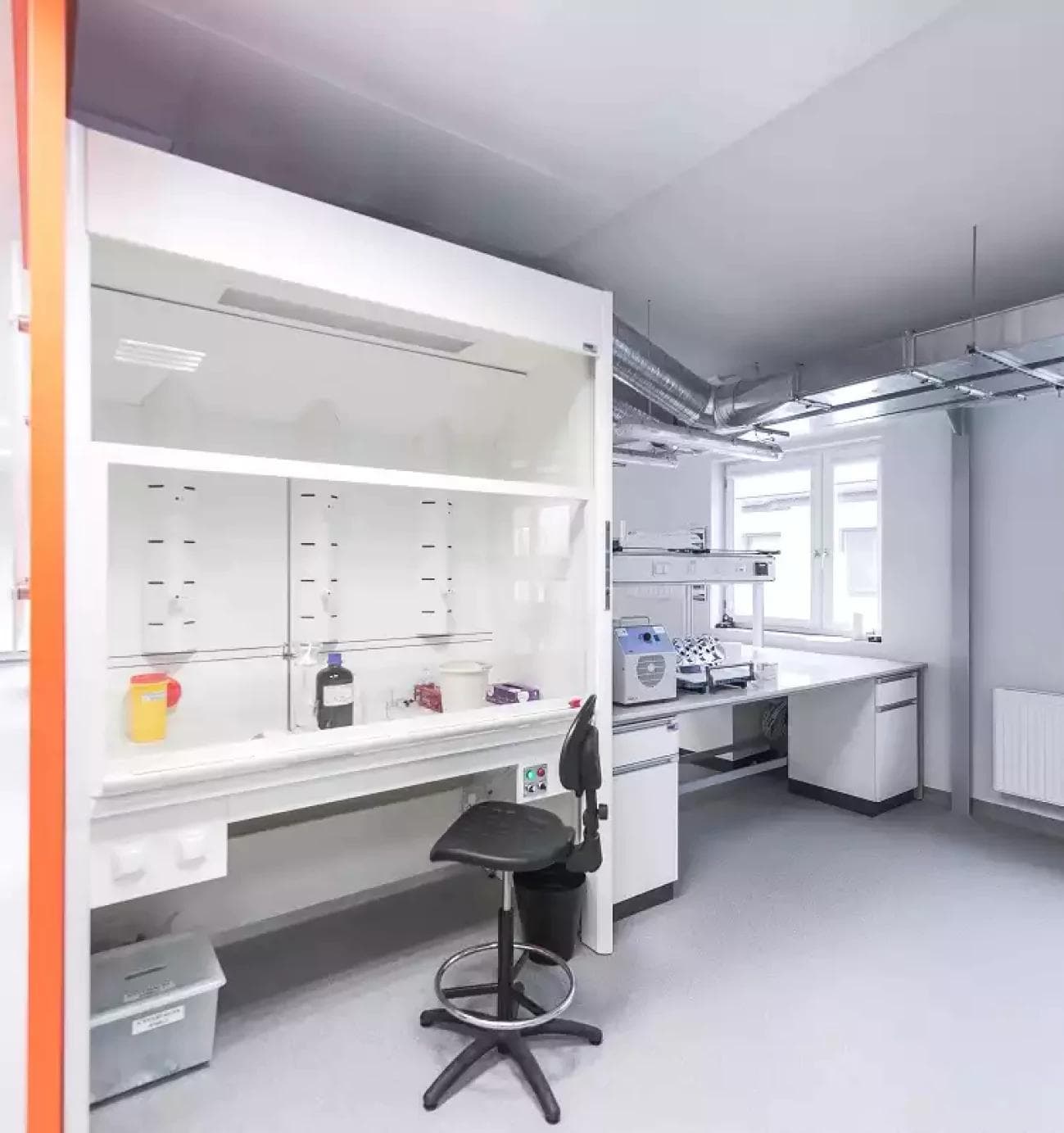
A laboratory dryer is a device used in laboratories for the controlled removal of moisture from samples at a strictly controlled temperature, and in some cases also under reduced pressure or in an inert atmosphere. It enables fast, repeatable and safe drying of materials used in chemical, biological, pharmaceutical and industrial analyses, ensuring that they are properly prepared for further research or technological processes.
What is a laboratory dryer?
A laboratory dryer is a basic device used in laboratories, classified as laboratory apparatus and thermostatic devices, used for drying samples, sterilizing them and conducting thermal processes requiring controlled temperature conditions. It is an important element of modern laboratory equipment and comprehensive laboratory equipment, where precision and repeatability of processes are crucial. "In such spaces, laboratory fume hoods are also very often used, which ensure the safety of working with chemicals.
Inside the device there is a drying chamber, which is usually made of high-quality stainless steel, which ensures its resistance to corrosion, high temperatures and chemicals. This allows the dryers to operate in demanding laboratory conditions for a long time, while maintaining stability and safety of use.
Modern devices of this type usually operate in a wide range of temperatures – from about +5°C to even +300°C – which allows them to be used in many test procedures. Precise control of conditions is provided by an electronic PID controller, which works together with an accurate PT100 sensor, which enables very precise measurement and maintenance of the set temperature, which is crucial for the quality of laboratory processes.
What are the types of laboratory dryers?
Different types of equipment are used in laboratories, and a laboratory dryer can operate based on different air circulation and operating conditions, which affects its application and the efficiency of the drying process.
Convection dryer - works on the principle of natural convection, i.e. it uses gravitational air circulation and natural air circulation inside the chamber. Warm air rises upwards and cooler air falls, allowing samples to dry slowly but safely. This type of device uses natural convection and works well for materials that are insensitive to a longer process time.
Forced air circulation dryer - uses mechanical air circulation and forced air circulation carried out by a fan. As a result, forced convection ensures that the temperature is evenly distributed in the chamber and significantly reduces the drying time. Stable air circulation minimizes temperature differences between samples.
Vacuum dryer - works under reduced pressure conditions in a sealed vacuum chamber, usually supported by a vacuum pump. By reducing the pressure, the water evaporates at a lower temperature, which protects the samples from processes such as oxidation and thermal degradation. This is ideal for temperature-sensitive materials.
Spray dryer - used to convert solutions into powders by rapidly evaporating the solvent in a stream of hot air. It enables the production of fine, homogeneous particles.
Freeze-drying (sublimation drying) - uses the process of freeze-drying, i.e. sublimation drying, which consists in removing water by sublimation of ice under vacuum conditions. This allows you to preserve the structure and properties of the material.
Pharmacy dryer - a specialized device used in pharmacy, where high process cleanliness and precise control of drying conditions for medicinal substances and preparations are required.
Each of these types of laboratory dryers has been designed with different process requirements in mind, so their selection depends primarily on the type of material, its sensitivity and the expected final effect of drying.
What are the applications of laboratory dryers?
Laboratory dryers are widely used in industries such as chemistry, pharmacy, biology, medicine and the food industry, both in chemical, biological, pharmaceutical and microbiological laboratories. They are used in sample drying processes, sterilization and other thermal processes necessary for research and production. In modern laboratories, there are also often complete fume hood sets, supporting safe work with reagents.
One of the primary uses is to dry laboratory glassware after washing to ensure that it is clean before analyses and to avoid contamination of samples. These devices also act as a dry air sterilizer, enabling dry hot air sterilization, i.e. the elimination of bacteria, microorganisms and mold from tools and glass.
In addition, dryers are used to evaporate solvents, as well as in processes such as quenching and annealing, which allow to modify the properties of materials in the field of materials science.
How to choose the right model of laboratory dryer?
When choosing a laboratory dryer , it is worth starting with the basics, i.e. with what you will actually dry in it. The temperature range, the required chamber volume and the nature of the charge are crucial – different conditions will work for delicate biological samples and different conditions for glasses or materials resistant to high temperatures. It is these factors that most affect the stability and quality of the entire drying process.
Occupational safety (OHS) is also a very important aspect. A good dryer should have effective protection against overheating, preferably in the form of independent protection systems that protect both the device and the load inside it. This is especially important when working for long periods of time or working without constant supervision.
In everyday use, work ergonomics also matter. Therefore, laboratory workstations are often based on chemically resistant laboratory worktops, which provide stable and safe working conditions.A well-thought-out laboratory design, easy access to the interior and adjustable shelves, often in the formof shelves made of perforated sheet metal, make the device much easier to operate and clean. This simply makes working in the laboratory more convenient and faster.
Energy efficiency is also becoming increasingly important – modern appliances consume less energy, which reduces operating costs and reduces environmental impact. It is also worth paying attention to the programmable controller, which allows you to set and save drying parameters, so that the process can run automatically and repeatably.
What technical parameters should be taken into account?
When choosing a laboratory dryer, it is worth focusing primarily on its technical parameters, as they determine the quality and repeatability of the device's operation. The most important thing is the temperature range, which should be adjusted to the type of research being carried out – different values will be needed in simple glass drying and different values in more demanding processes.
Temperature stability and overall temperature control throughout the work chamber are also crucial. Good control precision and high precision temperature control allow constant conditions to be maintained throughout the drying process, which has a direct impact on the reliability of the results. Temperature uniformity, i.e. even temperature distribution throughoutthe chamber – without hot and cold zones, is also important.
An important parameter is alsothe capacity of the chamber, which should be selected according to the size and number of samples. A chamber that is too small will limit the efficiency of work, while too large can generate unnecessary energy consumption and prolong the stabilization of conditions.
Modern devices also offer additional features such as humidity control, advanced air filtration systems and microprocessor controls, which increase precision and comfort of work. It is also increasingly possible to connect the dryer to a PC, which allows for archiving and analysis of measurement data and better control of the entire process.
How does the validation and qualification of the device work?
The validation and qualification process of laboratory equipment is crucial to confirm that the equipment is operating as required and provides reliable test results. For equipment such as laboratory dryers, it includes several stages referred to as DQ/IQ/OQ/PQ Qualification.
At the beginning, DQ (Design Qualification) is carried out, i.e. a design qualification, in which it is checked whether the device has been designed in accordance with the user's requirements and laboratory standards. This is followed by an IQ (Installation Qualification) – an installation qualification that confirms the correct installation of the equipment in the workplace.
The next stage is OQ (Operational Qualification), during which the operation of the device is tested in various operating conditions. The last step is PQ (Performance Qualification) – a process qualification that verifies whether the device actually meets the requirements in real laboratory processes and ensures the appropriate quality of work within quality control.
The entire validation processdocuments the compliance of the equipment with the technical specifications, user requirements and applicable standards and quality certificates. Standards such as DIN 12880 and ISO 17025 are particularly important, as they guarantee high quality and reliability of test results in accordance with the principles of Good Laboratory Practice (DPL).
An important part of the device's life cycle is also its maintenance, including both warranty and post-warranty service, which allows you to keep the equipment in full working order and compliance with quality requirements throughout its lifetime.
May 03, 2026