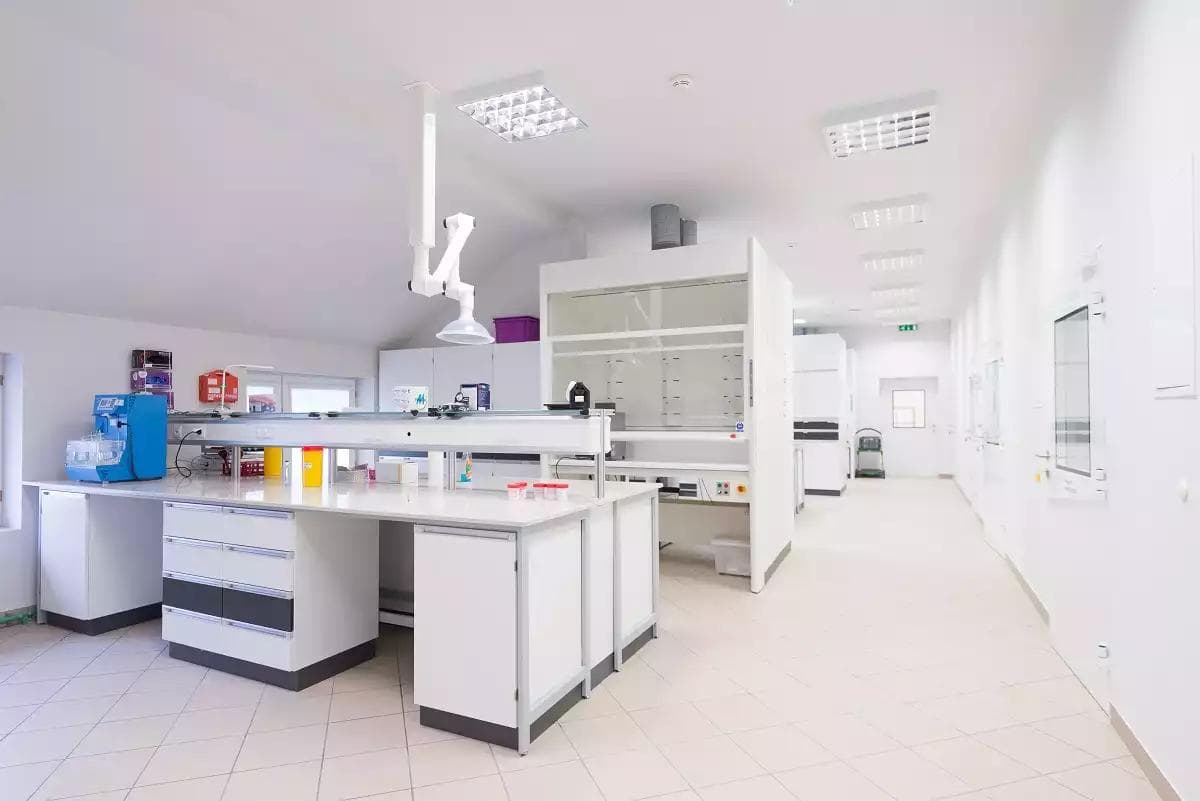
In the laboratory, not every ventilation system works the same – and choosing the wrong one can have a real impact on occupational safety. A laboratory extractor is a broad term that includes various solutions: from fume hoods, through hoods, to extraction arms. Each of them has a different use and level of protection.
The most important difference concerns what exactly we want to protect. A fume hood primarily protects the worker from harmful fumes and chemicals, while other forms of extractor are often only used to remove heat or odors. In practice, this means that the choice between them should not be random, but tailored to the type of laboratory work and the level of risk.
What is the difference between a laboratory extractor and a professional fume hood?
Simply put, a laboratory extractor is a general concept, and a fume hood is its most advanced and safe form. The category of extractors includes various devices, such asa laboratory extractor hood or a simple chemical extractor, which are mainly used to remove fumes, heat or odors.
When answering the question of what a fume hood is, it should be pointed out that it is a specialized, closed exhaust cabinet designed to work with hazardous substances. It has a sealed working chamber and a movable front window (the so-called working window), which is a physical barrier between the user and chemical fumes. It is this design that ensures real protection of personnel and a high levelof health and safety.
In practice, a simple chemical extractor or laboratory hood does not guarantee full insulation and does not meet such stringent safety standards as fume hoods. Therefore, in places where you work with toxins, volatile compounds or corrosive substances, the fume hood is the basis of work safety.
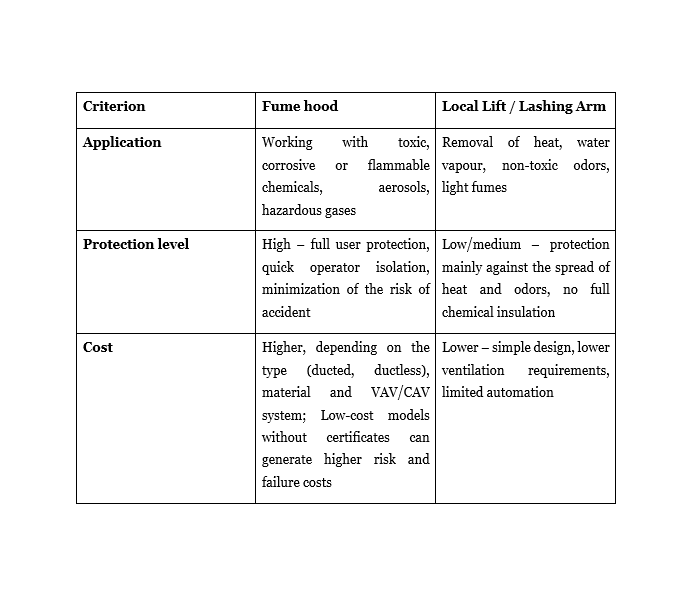
To help you decide which device is the right one, the table below compares the fume hood and the local extractor hood in terms of application, protection level and operating costs.
What to check before buying:
- Type of chemicals used in the laboratory: acids, bases, toxic substances, volatile solvents.
- Availability of a ventilation system in the building: ventilation ducts for duct fume hoods or the possibility of installing filters in recirculation fume hoods.
- Health and safety and user protection requirements – whether the fume hood has a front glass and a working chamber that ensures full insulation.
- Type of fume hood: ducted, ductless or mobile depending on the flexibility of operation.
- The performance of HEPA/carbon filters for ductless fume hoods and their replacement period.
- Possibility of connecting additional media: gas and water systems, media panel and reagent cabinets.
- Certificates and standards: PN-EN 14175, CE, hygienic attestation of the National Institute of Hygiene, possible ATEX directive when working with flammable substances.
Fume hood and laminar flow chamber – what provides better protection?
This is one of the most common misconceptions in laboratories – and at the same time potentially very dangerous. A fume hood and a laminar flow chamber have completely different functions and should not be used interchangeably.
The key difference concerns the so-called direction of protection. The fume hood provides user protection – it removes harmful fumes, aerosols and dusts, protecting the operator from contact with hazardous substances. It is essential equipment wherever there is a risk of working with toxins.
A laminar flow chamber, on the other hand,works in the opposite way – its task is to protect the sample. It produces a sterile airflow that prevents contamination of the test material from the environment. Therefore, it is mainly used in the biological laboratory or analytical laboratory, where cleanliness and sterility are key, not the neutralization of chemical vapors.
It is worth emphasizing: using a laminar flow chamber instead of a fume hood when working with toxic substances is a serious mistake. The device does not protect the operator, and can even direct hazardous substances towards him.
Therefore, you should always carry out a risk analysis before choosing equipment– if chemicals are a hazard, the choice is simple: you need a fume hood.
How to choose between a ducted and ductless fume hood?
The choice between ducted and ductless fume hoods depends primarily on the infrastructure of the building and the type of laboratory work. Ready-made fume hood sets are also available, which facilitate quick installation and adaptation to the needs of the laboratory.
A duct fume hood is connected to the building's installation and uses mechanical ventilation and exhaust ventilation to remove polluted air to the outside. This is the most classic and very effective solution, especially in the case of intensive work with chemicals. However, it requires access to an efficient ventilation system, which can mean higher installation costs.
On the other hand, a ductless fume hood (i.e. a recirculating fume hood) does not require connection to ventilation. It works on the basis of air recirculation – it sucks in vapors, purifies them and returns them to the room. Carbon filters (removing chemical compounds) and HEPA filters (capturing particulate matter) play a key role here. However, it should be remembered that their effectiveness depends on regular replacement and adjustment to the type of substance.
This solution is perfect for places where it is not possible to install ventilation ducts – e.g. in temporary laboratories, educational laboratories or asa school fume hood, which can be easily moved and adapted to current needs.
In practice:
- if you have access to an efficient installation – choose a duct fume hood,
- If you operate in a limited space or without infrastructure – a ductless fume hood will be more flexible.
The most important thing is to adjust the solution to real working conditions – it is the one that determines the safety and effectiveness of protection.
When is it worth using a local extractor and extraction arm?
A local extractor is a solution designed to remove lighter contaminants – such as heat, water vapor or non-toxic odors. In practice, it acts as a mechanical exhaust that collects air directly from above the workstation and discharges it to the ventilation system.
Even more flexibility is providedby the extraction arm. They can be positioned exactly where dirt is generated, which works well for spot work. However, it should be remembered that such a solution does not provide full insulation – unlike a fume hood, it does not protect the operator from direct contact with fumes.
Therefore, the local extractor and extraction arms are mainly used in situations where there are no toxic gases or highly harmful fumes. They work well, for example, for:
- simple laboratory processes,
- soldering,
- work generating heat or steam,
- removal of technological odours.
In practice, this is a good auxiliary solution – but if there is a risk of contact with hazardous substances, a local extractor hood will not replace a fume hood and should not be treated as an alternative.
How to match the material of the table top and chamber to work with aggressive chemicals?
The selection of materials in the laboratory is not a detail – it is a key element of safety. The chemical-resistant worktop and work chamber must be matched to the type of substances used, such as acids, bases or solvents. It is chemical resistance thatdetermines the durability of equipment and work safety.
For the most versatile applications, technical ceramics (e.g. monolithic ceramics) work great. It is resistant to high temperatures, most chemical reagents and mechanical damage, which is why it is often a standard in demanding laboratories.
However, if you work with extremely aggressive substances, such as hydrofluoric acid, it is necessary to use polypropylene. This material is resistant to highly corrosive substances that could damage other surfaces.
Many laboratories also use stainless steel or acid-resistant steel – especially where durability and ease of cleaning are important. An alternative is countertops made of composite materials such as epoxy or phenolic resin, which cope well with daily contact with chemicals and are easy to clean. HPL laminate is also found in less demanding applications, although its chemical resistance is lower.
The most important rule is simple: the material must be matched to specific chemical reagents, not the other way around. It is this choice that determines the durability of equipment and the safety of work in the laboratory.
How do VAV and CAV systems affect the safety and cost of ventilation?
In modern laboratories, the way ventilation is controlled has a huge impact on both safety and operating costs. The key difference is how airflow works.
The CAV (Constant Air Volume) system maintains a constant airflow regardless of whether the fume hood is open or closed. This means stable working conditions, but also higher energy consumption – the ventilation works at full capacity at all times.
A VAV (Variable Air Volume) system, on the other hand , adjusts the airflow to the current situation, e.g. the degree of opening of the work window. When the glass is closed, the flow decreases, which significantly improves energy efficiency. At the same time, the system takes care of maintaining the appropriate front speed, which is a key parameter responsible for user safety and effective maintenance of vacuum in the chamber.
Modern fume hoods equipped with an air flow sensor and an air flow monitoring system monitor the operating conditions on an ongoing basis. This information is presented on a control panel that allows the user to react quickly in the event of a decrease in ventilation efficiency.
In practice, this means that:
- CAV = simpler solution, but higher operating costs,
- VAV = more control, lower energy consumption and a higher level of safety.
That is why VAV systems that combine work safety with real savings are increasingly chosen in modern laboratories.
What standards and certificates (PN-EN 14175) should I pay attention to?
When choosing a fume hood, you cannot be guided only by the price or appearance – standards and certificates that realistically confirm the level of safety are crucial. In Europe, the basis is the PN-EN 14175 standard, which defines the requirements for laboratory fume hoods.
This standard covers several key areas: device design, airflow parameters, and testing methods. In practice, this means that a certified fume hood must undergo, among m.in, leakage tests, tests of the effectiveness of fume extraction and verification of the stability of working conditions. Thanks to this, the user can be sure that the device actually protects against harmful substances.
An important element is alsothe CE certificate, which confirms compliance with European safety requirements. When working with flammable substances or in potentially explosive areas, itmay be necessary to use ATEX-compliant devices– i.e. special solutions such as an explosion-proof fume hood.
An additional confirmation of quality and safety isthe PZH Hygienic Certificate, which is particularly important in medical and pharmaceutical laboratories. Modern fume hoods also use safety systems, such as optical and audible alarms, which inform about a decrease in ventilation efficiency or incorrect operating conditions.
In practice: the more confirmed standards and certificates, the greater the certainty that the fume hood not only meets the formal requirements, but above all really protects the user.
How much does a fume hood cost and what does the final price depend on?
The price of a fume hood in a laboratory depends on many factors – it is not only a matter of the type of device, but also its materials, equipment and ventilation system. The basic division includes countertop (table) fume hoods, free-standing fume hoods and large walk-ins, which allow you to work inside the entire chamber. Each type has a different starting price: countertop ones are usually the cheapest, while walk-ins – due to their size and complex design – are among the more expensive solutions.
The material of the chamber and table top has a huge impact on the final cost. Chambers made of stainless steel, acid-resistant steel or polypropylene increase durability and chemical resistance, while chemical-resistant tops made of technical ceramics or epoxy resins increase resistance to aggressive substances.
Another factor is ventilation automation. The VAV (Variable Air Volume) systemallows you to save energy and maintain the optimal airflow speed, but it is more expensive to purchase than traditional CAV (Constant Air Volume). In the case of ducted fume hoods, the energy costs associated with continuous air discharge must also be taken into account, while ductless fume hoods generate operating costs mainly by replacing HEPA and carbon filters.
Additional equipment such as undercounter cabinets, fireproof cabinets, ceramic beakers, media panel or connections to gas and water systems also affect the price. In practice, the purchase of a fume hood involves an investment not only in the device itself, but also in full laboratory equipment and integration with laboratory furniture and a ventilation system.
It is worth remembering that cheap fume hoods without certificates and appropriate equipment can generate higher costs of risk and possible failures, so the choice should take into account both safety and long-term operating costs.
In practice, the purchase of a fume hood involves an investment not only in the device itself, but also in full laboratory equipment and integration with laboratory furniture, ventilation system and medical furniture.
March 19, 2026