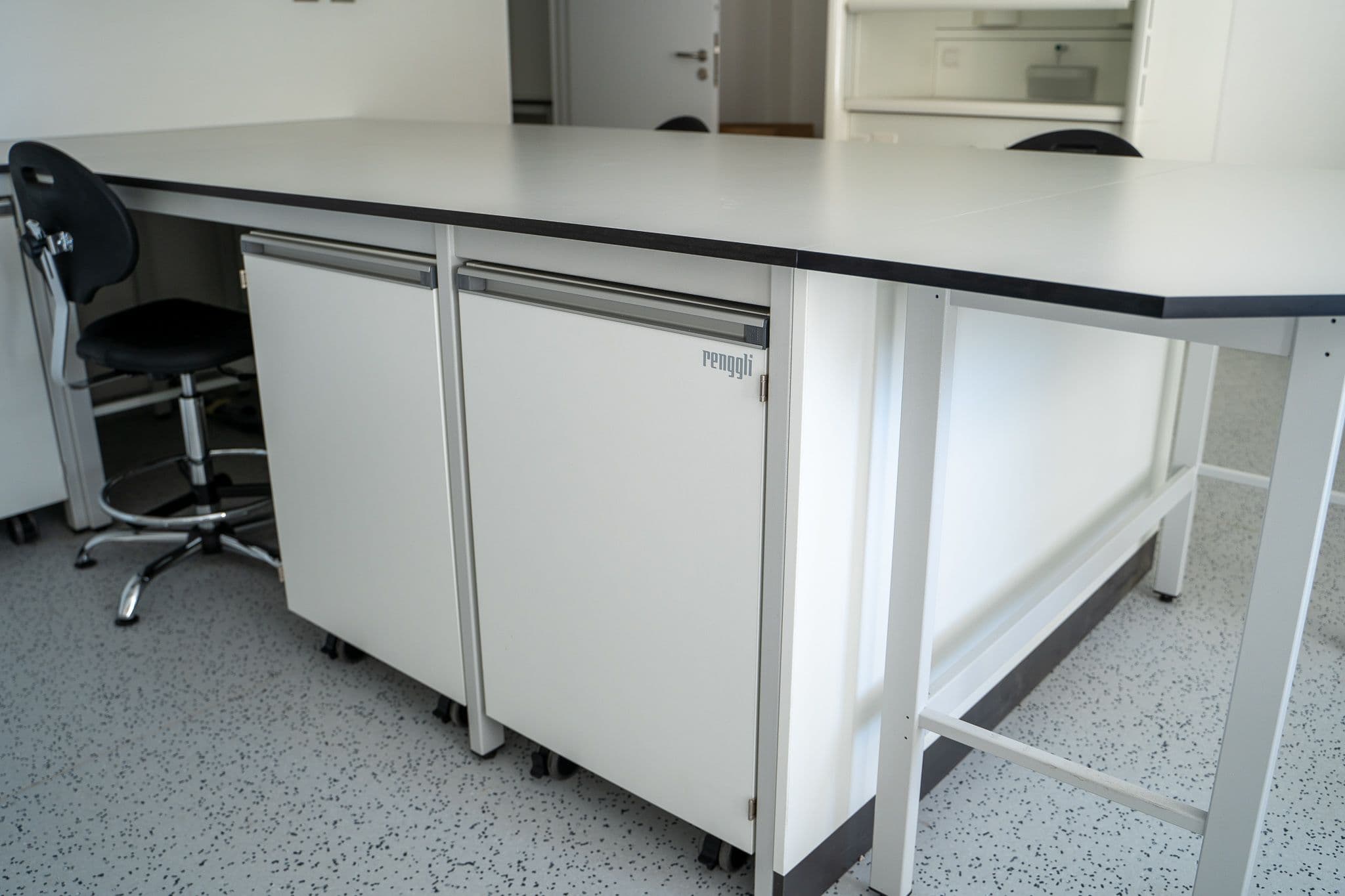
A laboratory freezer is a specialized refrigeration device that requires proper preparation of space and infrastructure so that it can work stably and without failure. The installation of freezing equipment requires a 15 cm ventilation clearance, a ceiling load capacity of 400–600 kg/m² and a dedicated 230V/50Hz power supply. Precisely selected ambient conditions (optimally +20°C to +25°C) reduce the heat load on the HVAC system. Renggli Polska's engineering guidelines allow laboratories to be designed flawlessly, eliminating the risk of failure.
What is a laboratory freezer and its thermal stability
A laboratory freezer is a medical device that guarantees continuous thermal stability in the required ambient temperature range from +15°C to +32°C.
A laboratory freezer is a critical component of laboratory infrastructure, acting asa research freezer with active temperature control. Its task is to safely store biological and chemical materials in stable conditions, regardless of changes in the environment. The standard operating temperature range includes approximately -20°C for routine reagents and up to -80°C for genetic material such as DNA and RNA.
In the ULT (Ultra Low Temperature) versions, the units operate in the range from -80°C to -150°C, which requires efficient cooling systems and stable installation conditions. It is crucial to maintain a constant temperature, as even small fluctuations can affect the degradation of samples, which is why wireless temperature monitoring and control of operating parameters are used, among m.in other things. Design practice also takes into account guidelines referred to as installation requirements for a laboratory freezer, covering the power supply and environmental conditions of the device.
FDA Recommended Temperature vs Lab Freezer
The FDA determines the storage requirements for biological material depending on its type and sensitivity. For deep-frozen plasma, a temperature below -18°C is recommended, while for cells and genetic material, the standard is -80°C, which ensures the long-term stability of biological structures. These guidelines are often the basis for the design of procedures in laboratories that operate in accordance with Good Laboratory Practices (GLP).
The difference between -20°C and -80°C storage is mainly due to the level of risk of sample degradation and audit requirements. Temperatures of around -20°C are sufficient for short-term storage of reagents, while -80°C is used where long-term storage of biological material is required without loss of activity. In practice, the selection of the device must comply with the test protocols and requirements of the FDA.
A key element of compliance is also full temperature documentation and the IQ/OQ/PQ validation process, which confirms the correct installation, operation and repeatability of the laboratory freezer operating conditions. This allows the device to be used in regulated and audited environments.
Laboratory architecture and spatial requirements and ground bearing capacity
ULT devices such as the vertical cabinet freezer and the chest freezer require proper planning already at the design stage. A ceiling load capacity of 400-600 kg/m² is crucial, as the total weight of the sample device can put a significant strain on the building structure. Installation spacing is also necessary: 15 cm from the walls and approx. 30 cm from the ceiling to ensure proper ventilation and operation of the cooling system.
Design practice takes into account ergonomics of setup and service access, especially in areas such as biobank equipment, where quick access to samples and safe operation of equipment are important. Freezers are also increasingly integrated withthe Building Management System (BMS), which allows for constant monitoring of work and alarms.
The installation also uses an access port (grommet) to guide sensors and a potential-free alarm contact, which transmits signals about the status of the device to the surveillance system.
Electrical Infrastructure and Backup Power of Laboratory Freezer
Safe operation of a laboratory freezer requires a stable 230V/50Hz power supply in the form of a dedicated electrical circuit protected by a B16 circuit breaker, which minimizes the risk of overloads and compressor disruptions. It is also crucial to take into account the high inrush current, which can exceed the nominal values several times at the time of starting the compressor.
UPS systems are used to ensure continuity of operation, but they must be selected for their ability to handle momentary load spikes. In practice, online UPS with adequate power reserve or hybrid solutions that work with a generator are often used. Some installations also use a CO2/LN2 backup system, which acts as emergency cooling in the event of prolonged power outages.
An alternative to a UPS is a generator that ensures long-term maintenance of the entire laboratory infrastructure, especially in facilities with a high level of criticality of stored samples.
Thermal Management: Freezer Cooling Systems vs. HVAC Heat Balance
Laboratory freezers generate significant amounts of heat that must be received by the building's HVAC system. The devices use two main solutions: air cooling and water cooling using a heat exchanger. In the air version, heat is released directly into the room by a condenser, which increases the load on the air conditioning. In water systems wherea water-cooled condenser operates, thermal energy is dissipated outside the laboratory space, which significantly improves the energy balance and reduces operating costs in terms of Total Cost of Ownership (TCO).
Assuming a typical heat emission of 700-1000 W for a single freezer of -86°C, in a laboratory with 10 devices, the total heat load is about 7-10 kW. Such an energy flow must be taken into account when selecting the capacity of a central air conditioner, as it directly affects the stability of the working conditions in the room. In practice, the difference between air and water cooling may determine the need to expand or optimize the HVAC system.
Laboratory freezer vs medical equipment: differences in ranges
Medical equipment, such as laboratory refrigerators for vaccines, usually operate in the range of +2°C to +8°C, where the stability of biologics intended for short-term storage is maintained. In the rangeof -20°C and -40°C, freezers are used for medium-sensitivity materials, such as some vector vaccines or biological raw materials, which require several years of stability.
In the case of the ULT -86°C freezer, we are dealing with biobank equipment, designed for long-term storage of DNA, RNA, cells and plasmids, where the stability can exceed 10 years. Such devices often use a double cascade compressor, and in the most advanced systems, cryogenics based on liquid nitrogen can be used to reach temperatures as low as -196°C.
Typical applications in temperature division:
- +2°C to +8°C (medical refrigerators) – vaccines, biologics, short-term storage
- -20°C to -40°C (medium-freeze freezers) – vector vaccines, biological materials, medium-term stabilization
- -80°C to -150°C (ULT deep freeze freezers) – DNA, RNA, cells, plasmids, long-term biobanks
Froma Comparison (Frame) perspective,pharmaceutical medical equipment is designed primarily for the routine storage of drugs and vaccines, while ULT freezers act as biobanking infrastructure, where maximum stability and repeatability of conditions is key.
What is the temperature work range for a laboratory freezer
The standard temperature range forlaboratory freezers depends on their class and purpose. Refrigeration equipment typically operates in the +2°C to +8°C range, while low-temperature freezers cover levels of around -20°C to -40°C, which is sufficient to store routine reagents and biological material parts.
In the case of ULT (ultra-low temperature) devices, the operating range is usually from -80°C to -150°C, which allows long-term storage of DNA, RNA and cells. The -86°C thresholdis crucial as it provides a benchmark for biobanks, but at the same time it significantly increases energy consumption and requires more advanced cooling systems and a stable electrical system.
In practice, the classification of devices includes:
- refrigerated freezers (+2°C to +8°C) – short-term storage of reagents
- low-temperature freezers (-20°C to -40°C) – routine biological materials
- ULT freezers (-80°C to -150°C) – biobanks and long-term archiving of samples
- cryogenic systems (< -150°C, up to -196°C) – storage in liquid nitrogen
Each of these levels requires different certification and validation of operating parameters, especially in the context of temperature stability and compliance with laboratory procedures.
Ventilation errors in design for laboratory freezer
Ignoring the requirement of a 15 cm gap from the wall disrupts the laminar flow around the unit and blocks the free flow of heat from the radiator, leading to overheating of the system and shortening the life of the compressor. The most common mistake is furniture construction without maintaining a service corridor, which forces hot air to recirculate and causes it to be sucked in by the condenser.
In the implementation analyses (m.in. photographic documentation of Rengli systems), the difference between correct and incorrect installation of ventilation grilles is clearly visible – in incorrect installations, the hot air stream "returns" to the device. In practice, this leads to overloading of the refrigeration system and unstable operation of the entire laboratory freezer, especially in tight spaces without adequate service space.
Laboratory freezer and building standards and safety certificates
Equipment such as laboratory freezer cabinet and laboratory freezing equipment must meet safety standards, m.in. IEC 61010-2-011 and DIN 58345, which specify the technical and operational requirements for refrigeration equipment in laboratories.
In the area of quality and control, ISO/IEC 17025, EN 12830 (temperature recording) and ISO 15189 are crucial, requiring full validation of devices in IQ, OQ and PQ processesand documented repeatability of measurements in audits.
In addition, the F-Gas Directive is in force, which forces the use of more environmentally friendly refrigerants, and in modern constructions, VIP (Vacuum Insulation Panel) insulation is increasingly usedto reduce energy losses and meet efficiency requirements.
Backup time and emergency operation of the laboratory freezer
In the event of a power failure, the hold-over time, which is the period during which the device maintains temperature without active cooling, plays a key role. Thanks to the use of VIP (Vacuum Insulation Panel) insulation, the freezers can keep the temperature below -60°C for up to several hours, which protects the samples from degradation. In practice, this time depends on the load on the chamber and the environmental conditions.
Biobank crisis procedures use rapid switching to emergency power sources and systems such as the CO2/LN2 backup system, which act as a cooling buffer in the event of a loss of 230V power supply. In modern installations, temperature drops are also monitored on hourly cycles to control the reaction of the insulation during a blackout.
Main causes of laboratory freezer failure and overload
The most common cause of failure is improper room infrastructure, especially the lack of effective ventilation and too high an ambient temperature above +32°C, which leads to overloading of the refrigeration system and, in extreme cases, compressor failure. The starting current of the compressor plays a key role here, which, if installed incorrectly, can cause voltage drops and problems with the power phase.
In designs with cascade compressors (two-stage discharge system), the system is particularly sensitive to unstable overcurrent protection and the absence of a UPS, which can lead to damage to the control electronics. In addition, an incorrect calculation of the thermal balance of the room results in overheating of the seals and accelerated degradation of the entire cooling system.
FAQ
1. What are the differences between a cabinet freezer and a chest freezer in terms of sample stability?
Chest doors are better at maintaining the temperature when opening, while cabinet doors provide more convenient access. In box doors, cold air does not escape when the flap is opened, while in cabinet compartments, internal partitions and insulated doors are used. The choice depends on the intensity of the work and the rotation of the samples.
2. How to store RNA correctly to avoid degradation?
RNA requires constant conditions of -80°C and thawing limitation. It is crucial to avoid door zones and use rack systems and 2D markings that reduce the time it takes to access samples.
3. What is the difference between a refrigerated incubator and a laboratory freezer?
The incubator works at positive temperatures and is used for breeding, and the freezer for freezing. Incubators often operate in the range of +4°C to +50°C and use more stable, gentle cooling systems than ULT freezers.
4. What emergency systems protect samples in the event of a power outage?
The best protection is provided by a UPS connected to a CO2 or LN2 system. When the temperature rises, the system automatically introduces the refrigerant, which allows you to maintain the conditions for up to several dozen hours.
5. Why is ULT freezer maintenance crucial?
Lack of cleaning and worn gaskets increase energy consumption and the risk of failure. A contaminated condenser and a leaky door cause the compressor to run continuously and overheat.
May 26, 2026