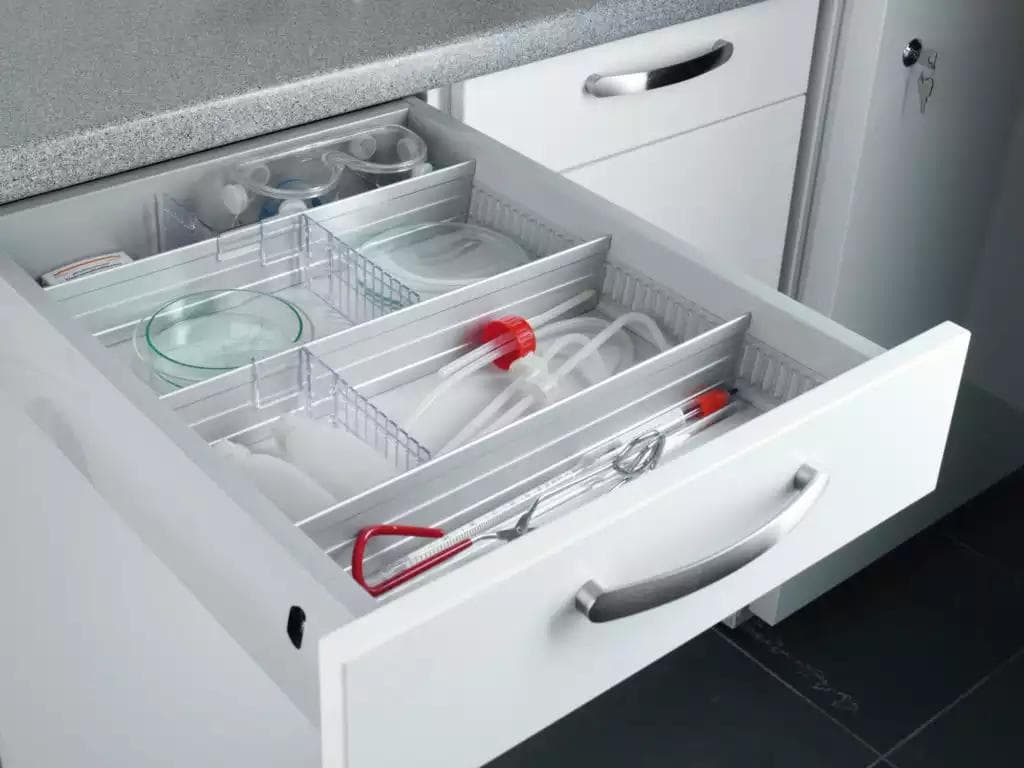
Laboratory glassware is a basic element of equipment in every laboratory, used both in simple analyses and advanced chemical or biological research. It differs in properties, resistance and precision of workmanship, so its selection has a direct impact on the reliability of results and work safety.
What are the physicochemical properties of laboratory glassware?
Laboratory glassware must combine several key features that determine its safety and reliability at work. One of the most important is resistance to thermal shocks, i.e. the ability to withstand sudden changes in temperature without breaking. This is directly related to the low coefficient of thermal expansion, which reduces the stresses that arise in the glass structure during heating and cooling.
The second important parameter is chemical resistance, which includes the action of acids, bases and solvents. High chemical stability ensures that the glass does not react with the test substances, which protects the analysis results from contamination. In practice, hydrolytic resistance, i.e. resistance to water and the processes of washing components out of the glass structure, is also of great importance.
Another important feature is mechanical strength, which determines resistance to impact, pressure and damage during daily laboratory work. Optical transparency is equally important, allowing for the observation of chemical reactions and precise readings of measurements.
The properties of glass also depend on its thermal structure, including parameters such as softening point and stress relief point, which determine the behavior of the material during manufacturing processes and heat treatment. Thanks to these features, laboratory glassware can be safely subjected to processes such as autoclave sterilization, without the risk of loss of properties.
In practice, all these parameters are verified through strength tests, which confirm that the glass meets the requirements of work in laboratory conditions and can be safely used in autoclave and other procedures requiring high material resistance.
What materials are used to make laboratory glassware?
Laboratory glassware is mainly made from a mixture of silica (SiO₂ silicon oxide) and additives such as sodium oxide, potassium oxide and calcium oxide, which are derived from raw materials such as quartz sand, soda ash and limestone, among m.in other things.
The most important types are:
- Borosilicate glass (e.g. 3.3, Pyrex, Duran, Jenai glass, Supremax) – resistant to temperature and chemicals
- Quartz glass – very resistant to high temperatures (above 1000°C) and UV radiation
- Sodium-calcium glass – cheaper, used in auxiliary equipment
There are also specialized lenses:
- Neutral glass – chemically resistant
- Amber glass – protects against light and UV
- Potassium glass – increased thermal resistance
- Lead glass – better optical properties
- Safety glass – resistant to shattering
- Optical glass – for precise measurements
- Electrotechnical glass – insulated
In practice, all these materials are based on a properly modified structure of silicates: sodium silicate and potassium silicate, which allows the glass to be adapted to specific laboratory applications.
What are the uses of individual glassware in the laboratory?
In the laboratory, various glassware have specific functions – from simple mixing of substances to advanced chemical and biological processes.
Basic dishes
- Beakers – for mixing, heating and pre-reactions
- Conical flasks (Erlenmeyer) – for mixing solutions without the risk of splashing, often with magnetic stirrers
- Test tubes – for small-scale reactions and tests
Breeding and crystallization
- Petri dishes – for microbial culture and biological research
- Crystallizers – for crystallization and evaporation of solutions
Specialized equipment
- Kippa apparatus – for the production of gases in chemical reactions
- Suction flasks (Büchner) – for reduced pressure seeping and filtration
- Laboratory coolers / Liebig coolers – for distillation and vapor liquefaction
- Exizators – for storing substances in a dry environment
Other accessories
- Reagent bottles – for storing chemicals
- Distribution funnels / manifolds – for separating immiscible liquids
- Evaporators – for evaporating solvents
- Glass baguettes – for hand mixing
- Weighing vessels – for precise weighing
- Basic, cover and watch lenses – for biological analysis and microscopic work
- Crucibles and round-bottom flasks – for heating and high-temperature reaction
Such glass is used both in chemistry and biology (e.g. cell cultures, electron microscopy, or work with laboratory centrifuges).
How is measuring glass used in quantitative analysis?
In quantitative analysis , measuring glass is an essential tool for precise solution preparation and volume measurements, which directly affects the accuracy of the results.
The most important role isplayed by measuring flasks, which are used to prepare solutions with a strictly defined concentration, including standard solutions and nominal solutions. Measuring pipettes, pasteurization pipettes and automatic pipettes are used to transfer and measure liquids, which allow for high repeatability of measurements. Burettes, on the other hand,are mainly used in titration, where the titrant reacting with the analyte is precisely dosed.
Less accurate, but still useful in laboratory work, are measuring cylinders (scales), used for approximate measurement of liquid volumes. In very precise physicochemical measurements, on the other hand, pycnometers are used to determine the density of substances.
A correct meniscus reading is also of great importance, because even a small error affects the final result of the analysis. More advanced methods of chemical analysis also use relationships such as the Lambert-Beer law, where standard curves are created based on the measurement of absorbance and transmittance.
In practice, the entire measuring glass is the foundation for precise measurements in analytical chemistry and is essential in any process that requires accurate dosing and preparation of solutions.
What is the difference between Class A and Class B measuring glass?
Class A measuring glass is the highest accuracy equipment for precise laboratory analysis. It is characterized by very tight error tolerances, high measurement precision and excellent repeatability of results. Each component often has an individual certificate of conformity and identification number, and its calibration is performed in accordance with stringent standards. In addition, glass of this class has a high-quality cut, which reduces volume loss and improves work accuracy.
Class B, on the other hand , is a glass with lower accuracy, allowing up to twicethe error tolerance. It is mainly intended for routine analyses, didactic classes and works in which the highest precision is not required. It still provides correct functionality, but its repeatability of results is lower than that of class A, and the calibration process is less stringent.
In practice, glass of both grades is used in various types of research – from advanced chemical and biochemical analyses, such as serological tests, ELISA (Enzyme-Linked Immunosorbent Assay) or agglutination and neutralization reactions of viruses, to simple educational experiences.
How do ISO and DIN standards regulate the quality of laboratory equipment?
ISO (International Organization for Standardization) and DIN (Deutsches Institut für Normung) standards set uniform quality requirements for laboratory equipment to ensure its repeatability and reliability of results. They regulate, m.in fact, fault tolerance, as well as the glass's resistance to temperature and chemicals.
For example, ISO 385 applies to burettes and specifies their requirements for the accuracy of liquid dispensing, which is crucial in titration processes. ISO 1042 regulates the parameters of measuring flasks, ensuring their high precision in the preparation of solutions. ISO 3585, on the other hand, refers to borosilicate 3.3 glass and defines its resistance to thermal and chemical stress, which is important when working in harsh laboratory conditions. DIN 12600, on the other hand , specifies the criteria for identifying and marking glass, facilitating its correct recognition and quality control.
Compliance with these standards directly affectsthe control procedures in laboratories, allowing the equipment to be regularly verified and compliant with technical requirements. This also makes it possibleto properly maintain the glass, which extends its lifespan and ensures operational safety.
In modern laboratories, compliance with standards is also supported by appropriate workspace equipment, such as laboratory furniture, as well as safety systems based on laboratory fume hoods and fume hood sets, which help to maintain controlled working conditions.
June 02, 2026