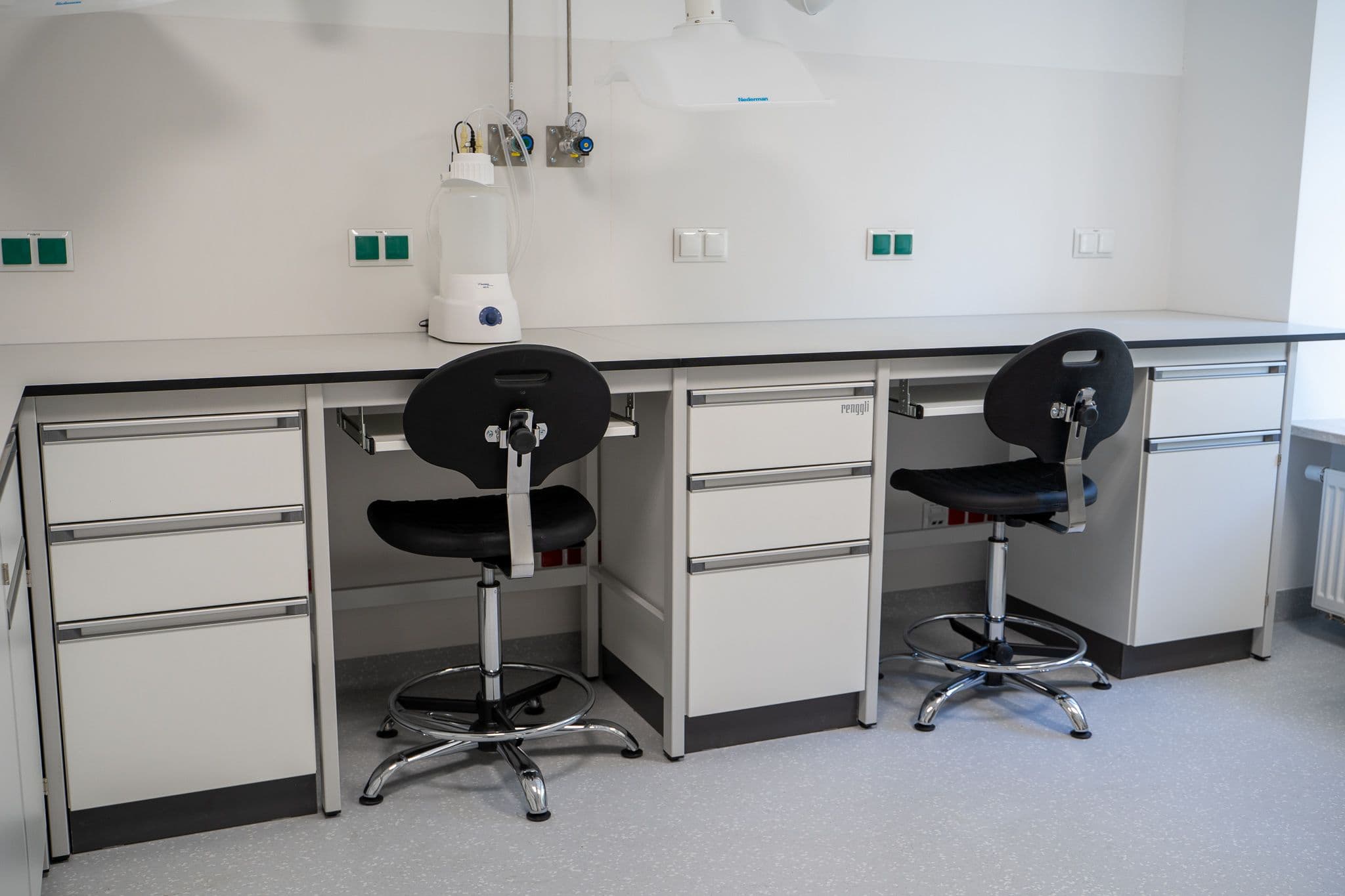
Microbiological and chemical laboratories differ primarily in the scope of work, biological risks, and equipment and safety requirements. In microbiology, aseptic conditions and control of microorganisms are crucial, while in chemistry, work with reagents, reactions and vapor emission dominate. Therefore, the equipment of the microbiological and chemical laboratory must be selected differently at the planning stage, i.e. duringthe design of the laboratory, also taking into account the appropriate laboratory furniture, laboratory chairs, laboratory worktops and – in the case of chemistry – laboratory fume hoods.
How does the equipment of a microbiological laboratory differ from a chemical one?
The equipment of a microbiology laboratory and a chemical laboratory differs primarily due to the type of hazards and the nature of the work. In microbiology, biosafety, sterility and protection of samples from contamination are crucial, while in chemistry, resistance to chemicals, chemical reagents and toxic fumes requiring effective exhaust ventilation is a priority.
The primary device in microbiology is the laminar flow chamber, which protects samples from microbial contamination and provides aseptic conditions. In a chemical laboratory, its functional equivalent is a fume hood, which protects the user from harmful fumes and enables safe work with reactive substances.
10 commonly used equipment in a chemical laboratory:
fume hood
Analytical Balances
borosilicate glass (flasks, beakers, cylinders)
Chemical Cabinets
Magnetic stirrers
Laboratory torches
Water baths
Automatic pipettes
pH meters
Laboratory centrifuges
Microbiology, on the other hand, is dominated by devices such as autoclaves, incubators or laminar flow chambers, and furniture must be adapted to frequent disinfection. In chemistry, on the other hand, the resistance of surfaces to aggressive chemicals and solvents is crucial.
In both types of laboratories, properly selected laboratory furniture is important, but their design and materials differ depending on the specifics of the work.
What are the standards and requirements in a microbiology laboratory?
In a microbiology laboratory, it is crucial to ensure the reliability of results and work safety, which is why accreditation in accordance with the ISO/IEC 17025 standard, which defines the requirements for the competence of testing and calibration laboratories, is the basis for operation. This standard includes, m.in, quality control, measurement consistency and assessment of measurement uncertainty.
An important element of the quality system is also Good Laboratory Practice (GLP), which regulates the organization of work, documentation and repeatability of tests. In practice, this means the use of Standard Operating Procedures (SOPs) and a rigorous approach to conducting microbiological analyses.
The laboratory must regularly calibrateand calibrate the apparatus, as well as validate and verify test methods using reference strains, which ensures the reproducibility and reliability of the results.
Health and safety requirements and the use of personal protective equipment (PPE) also play an important role, as they protect staff from biological agents and minimize the risk of infection. The entire functioning of the laboratory is based on compliance with industry standards, which guarantee the safety and quality of the conducted tests.
How does the one-way rule prevent cross-contamination?
The one-way principle is a key component of microbiology laboratory design, which involves planning laboratory rooms in such a way that personnel, samples and materials move in only one direction – from clean zones to potentially contaminated zones. This avoids crossing paths and reduces the risk of contact with biological agents.
Cross-contamination is theunintentional transfer of microorganisms between zones, samples, or surfaces that can lead to contamination of test material and erroneous analysis results. That is why the organization of traffic in the laboratory is so important for the quality of research.
In this system, sanitary and aseptic locks play a key role, i.e. transitional rooms where protective clothing is changed and hands are disinfected. They act as a barrier between different functional zones and effectively reduce the risk of transmission of microorganisms.
Thanks to such an organization, the organization of the microbiological laboratory minimizes the risk of contamination and ensures high reliability of test results.
What is included in the basic equipment for microbiological testing?
Basic microbiological equipment includes equipment and materials necessary for the cultivation, observation and analysis of microorganisms. Incubators (greenhouses), which provide appropriate temperature conditions for the growth of microorganisms, as well as optical and fluorescence microscopes, which allow for detailed observation, play a key role.
Basic consumables include petri dishes, microbial media (media), microbial eses, test tubes and automatic pipettes that allow for precise sample preparation and handling.
Microbiological analyses also use equipment to support diagnostics and measurements, such as a centrifuge, spectrophotometer, pH meter and bacterial colony counter, which facilitates the assessment of microbial growth and quantification of test results.
How do autoclaves and laminar flow chambers ensure sterility of work?
Autoclaves are the primary equipment for sterilizing instruments, laboratory glassware, and media. They work on the basis of steam under high pressure and temperature, which allows to effectively eliminate bacteria, viruses and spore forms, ensuring full sterility of the materials used in the research.
A laminar flow chamber (aseptic bed),on the other hand, provides sterile conditions when working with samples. With HEPA filters, it generates a unidirectional, sterile airflow that protects the test material from environmental contaminants and reduces the risk of contamination. In practice, it is the basic environment for sterile work in microbiology.
Both devices – autoclaves and sterile laminar flow chambers – are the foundation for maintaining microbiological purity and test safety, as they directly prevent contamination and guarantee the reliability of the results.
In addition, methods are used to support disinfection, such as bactericidal (UV) lamps, which reduce the amount of microorganisms in the air and on work surfaces.
What properties must furniture and countertops in biological zones have?
In biological zones, laboratory furniture must meet very high hygienic and functional requirements, as it comes into contact with biological material and disinfectants. Laboratory furniture and laboratory worktops should have at leastan E1 hygiene class, which means reduced emissions and safety of use in the test environment.
Materials resistant to moisture, high temperature and intensive disinfectants are crucial . The most commonly used are stainless steel and phenolic resin, which ensure durability and ease of cleaning even with intensive use.
In laboratories, the stability of the equipment is also important – specialized tables, e.g. weighing tables with vibration isolation, allow for precise measurements without interference. Equally important are lockable laboratory cabinets that allow the safe storage of materials and reagents.
The whole is complemented by the modular design of the furniture elements, which supports ergonomics of work and allows the space to be adapted to changing laboratory procedures.
April 05, 2026