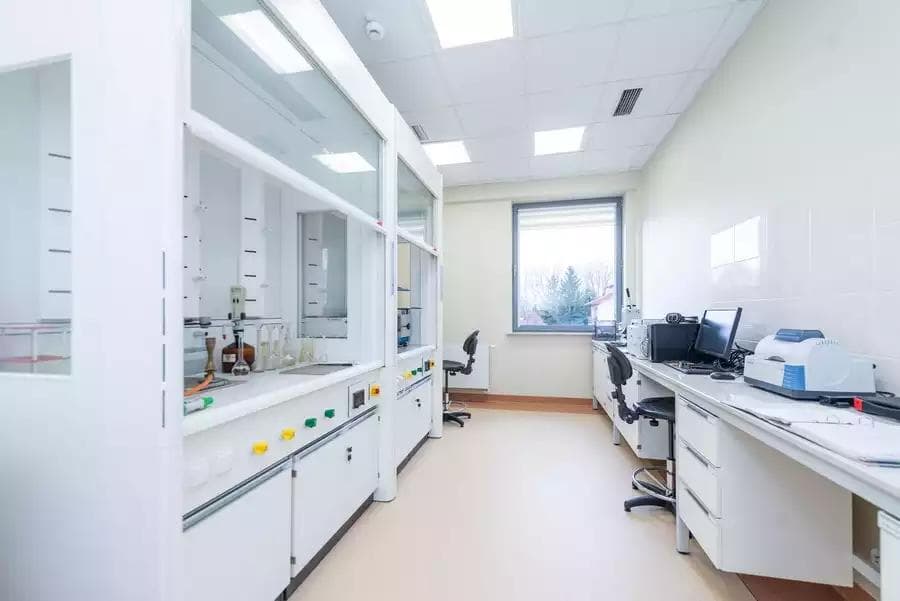
Pharmaceutical laboratory equipment must meet GMP requirements, as it directly affects the quality and safety of drug production and research processes. Properly selected medical furniture, resistant to chemicals and easy to clean, as well as laboratory fume hoods, which ensure safe work with volatile and active substances, are crucial here. Laboratory worktops, laboratory sinks and laboratory fittings also play an important role, as they must meet high hygienic and chemical resistance standards.
What GMP requirements must a pharmaceutical laboratory meet?
GMP (Good Manufacturing Practice) is a system of rules defining legal and quality requirements for processes related to the manufacture of medicinal products, including qualification, validation and keeping of full process documentation withinthe quality system.
A pharmaceutical laboratory must ensure high microbiological safety and effectively prevent contamination, which applies to both the organization of work and the selection of equipment and maintaining proper hygiene of the plant.
Space requirements include, m.in:
- minimum 2 m² of free space per employee,
- room height of at least 3.30 m, which is to ensure safe and ergonomic working conditions.
Regular maintenance of the equipment is also important, which guarantees its efficiency and compliance with quality requirements. The GMP system also takes into account Annex 21 of the GMP, which defines the obligations related to the import of medicinal products.
How to choose laboratory furniture and countertops with high chemical resistance?
The selection of laboratory furniture should start with the type of workstation. Wall-mounted laboratory tables are suitable for single-station work and routine analysis, while island laboratory tables allow access from several sides and are used in larger laboratories. For precise measurements, weighing tables equipped with anti-vibration modules are also used to reduce the impact of vibrations on the results.
The key is the selection of material for laboratory worktops, which should be matched to the type of work:
- technical ceramics – the highest chemical, thermal and mechanical resistance,
- epoxy resin – very good resistance to acids, alkalis and solvents,
- phenolic resin – good chemical resistance at lower costs,
- HPL laminates – a cost-effective solution for less demanding applications.
An important aspect is also work ergonomics, i.e. proper adjustment of the height and layout of the station to the user. Modular furniture systems are increasingly used, which allow you to flexibly change the layout of the laboratory depending on your needs.
All equipment must have high chemical resistance – including resistance to acids, alkalis, UV radiation and disinfectants – to ensure durability and safety of operation in laboratory conditions.
What equipment will work well in Clean Rooms?
A clean room is an environment with a strictly controlled cleanliness class, in which it is crucial to reduce particle emissions and maintain high microbiological purity. Each piece of equipment must support the decontamination and sterilization processes so as not to introduce additional contaminants into the work area.
The basic construction material is stainless steel (304L/316L), as it provides high corrosion resistance and ease of sterility. Smooth, low-roughness surfaces (Ra < 0.8 μm) facilitate effective disinfection and reduce the risk of microbial growth.
In cleanroom zones, protection against electrostatic discharge, or ESD (Electrostatic Discharge), is also important. Specialized anti-static furniture, including laboratory chairs, is used in EPA zones to prevent the build-up of loads and protect sensitive process processes.
How to choose fume hoods and cabinets for chemical reagents?
A fume hood (exhaust cabinet) is a basic safety device in a chemical laboratory that protects the user from fumes, gases and dust generated when working with hazardous substances. Its interior and working elements must be made of materials with high chemical resistance to withstand contact with corrosive and flammable substances, while ensuring effective airflow within the chemical extractors and the entire ventilation system.
When choosing chemical reagent cabinets and laboratory cabinets, itis crucial to ensure that substances are stored safely and that they can be discharged in the event of vapor emissions. Therefore, cabinets should be equipped with ventilation ports that allow connection to laboratory ventilation, which allows to maintain controlled conditions and reduce the risk of vapor accumulation.
It is also worth considering elements of safety infrastructure at workstations, such as laboratory sinks (e.g. made of solid ceramics) anda binocular eye washer, which allow for a quick reaction in the event of contact with hazardous substances.
What technical standards and certifications are required for research infrastructure?
The research infrastructure in laboratories must meet specific PN-EN standards, which regulate both the safety and functionality of the equipment. For m.in, PN-EN 14727 (concerning requirements for storage furniture in laboratories) and PN-EN 14056:2003, which defines the rules for designing and installing laboratory equipment, are of key importance.
In practice, all elements of equipment should havea certificate of compliance with applicable standards, as well as certificates of approval for use in medical and laboratory rooms. It is also important that the equipment is brand new and meets current technical requirements and safety standards.
An important material parameter is the E1 hygiene class, which guarantees low emissions of harmful substances from furniture materials, which has a direct impact on the safety of users and the quality of work in the laboratory environment.
How does the process of qualification and validation of laboratory equipment work?
According to Annex 15 of the GMP, every piece of laboratory equipment – such as autoclaves, laboratory centrifuges or incubators – must undergo a qualification processbefore being allowed to operate routinely. This is to confirm that the device works as intended and is safe for research or production processes.
The qualification and validation processconsists of gradually checking and documenting the correctness of the equipment at each stage of its implementation. This includes installation, operational, and process testing, and all results are recorded as part of process and production documentation, demonstrating full compliance with GMP requirements.
An important element is the preparation of full qualification documentation for the equipment, including not only the results of equipment tests, but also reports on the installation of furniture and infrastructure. Environmental measurements such as ESD reports and cleanliness tests after equipment assembly are also increasingly taken into account, which supports the comprehensive validation of equipment and the entire laboratory environment.
May 13, 2026