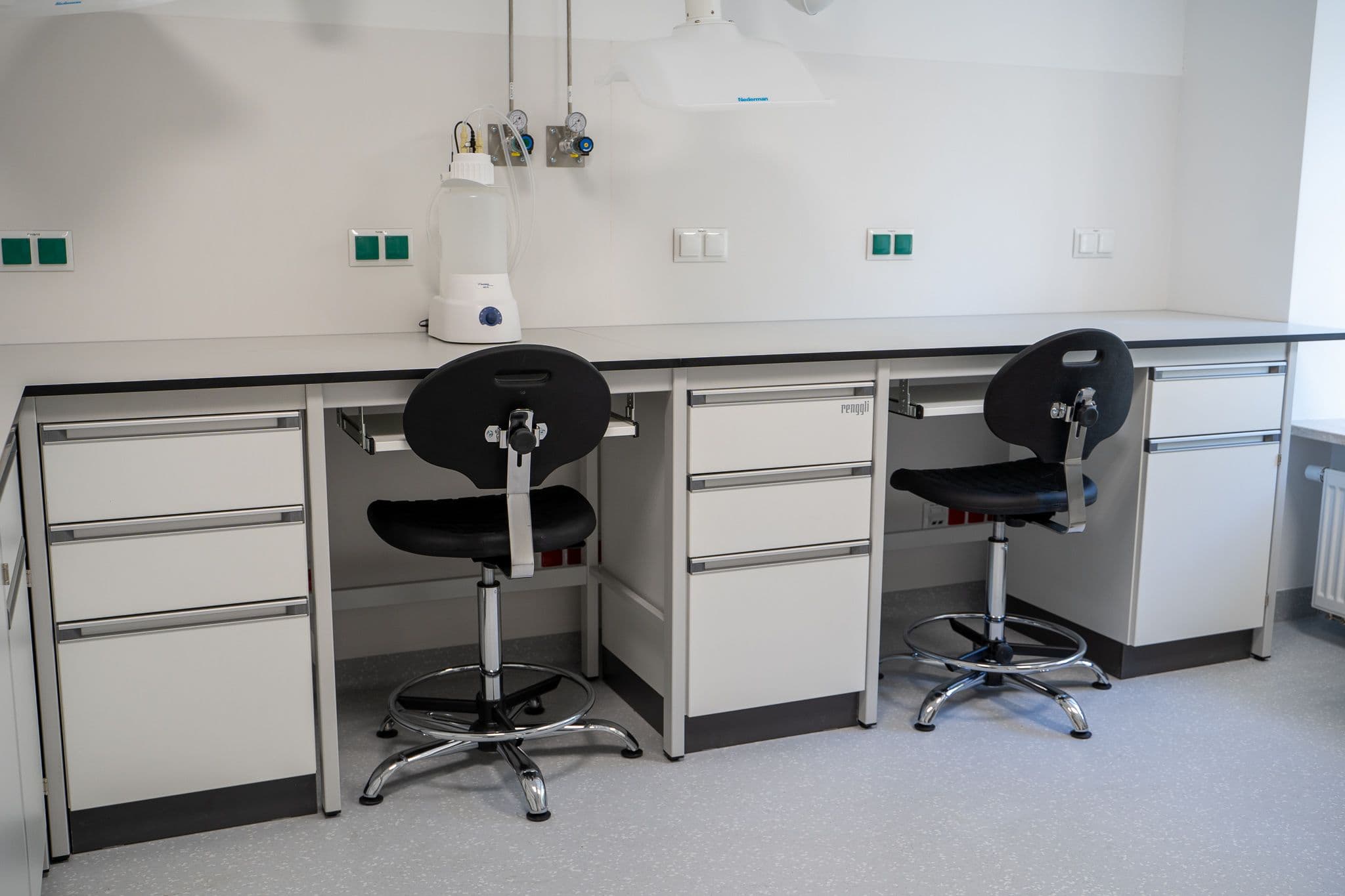
Stainless steel countertops are chosen in laboratories where sterility, durability and easy decontamination of surfaces are important. The most commonly used steels are AISI 304 and AISI 316L with a thickness of approx. 1.5 mm, resistant to moisture, chemicals and frequent washing. These solutions meet the requirements of the PN-EN 14727 standard.
Such worktops are especially suitable for microbiological, medical and pharmaceutical laboratories, where a pore-free surface and quick cleanliness are important. In practice, the choice of steel and structure depends on the working conditions and the type of test procedures used.
Why Choose Stainless Steel Worktop For Lab
A stainless steel table top is an essential piece of laboratory equipment where sterility, durability and easy decontamination are important. The most commonly used stainless steel worktops in the AISI 304 and AISI 316L variants with a thickness of 1.2-1.5 mm are provided for stability and resistance to intensive use.
The standard steel laboratory table has a profile of approx. 40 mm, which increases its rigidity and reduces deformation under the load of the instrument. The surface is sanded or satin-plated, so that dirt is easily removed and difficult deposits are not formed.
The AISI 304 steel worktop withstands contact with hot dishes and typical detergents well. Many projects also use stainless steel countertops, which can be integrated with fume hoods and ventilation systems. An additional rim, i.e. a steel top with a marine roll-up, reduces the risk of liquid spillage.
These solutions meet the requirements of the PN-EN 14727 standard and are confirmed by the Hygienic Certificate of the National Institute of Hygiene. A stainless steel laboratory worktop is often a standard in areas of increased cleanliness, although it is not always a universal solution.
Chemical Resistance of Acid Resistant Stainless Steel Countertop
The acid-resistant steel worktop in grades OH18N9 or AISI 316L shows high resistance to most organic acids thanks to the passive layer formed by chromium (16–19%).
The limitation is the effect of chloride ions, which can cause pitting corrosion, especially in humid environments and with prolonged exposure to aggressive solutions.
Surface finish is also important – a surface roughness of less than 0.8 μm Ra facilitates decontamination and reduces the risk of contaminant retention. Still, a professional stainless steel worktop can be prone to scratches and the visibility of fingerprints.
In environments with very high chemical aggressiveness, especially in the presence of halides and strong oxidants, stainless steel ceases to be a recommended material.
Application of Stainless Steel Countertop in Microbiology Laboratories
The stainless steel acid-resistant worktop is used in microbiological, pharmaceutical and medical laboratories where high standards of cleanliness are required, m.in. in the ISO 5 Cleanroom.
The weldless, welded design integrated into the sink eliminates microbial build-up points and makes it easy to maintain sterility.
Stainless steel countertops are valued for their high biological resistance, although minor functional scratches may appear during intensive use. Compliance with WHO (Laboratory Biosafety Manual) and GMP guidelines confirms their suitability in medical applications.
Maintaining high sterility requires regular, properly selected cleaning and disinfection procedures.
Care and cleaning of the stainless steel worktop
The basis of countertop care is regular cleaning and disinfection after each work cycle to prevent the deposition of reactants and discoloration.
Daily care should be simple: a soft cloth, water or mild detergent, and finally dry the surface thoroughly. This reduces the risk of stains and local corrosion.
In the case of acid-resistant steel , chlorine agents should be avoided, which can damage the passive layer and lead to pitting corrosion. Strong acids and aggressive detergents without neutralization are also not recommended.
Stains most often result from a violation of the chromium oxide layer. Scratches are created using rough sponges or tools. Therefore, it is recommended to use only soft materials and agents dedicated to stainless steel.
Regular, proper care allows you to maintain stable performance parameters for a long time.
Comparison of Stainless Steel Countertop with Alternative Materials
The stainless steel worktop is distinguished by its high thermal resistance and mechanical stability. Compared to other solutions, it maintains repeatable parameters in intensive use.
Compared to the HPL laminate top , the steel is much more resistant to temperature and does not swell, although HPL works well in less demanding conditions.
Compared to epoxy resin countertops, steel is more mechanically resistant, but less flexible in surface regeneration. Resins are better at tolerating some chemicals, but are more susceptible to damage.
Ceramics and quartz composites have high chemical resistance, but they tolerate point impact worse.
In practice, a stainless steel worktop is the most versatile solution where the balance between hygiene, durability and occupational safety is important.
Which grade of steel for stainless steel countertop should I choose?
For general laboratory applications, the most commonly used is the AISI 304 steel worktop, which performs well in moderate humidity environments and standard cleaning procedures. It is a stainless steel with a stable austenitic structure, containing chromium and nickel, which are responsible for the basic corrosion resistance.
In places where aggressive reagents, especially chlorides and acid solutions, are present, AISI 316L acid-resistant steel is a better choice. Its advantage is due to the addition of molybdenum, which increases resistance to pitting and crevice corrosion. This ensures that the work surface remains chemically stable for longer, even in intensive contact with reactants.
The difference between these materials is therefore due not only to the composition itself, but also to their structural resistance to degradation in laboratory conditions. In practice, AISI 316L acid-resistant steel is chosen where the risk of contact with highly reactive substances is a permanent part of the work.
When Stainless Steel Countertop Should Not Be Used
A stainless steel worktop is not suitable for environments where concentrated mineral acids are regularly used. Hydrochloric, sulphuric and nitric acids in high concentrations are particularly problematic, as they disrupt the passive layer of steel and initiate corrosion. In such conditions, permanent damage to the surface occurs, which cannot be fully reproduced in standard operation.
In fume hoods with high chemical loads, where intense fumes and frequent spills occur, steel can degrade at an accelerated rate. Pits and microcracks appear, which reduce hygiene and safety at work.
In such applications, monolithic ceramic or epoxy resin countertop is most often used, which better withstand contact with aggressive reactants and ensure the chemical stability of the work surface. The choice of material must also take into account the method of joining the elements, where, for m.in, polyurethane glue is used to ensure the tightness of the system.
How to choose a professional stainless steel countertop
The selection of a stainless steel worktop in the laboratory requires taking into account the supporting structure, dimensions and integration with the entire furniture system in accordance with the PN-EN 14056 standard. In practice, stability and resistance to moisture and chemical environments are crucial.
Metal reinforcing profiles are used on the bottom, which replace less durable solutions based on a chipboard substructure, which is susceptible to degradation in conditions of increased humidity. The work surface itself can be equipped with side and rear edges (railing), which limit the spillage of liquids towards other elements of the laboratory equipment.
The projects also take into account integration with sinks and fume hoods, where tightness and ergonomics of work are important. Technological limitations are important, such as the maximum seamless length (approx. 2200 mm), resulting from welding and assembly technology.
The whole should be evaluated in terms of TCO, taking into account durability, serviceability and operating conditions throughout the life cycle of laboratory equipment.
What Construction Parameters Affect the Cost of a Stainless Steel Countertop
The cost of a stainless steel worktop is primarily influenced by the thickness of the sheet metal used – the 1.5 mm variant is more expensive, but provides higher rigidity than 1.2 mm. The steel grade is also important: AISI 316L increases the cost compared to AISI 304, but offers better resistance to corrosive environments.
Non-standard dimensions and additional elements such as a reinforcing profile, integrated sinks or safety edges are also important. When analyzing investments in laboratory equipment , it is worth taking into account not only the purchase cost, but also TCO, i.e. the total cost of use over time.
FAQ - Frequently Asked Questions
1. What is the difference between a professional laboratory worktop and standard catering solutions?
The laboratory table is made of a thicker alloy (e.g. AISI 316L) and does not have a chipboard base – instead metal profiles are used. It must meet the requirements of the PN-EN 14056 standard and have a PZH Hygienic Certificate. In addition, it has a lower surface roughness (Ra < 0.8 μm), which makes it easier to decontaminate.
2. Why choose a stainless steel countertop integrated into the sink?
The seamless design eliminates gaps where dirt and moisture could accumulate. The welded connection of the sink to the work surface increases sterility and reduces the risk of leakage into the built-in. Such solutions are standard in pharmaceutical and microbiological laboratories.
3. What sterilization methods are safe for acid-resistant steel countertops?
It is recommended to use alcohols (e.g. 70% isopropanol) and UV radiation. Chlorine agents should be avoided, as they can damage the passive layer of steel and lead to corrosion. Regular disinfection allows you to maintain stable hygienic conditions in the laboratory.
June 24, 2026