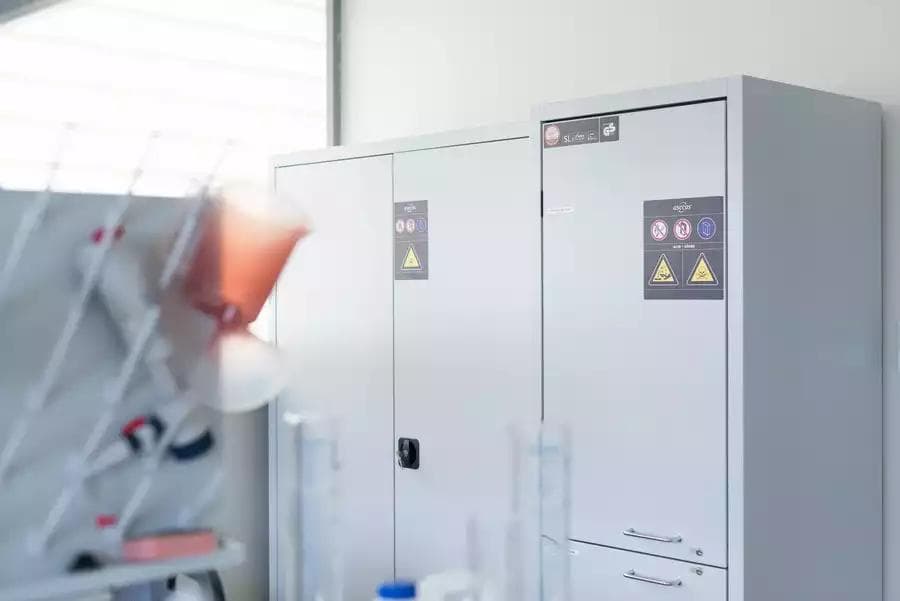
The storage of hazardous substances in the laboratory has a direct impact on the protection of the health of employees and the reduction of the risk of failures and accidents. Improper segregation of chemicals, lack of proper cabinets or negligence in the control of installations can lead to serious consequences – from dangerous chemical reactions to fire hazards. Check out what you need to pay special attention to to ensure compliance and a high level of security.
What regulations and standards govern the storage of hazardous substances?
Storing hazardous substances in a laboratory requires not only appropriate equipment, but also knowledge of the regulations that govern this area. The most important are EU regulations – the REACH regulation and the CLP regulation. They determine how to classify, label and use chemicals safely. On their basis, storage instructions are also prepared, tailored to specific substances.
In practice, technical standards are also very important. The EN 14470-1 standard applies to cabinets for flammable substances and specifies, m.in, their fire resistance, while the EN 14470-2 standard refers to the storage of gases. Thanks to them, it is easier to choose solutions that really increase work safety.
From the point of view of work organization, health and safety regulations (Occupational Health and Safety) and the Labor Code are important. They impose an obligation on the employer to carry out an occupational risk assessment, keep an up-to-date inventory of hazardous substances and take care of appropriate storage conditions. In practice, this also means applying the principles providedfor in Good Laboratory Practice (GLP). "Every employee should know and apply current health and safety rules in the chemical laboratory to minimize the risk of accidents and improper handling of chemicals.
It is also worth remembering that it is not only what we store that matters, but also where. The premises must meet the building requirements and rules related to fire protection – m.in. in terms of ventilation, signage and equipment. In addition, it is worth choosing proven medical furniture that facilitates the safe storage of substances and equipment in medical laboratories.
How do I read Safety Data Sheets (SDS) and CLP-compliant labels?
The primary source of information for each chemical is the SDS (Safety Data Sheet). It is a document that clearly defines how to store a given substance – we will find, among m.in, recommendations on temperature, humidity or required ventilation conditions, as well as information on its physicochemical properties. In practice, SDS should always be the starting point when organizing storage.
CLP labels are equally important, as they allow you to quickly assess a hazard without having to reach for documentation. They are based on the principles introduced by the GHS (Globally Harmonized System of Classification and Labelling of Chemicals) and contain several fixed elements:
- warning pictograms – graphic symbols informing about the type of hazard,
- Hazard passwords (e.g., "Danger" or "Caution")
- H phrases (hazard statements) – describing the risk associated with the substance (e.g. toxic effects, flammability),
- P phrases (precautionary statements) – i.e. specific recommendations for safe use and storage.
The label also includesthe CAS number, which is a unique identifier for the substance – especially useful when dealing with similarly named compounds or mixtures.
In everyday work, it is very important that substances are stored in airtight packaging, with legible labelling in Polish. This is especially true for groups such as carcinogens or mutagenic substances, where the risk to health is particularly high.
How to properly segregate chemicals in the laboratory?
Proper segregation of chemicals is primarily based on how substances react with each other. It is about the so-called chemical compatibility – that is, the assessment of which compounds can be stored next to each other, and which absolutely should not come into contact. In practice, special compatibility matrices are often used, which facilitate division into groups.
The basic rule: we only store together those substances that do not enter into dangerous reactions with each other. In particular, you should avoid such combinations as:
- acids with bases – risk of violent reactions,
- oxidizers with flammable substances – high risk of fire,
- corrosive substances with sensitive materials (e.g. metals),
- different groups with strong reactive properties without prior analysis.
Reactive substances, organic peroxides, as well as explosives, pyrotechnic substances or pyrotechnic materials require special attention. They often require controlled conditions, e.g. storage at reduced temperatures or in devices in the Ex standard.
It is also worth remembering about the organizational basics – in the laboratory , food must not be stored near reagents. This is a simple rule that really reduces the risk of accidental contamination.
When to use fireproof and acid-resistant cabinets?
Proper storage of hazardous substances in the laboratory requires specialized cabinets. Fireproof cabinets are used to store meltable liquids and organic solvents. They differ in fire resistance class – e.g. Type 30, 60 or 90 – which determines how many minutes the cabinet can withstand in the event of a fire, giving time for safe evacuation.
Acid-resistant cabinets made of chemical-resistant materials, e.g. polypropylene,are used to store acids and alkalis. This ensures that chemically aggressive substances do not damage the cabinet or cause leaks.
For particularly dangerous or toxic substances, it is advisable to use armoured cabinets or lockable safety cabinets, which restrict access only to authorised personnel.
Drip trays, drip trays and spill trays are essential in every cabinet to prevent leaks. In addition, hazardous material racks make it easier to segregate and organize chemicals inside the cabinet.
The following table shows the most commonly used rack classes and their corresponding protection period.
Fire resistance class - Safe evacuation time
- Type 30 - 30 minutes
- Type 60 - 60 minutes
- Type 90 - 90 minutes
What technical and ventilation requirements must a reagent warehouse meet?
Chemical storage primarily requires proper mechanical ventilation, ensuring 10-fold air exchange and removal of fumes from the bottom and top of the room. In older laboratories, gravity ventilation can be used, but in places with increased risk, exhaust ventilation is necessary.
The temperature in the warehouse should not exceed 25°C, and the room must be protected from sunlight. Walls and floors should be made of chemically resistant and easily washable materials, and laboratory racks should be stable – heavy containers should be stored low.
Escape routes must be kept clear in the warehouse and refrigeration equipment, e.g. laboratory refrigerators, must be used for sensitive substances. In places at risk of explosion, it is worth using ATEX-certified equipment and designating an appropriate explosion hazard zone. To do this, it is worth using certified laboratory furniture, which increases safety and facilitates the segregation of chemicals."
How to safely store technical gas cylinders?
Gas cylinders should always be stored upright in cages, secured with chains or belts to prevent them from tipping over. Each cylinder should be located in a separate, ventilated place, e.g. in special cabinets for gas cylinders, which reduces the risk of accumulation of dangerous fumes.
Flammable and oxidizing gases must not be stored together – separating them reduces the risk of explosion and the risk of fire. It is also a good idea to use gas detectors in places where pressurized gases are stored to quickly detect possible leaks.
What protective measures and emergency equipment are necessary in the warehouse?
In a chemical warehouse, it is very important to use appropriate personal protective equipment (PPE). Basic equipment includes safety glasses, laboratory gloves, protective gowns and, if necessary, protective masks.
Permanent emergency equipment is also necessary – safety showers or emergency showers, as well as eye washers and well-stocked first aid kits. In the event of chemical spills or spills, it's a good idea to have sorbents, emergency kits, and fire blankets on handto quickly neutralize chemicals and protect against spills.
However, the most important thing is that the staff is aware of the emergency procedures in force – a quick and correct response in crisis situations often determines the safety of the entire laboratory.
How to deal with chemical waste and substance packaging?
All chemical waste should go into chemical containers, which are clearly labeled and divided according to the type of substance. Hazardous waste, including empty packaging of substances and expired reagents, requires special care – they must not be mixed with ordinary waste.
The collected substances should only be handed over for chemical waste disposal to companies that have experience in the safe disposal of chemicals. This not only reduces the risk in the laboratory, but also protects the environment.
Chemical containers are used for temporary storage of waste, which ensure safety against leakage and facilitate segregation.
To sum up, the safe storage of hazardous substances in the laboratory is based on a few basic principles:
- Do not combine acids with bases or oxidizers with flammable substances.
- Store chemicals in appropriate cabinets – fireproof, acid-resistant and armored, equipped with drip trays and stable laboratory racks.
- Gas cylinders always in an upright position in cages, in separate, ventilated places.
- Collect waste and expired reagents in chemical containers and hand over chemical waste for disposal.
In addition, regular inspections of the technical condition of cabinets and ventilation (e.g. every six months) and employee training, which complements technical safety and emergency procedures, are crucial.
March 21, 2026