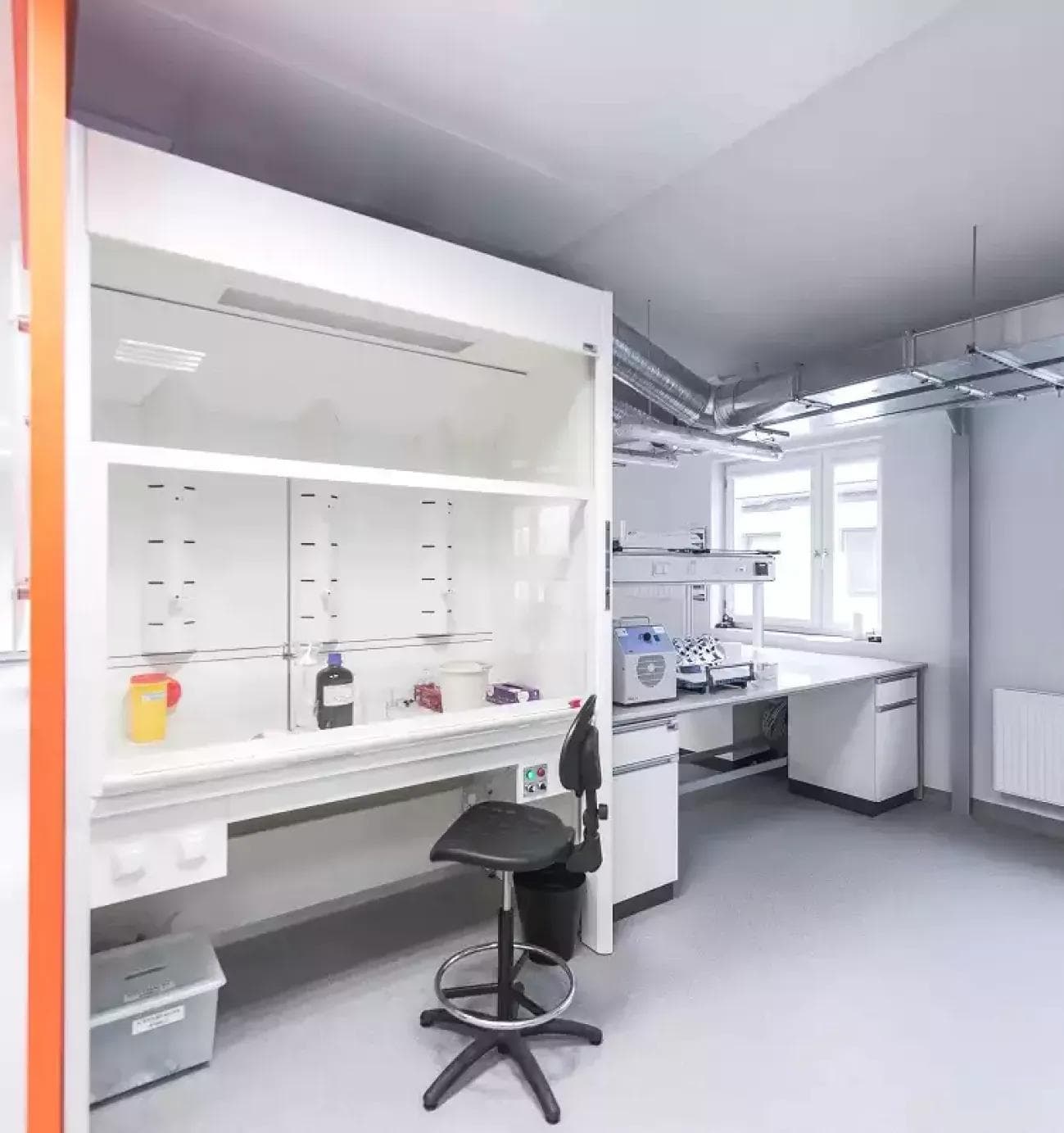
What is a laboratory fume hood and what is it for?
A fume hood (laboratory extractor) is a glazed cabinet equipped with a ventilation system, designed for safe work with chemical and biological substances in laboratory conditions. It is one of the most important protective devices used in chemical, analytical and industrial laboratories. A fume hood, also known as a fume hood or chemical extractor, is a key component of an occupational health and safety (OHS) system.
The basic task of the fume hood is to protect the staff from the harmful effects of toxic substances, such as fumes, gases, dust or aerosols. The device also reduces the risk of fire, explosion, or uncontrolled chemical reaction. Thanks to the controlled working environment, the laboratory extractor allows for safe, repeatable and compliant testing processes with applicable standards.
The most important functions of the fume hood:
- protection against toxic fumes and hazardous gases,
- improving the safety of personnel,
- control of chemical processes,
- Reducing the spread of contaminants in the laboratory
- Meeting health and safety requirements for laboratory furniture.
How does a chemical extractor and vapor extraction system work?
The principle of operation of the fume hood is based on mechanical exhaust ventilation, the task of which is to remove polluted air from the working chamber. The key element is to maintain negative pressure (vacuum) inside the handling chamber. Thanks to this, air is always sucked inside the fume hood and does not escape into the room.
Polluted air can be:
- discharged outside the building through a ventilation duct (exhaust fume hood),
- filtered and returned to the room in non-exhaust models.
Modern laboratory fume hoods use airflow control systems such as VAV (Variable Air Volume), which automatically adjust the ventilation intensity to the degree of opening of the glass and the current operating conditions. Crevice systems are also used to ensure uniform removal of vapours of different densities. The whole thing is supported by chemically resistant fans, designed to work with hazardous gases.
What structural elements does a fume hood consist of?
A typical laboratory fume hood consists of several key structural elements:
- working (handling) chamber – a space in which laboratory activities are performed,
- worktop – made of chemically resistant materials, such as technical ceramics, ceramic sinter, epoxy resin or polypropylene,
- sliding window (windshield) – made of tempered glass or VSG safety glass, protecting the operator,
- utility connections – water, gas, electrical installations, ceramic sinks,
- ventilated undercounter cabinet – for storing reagents,
- LED lighting to ensure proper working conditions,
- safety flap in the ceiling, supporting airflow control.
Construction materials such as acid-resistant steel or polypropylene guarantee durability, chemical resistance and many years of service.
What types of fume hoods are used in laboratories?
Depending on the purpose and design, there are several types of fume hoods:
- tabletop fume hood – compact, used in smaller laboratories,
- walk-in fume hood – designed to work with large equipment,
- explosion-proof fume hood (ATEX) – for explosion hazard zones,
- radiochemical fume hood – used in specialist laboratories,
- School fume hood – glazed on many sides, intended for educational purposes.
The choice of the type of fume hood depends on the profile of the laboratory – the industrial laboratory has different requirements than the analytical or didactic ones.
See also: laboratory kits.
What is the difference between a hoodless and a ducted fume hood?
A duct fume hood requires connection to an external ventilation system and discharges polluted air outside the building. This is a very effective solution, but it requires the right infrastructure.
A fume hood without exhaust (mobile) works on the basis of air recirculation and molecular filtration. The air is purified by carbon filters and HEPA filters, and then returned to the room. The advantage is mobility and no need to rebuild the installation, the limitation is the need to regularly replace filters.
The choice of solution depends on the type of work carried out and the technical capabilities of the building.
What safety standards must a fume hood meet?
The most important standard regulating the requirements for fume hoods is PN-EN 14175, which specifies the parameters of safety, extractor efficiency and test methods. The fume hood must be equipped with an air flow sensor, an alarm system and a clear control panel.
The following are also crucial:
- regular technical inspections,
- inspection of the ventilation system,
- use of non-flammable and chemically resistant materials,
- compliance with fire protection rules.
Did you know that...
A VAV system can significantly reduce energy consumption by automatically reducing airflow when the fume hood is not actively in use?
A laboratory fume hood is not just a piece of furniture, but an advanced protective device, without which it is impossible to ensure safe and compliant work in a modern laboratory.
March 03, 2026