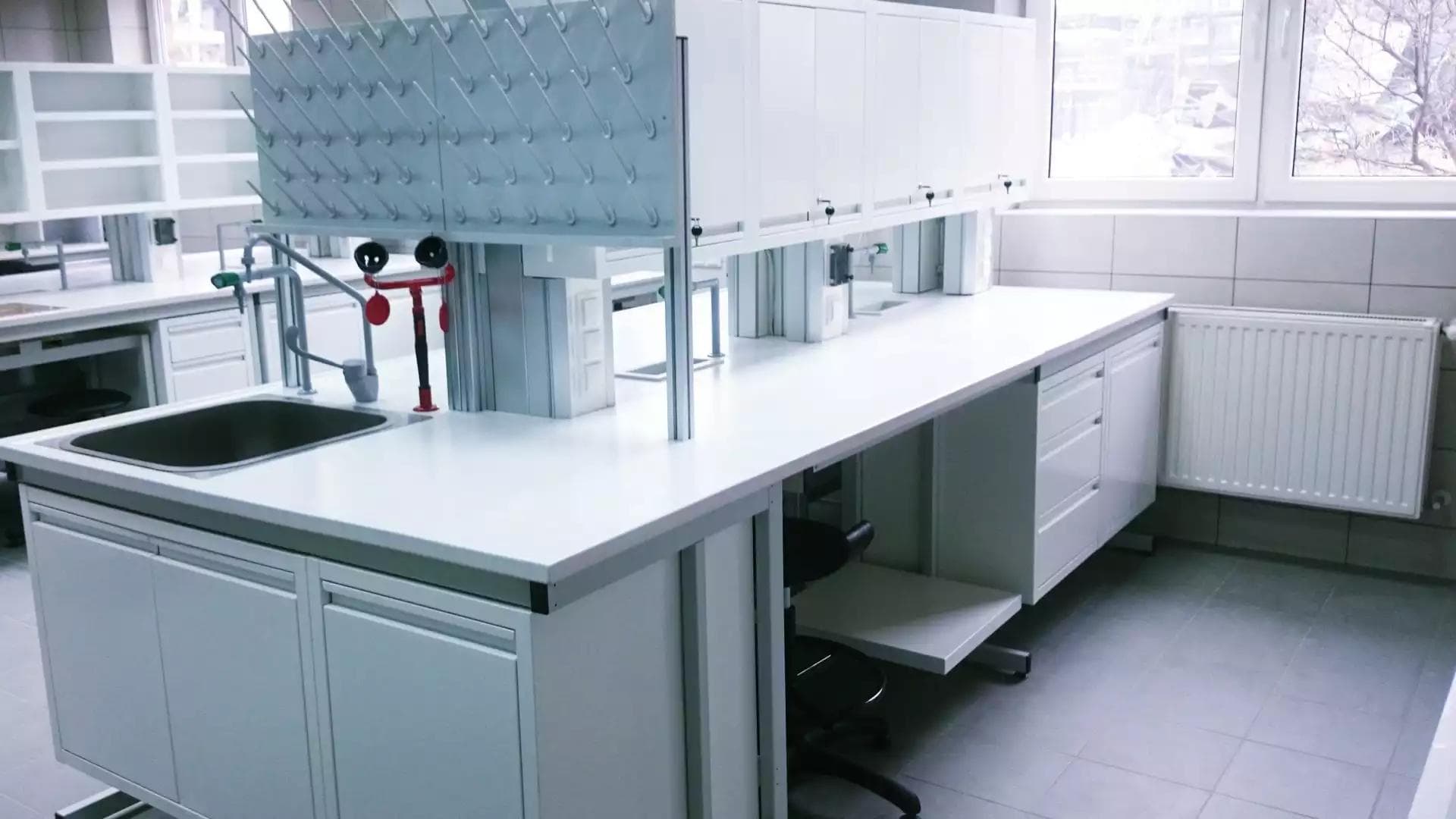
Ergonomics in the laboratory begins with the arrangement of the workstations and free access to the equipment. Modular systems allow you to adjust the space to the type of work, reducing unnecessary movements and improving the comfort of daily analyses. Light also plays an important role – even, shadowless lighting improves precision and reduces eye strain.
Ergonomic Laboratory Workstation – Definition and Main Principles
An ergonomic laboratory workstation is an organized workplace in the laboratory that is tailored to the user and the activities performed, so as to reduce the burden and increase safety and efficiency.
Ergonomics (from the Greek ergon – work and nomos – principle) was described as early as the nineteenth century by Wojciech Bogumił Jastrzębowski in his work "Rys ergonomji" (1857). Nowadays, it is divided into conceptual ergonomics (designing from scratch) and corrective ergonomics (improving existing solutions).
In laboratories, a common problem is the static load on the spine, resulting from working in one position for a long time. This promotes MSDs, i.e. muscle and joint pain. Therefore, when designing a laboratory space, the need to bend and reach is reduced, and the equipment is placed within reach.
Lighting in accordance with PN-EN 12464-1 is also important: approx. 500 lux for general lighting and 750-1000 lux for precision work. Good light reduces fatigue and improves working accuracy.
The five most important principles of ergonomics and the laboratory workstation
The most important principles of ergonomics in working with laboratory equipment are: maintaining a natural body posture, avoiding prolonged static positions, ensuring easy access to reagents, proper lighting and effective ventilation.
In practice, this means organizing work in such a way as to limit bending, reaching and twisting of the torso and applying the principle of the golden triangle in the lab, i.e. the logical arrangement of equipment and reactants within reach.
What is ergonomics at the workplace in the laboratory?
Ergonomics in the workplace in the laboratory is about matching furniture and equipment to a person, not the other way around. The idea is to set the position in such a way as to limit forced body positions during work.
This is especially true when working with a microscope or laboratory scale, where the wrong height or positioning of the equipment leads to overloads and discomfort. Well-designed workplace ergonomics reduce muscle tension and improve work comfort.
The most common design errors and the laboratory bench
The most common mistakes on a laboratory workstation include: blocking communication routes, not adjusting the height of the countertops and too rigid arrangement of equipment.
Lighting standards are also often ignored and the flexibility of the system is not taken into account. Improper placement of media forces unnatural movements and twists of the torso, which reduces ergonomics and can lead to a substandard position.
Dimensions and height of the worktop on the laboratory bench
In laboratory ergonomics, it is assumed that the height of the worktop should be about 75–85 cm for sedentary work and 90–100 cm for standing work. Such ranges suit most users and limit the static load on the spine.
A typical office table (e.g. 150 × 75 cm) does not meet the requirements of research work, as it does not take into account more equipment, reagents and work zones. In the lab, maximum hand reach is also key– optimally 50-60 cm within the table top to reduce the need to bend and reach.
It is not recommended to work with objects placed above the shoulder line (approx. 87-94 cm), as this increases muscle tension and the risk of overload. A correct field of vision is also important – work should take place in the range of approx. 30°, with a slight inclination of the gaze (10–15° downwards), which reduces eye strain.
The design of workstations should take into account the ISO 14738 standard, which defines the anthropometric requirements for workplaces.
Certified furniture and safety standards in the laboratory
Safe laboratory equipment must meet the requirements of standards, including PN-EN 14056, which applies to the design and installation of laboratory furniture.
An important element are laboratory chairs, which should be adjustable in seat height, backrest angle, armrests and an optional footrest – all to adjust the position to the user and reduce loads.
In the case of flammable substances, cabinets compliant with PN-EN 14470-1 in classes Type 30 or Type 90 are used, ensuring fire resistance and safe storage.
Modern solutions are based on a modular design, where the supporting frame of the furniture allows you to integrate mobile undercounter cabinets and a media connection panel, which increases the flexibility and safety of work organization.
Arrangement of the station and selection of resistant worktops in the chemical laboratory
In a chemical laboratory, the basis for safety is the environmental conditions: in a permanent work room , a minimum of 18°C and approx. 13 m³ of cubic capacity per person are maintained to limit the accumulation of fumes.
However, the most important thing is the selection of the worktop:
- Monolithic ceramics – the highest chemical and thermal resistance, good for strong acids,
- Epoxy resin (e.g. Durcon) – very good chemical and mechanical resistance, for intensive work,
- HPL laminate (e.g. Trespa TopLab) – a universal solution for moderate chemicals,
- Stainless steel – best where hygiene and easy cleaning are important.
Worktops must work with fume hoods and fume extractors, especially in temporary work rooms where intensive reactions are carried out. Stability of the stations, e.g. during titration, is also important.
The choice of material should take into account long-term resistance to chemicals and loads, not just single contact with substances.
Implement 5S principles in your workspace organization
The 5S methodology in the laboratory translates directly into the design of the workplace and the organization of the architecture of laboratory interiors. Its goal is to reduce chaos on the counter and streamline work.
On the workbench, the division into zones is used:
- frequent access zone – closest to the user, basic reagents and tools,
- medium access zone – auxiliary equipment,
- Rare access zone – equipment used occasionally.
This system reduces unnecessary movements and supports workplace ergonomics.
The constant placement of the equipment reduces the risk of confusion and contamination, as each component has an assigned place and returns exactly there after use.
Fixed installation and modular test stand
Permanent laboratory equipment is a solution "for years", but in practice it is difficult to change it. Each layout correction means assembly work and limited access to undercounter installations, which makes it difficult to modernize the space.
A modular lab bench, on the other hand, gives you more freedom. They can be rebuilt faster, adapted to new processes and easier to access the media hidden under the countertop. This is especially important in laboratories that often change the profile of work.
The differences can also be seen in everyday use. Fixed installation rarely allows you to change the height of the countertops, while modular systems offer manual or electric adjustment. In addition, there are mobile containers and extensions that make it easier to organize work and order at the workstation.
As a result, the modular approach works better where the laboratory is to be flexible and ready for change.
The impact of ergonomics on work efficiency and business ROI of the laboratory
Implementing ergonomics in the lab has a direct impact on business outcomes. A better data entry station and well-designed seated work reduce fatigue and errors.
The data show that a change in the organization of work can reduce sick leave from about 4% to 1%, i.e. by 75%. At the same time, effective working time increases up to 86%, which translates into greater team efficiency.
In practice, this also means a better pace of work – e.g. an increase in the number of data entered from 9480 to 11300 characters at the same time. Such effects are possible thanks to a better fit of equipment to the user and a reduction in static loads.
An ergonomic audit carried out by a certified OHS specialist also plays an important role, which allows you to indicate places of time losses and overloads in everyday work.
Health and psychophysical comfort of laboratory employees
A well-designed test bench in the laboratory affects not only the performance, but also the health of the staff. Proper ergonomics reduce back pain, muscle tension and eye strain.
An important element is sensory ergonomics, i.e. reducing the overload of the visual system and improving concentration through proper lighting and space organization.
According to the recommendations of the CIOP-PIB, eliminating forced body positions and ensuring proper adjustment of the workplace significantly reduces the risk of musculoskeletal ailments and improves the comfort of work on a daily basis.
FAQ - Frequently Asked Questions
1. When should a workplace in the laboratory be modernized?
When there is a lack of flexibility, there are health problems for the staff or the position does not meet current health and safety standards. Worn countertops, lack of adjustment and poor lighting are also a signal.
2. Why does poor workplace organization affect the health of employees?
It causes prolonged work in forced positions and strain on the spine, which leads to pain and a decrease in work precision.
3. How to choose the material of the table top for testing?
Ceramics and epoxy resins are used for aggressive chemicals, and HPL for lighter applications. Chemical resistance and ease of cleaning are key.
4. How to integrate heavy equipment into a modular station?
Reinforced frames, suitable media connections and worktops with high mechanical resistance and vibration stabilization are required.
5. How does the modernization proceed without interrupting the research?
The work is carried out in stages, based on modules assembled without construction work, which allows to reduce downtime.
June 15, 2026