How to choose a cleanroom chair and meet cleanliness standards
Choosing a cleanroom chair is a strategic decision that affects the quality of conducted processes. Even the smallest contaminants generated by equipment can ruin the efforts of the entire team. A proper seat guarantees the maintenance of ISO cleanliness classes and necessary antistatic protection.
 Renggli TeamEditorial team
Published: Updated Reading time: 7 min read
Contents
Air cleanliness classes according to ISO 14644-1#
The ISO 14644-1 standard determines air cleanliness classes based on the maximum number of particles of a given size in a cubic meter of air. The rule is simple: the lower the class number, the more stringent the requirements and the lower the allowable particle concentration. The standard distinguishes classes from ISO 1 to ISO 9, although classes ranging from ISO 5 to ISO 8 are most commonly found in industrial and laboratory practice.
Assigning a room to a specific class translates into work organization in the zone: the intensity of air filtration, the number of air exchanges per hour, the necessity of using airlocks and protective clothing, and restrictions on allowed equipment, including laboratory furniture. Personnel and equipment present in the cleanroom are the main sources of particle emission, which justifies a rigorous approach to contamination control when selecting equipment.
The measurement of particle concentration is performed in specific operational states of the room - at rest and during actual operation. The limit values of concentrations for individual classes must be verified directly in the standard's content, as they differ depending on the size of the analyzed particles.
How to choose a cleanroom chair for a cleanliness class?#
The choice of a cleanroom chair primarily depends on the ISO 14644-1 cleanliness class applicable in a given zone, as this determines the permissible emission of solid particles by the equipment. A standard laboratory chair differs from a cleanroom seat by several specific solutions: a hermetic cover for the gas spring, the absence of exposed upholstery elements, a closed seat structure, and metal elements with a smooth, pore-free surface.
Technical requirements increase along with the room class - the lower the ISO class number, the more restrictive criteria a dust-free chair must meet. Manufacturers declare the compliance of a specific model with a particular class, not with the entire scope of the standard, so the selection of equipment should start with determining which class the target work zone is assigned to.
An improper choice carries measurable consequences: an increase in particle concentration in the zone, the risk of rejecting a production or research batch, and non-conformities revealed during an audit. In environments covered by GMP guidelines, typical for a pharmaceutical laboratory, the selection of a cleanroom chair falls within the scope of formal room qualification, which requires documenting the parameters of the chosen seat.
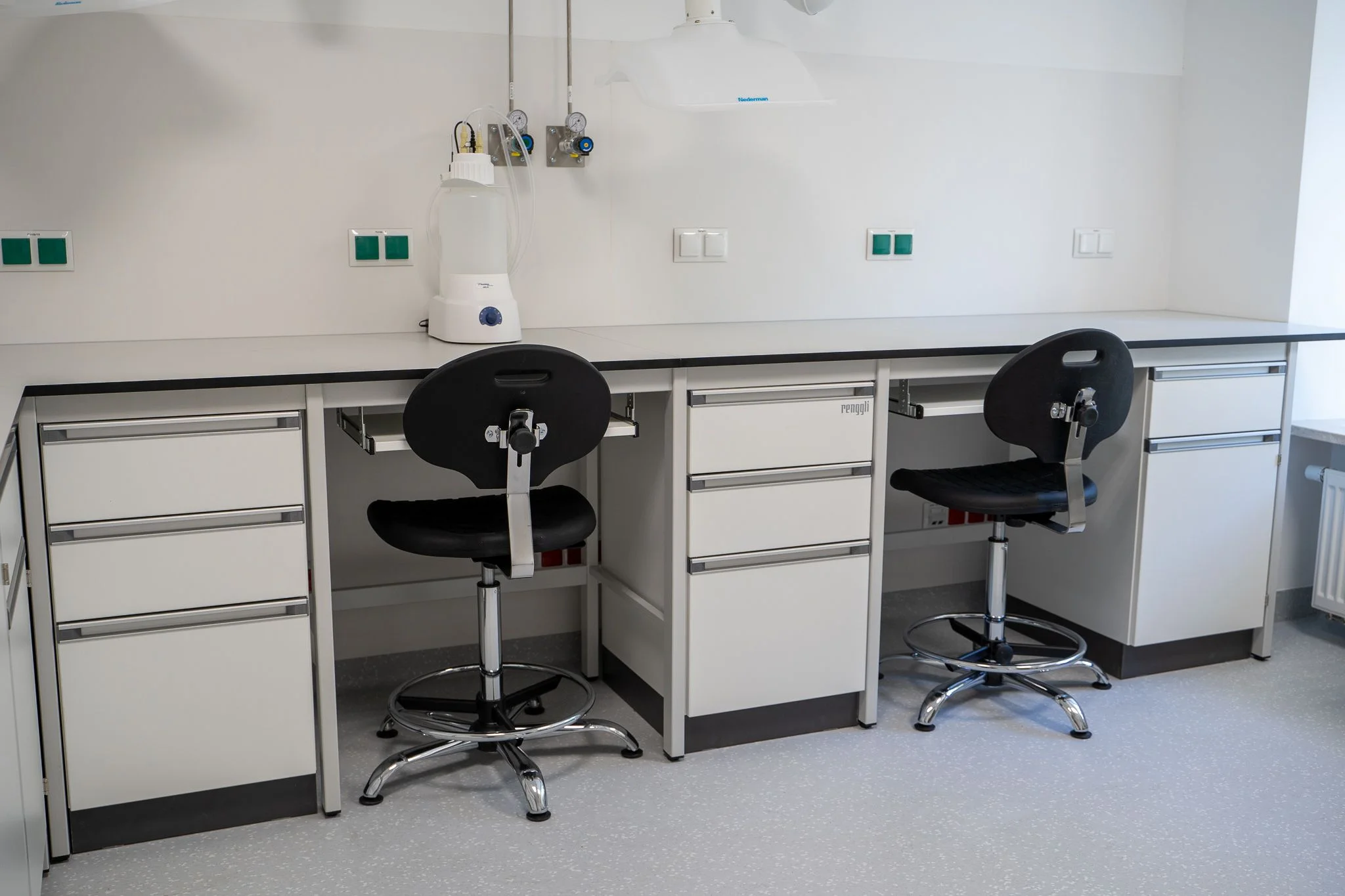
Besides models with a backrest, cleanroom stools are also used in many zones, which, while maintaining the same material requirements, provide the operator with greater freedom of movement. It is worth selecting laboratory chairs and laboratory stools intended for clean zones from suppliers who confirm the compliance of each unit with appropriate material and measurement documentation.
Construction materials reducing particle emission#
In clean zones, materials with a closed surface structure, devoid of open pores and fibers, are used - primarily integral polyurethane foam and stainless steel. Admission is determined by resistance to abrasion and disinfectants.
An antistatic polyurethane seat made of integral foam does not absorb water or fats and has an increased resistance to disinfection and UV radiation. These are baseline properties for controlled zones, although the admission of a model to a given class requires separate confirmation.
Metal elements - base, column, adjustment mechanisms - must have a smooth surface without pores and microcracks, as well as resistance to corrosion. Every element, including the castors, is subject to these requirements, because a single non-compliant component can compromise the cleanliness class of a polyurethane stool.
ESD protection: antistatic properties of a laboratory chair#
Chairs in a cleanroom must safely discharge electrostatic charges according to the PN-EN 61340-5-1 standard. Two concepts are confused in commercial descriptions: an antistatic material limits charge accumulation, while a dissipative element discharges it at a controlled rate to the ground - it is this second function that determines real protection.
In an area protected against static electricity, the continuity of the entire charge discharge path is what counts. Interrupting it anywhere - for example, by replacing castors with standard ones - invalidates the effectiveness of the solution, regardless of the other elements of the chair.
Electrostatic discharges threaten electronics and flammable substances, increasing the risk of damage and ignition. The parameter confirming the properties is the surface resistance, measured for a specific unit - limit values are read from the standard, not from commercial materials.
Hygienic requirements for chairs in a clean zone#
Seats in controlled zones must have smooth, impermeable surfaces resistant to isopropyl alcohol and other disinfectants. Requirements include rounded edges, a limited number of crevices, and the absence of recesses that accumulate dirt.
Chemical resistance is a condition for durability - repeated disinfection quickly destroys surfaces not adapted to it at the design stage. An ESD laboratory chair should maintain its mechanical and antistatic properties despite contact with strong agents, remaining an easily washable material throughout its entire service life.
Cleaning in a clean zone is conducted in a specific order - from the cleanest places to the most exposed ones - using non-linting materials, with documented procedures. The frequency and type of agents result from the facility's procedures, not from the furniture manufacturer's recommendations.
Ergonomics of a chair when working in a controlled zone#
Working in a controlled zone involves limited freedom of movement, protective clothing, and long sessions at a single workstation, which places demands on the chair's ergonomics. The key features are: height adjustment tailored to the worktop or chamber, backrest adjustment relative to the seat, and a footrest for elevated worktops.
Typical height adjustment ranges are approximately 450-580 mm in low models and 550-800 mm in high models. Base stability has additional importance during work requiring manual precision.
Ergonomic solutions, however, cannot violate cleanliness requirements - every additional mechanism is a potential source of particles, which is why it is subject to the same strict rules as the other elements of the chair.
Industries using cleanroom equipment: pharmacy, electronics, food industry#
Cleanroom chairs are used in several areas of industry, with a different type of threat to the process dominating in each of them. In pharmacy and the production of medical devices, the priority is to limit microbiological contamination and solid particle emission, as both factors affect product safety and quality.
In electronics, solid particles and electrostatic discharges come to the forefront, as they can damage sensitive components during assembly or testing. In the food and cosmetics industry, the microbiological cleanliness of equipment in contact with the production environment is crucial.
The type of dominant threat dictates different priorities in equipment selection - in electronics, the emphasis is on ESD protection, while in pharmacy, it is on the ability to frequently disinfect surfaces. In areas covered by GMP guidelines, equipment, including laboratory furniture, is subject to formal documentation as part of room qualification.
Laboratory chairs for cleanrooms - what to look for when buying?#
When purchasing chairs for cleanrooms, it is worth requesting several elements of documentation from the supplier: indication of the cleanliness class along with the standard, a certificate of conformity issued by an independent testing body, a resistance measurement protocol for the given unit, material documentation, and cleaning and disinfection instructions.
Terms such as "antistatic" or "for cleanrooms" alone, without indicating the class and standard, do not provide full information about the product's parameters. Compliance concerns a specific model - a change in equipment, e.g., replacing castors or upholstery, requires separate confirmation.
It is worth determining the choice of seats together with the rest of the zone's equipment so that cleanliness requirements remain consistent throughout the entire room.
Renggli, a Swiss manufacturer operating since 1927, designs and manufactures custom laboratory furniture in its own factory in Białystok, providing dedicated solutions for pharmaceutical and industrial laboratories, among others. The company's team of engineers provides technical consulting when selecting equipment for a specific cleanliness class, and the Polish branch of Renggli Sp. z o.o. provides individual pricing and technical specifications upon request.