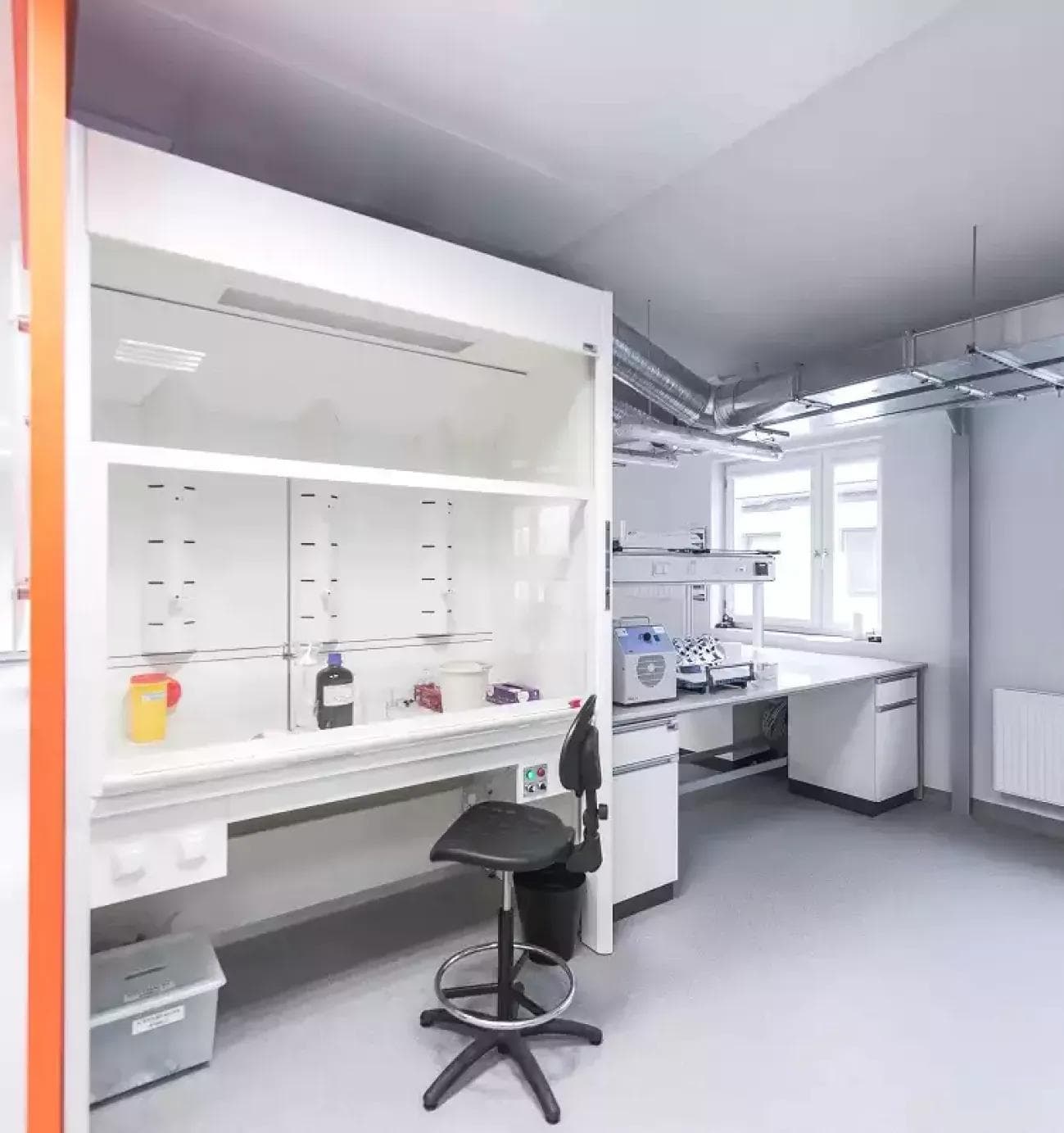
Fume hood efficiency - how to calculate the proper airflow?
Proper airflow in a laboratory fume hood determines the safety of working with chemicals. Effective extraction of fumes requires a precisely balanced exhaust system. Too weak of an exhaust does not protect the personnel, while too strong generates turbulence and energy losses. In this article, we explain how to calculate the volume flow and select parameters in accordance with health and safety standards.
What is a laboratory fume hood and what does it protect against?
A laboratory fume hood, also known as a fume cupboard or laboratory exhaust, is an absolutely crucial piece of equipment in any modern research and industrial environment. Its primary task in terms of health and safety protection is to secure personnel from inhaling harmful, toxic, corrosive, or irritating fumes, gases, and dusts generated during chemical reactions. The device operates based on a controlled laboratory exhaust, which generates constant negative pressure inside the chamber, preventing dangerous substances from escaping into the workspace.
The design of the device is based on a sealed chamber, which contains all the processes carried out, and a movable front sash allowing for free manipulation of reagents. To ensure the longevity of the equipment, the interior is finished with materials of high chemical and thermal resistance. The most commonly used solutions are technical ceramics (including monolithic acid-resistant ceramics), epoxy resin, polypropylene, and stainless steel, chosen depending on the specificity of the work performed and the degree of aggressiveness of the media used. A properly designed fume cupboard must be integrated with other elements of the infrastructure, such as laboratory furniture or modular installation systems, including the advanced RL6 system. The entire construction is subject to strict criteria specified in the PN-EN 14175 standard, which guarantees full work safety.
Ducted or ductless fume hood - which to choose?
The choice of the appropriate exhaust system depends on the nature of the work and the technical capabilities of the facility. A ducted fume hood discharges pollutants outside the building through a dedicated installation. This solution guarantees the highest efficiency and low operating costs, although it requires significant investment in ventilation assembly. The ductless model operates in a closed circuit, cleaning the fumes through carbon and HEPA filters, which facilitates the potential reconfiguration of workstations.
In laboratories operating with significant amounts of aggressive acids, a ducted fume hood is the only safe choice. The ductless variant, on the other hand, works well for auxiliary work with low fume emission and in places where connection to an exhaust duct is impossible.
What is the safe inflow velocity in the working window?
A safe airflow velocity in the working window is crucial for maintaining a protective barrier. The minimum face velocity cannot drop below 0.1 m/s, but values in the range of 0.3 to 0.5 m/s are the standard guaranteeing stability. Confirmation of effectiveness is a certified retention test with a tracer gas, sulfur hexafluoride (SF6), in which the concentration outside the chamber cannot exceed 0.65 ppm. For safety reasons, personnel should work at a distance of at least 15 cm from the edge of the worktop.
What standards regulate fume hood ventilation?
Designing ventilation for fume cupboards is based on rigorous legal and technical regulations. The basic document binding in the European Union is the PN-EN 14175 standard, which precisely defines the requirements for the construction, efficiency, and methods of testing the retention capacity of fume cupboards. All supplied devices must have CE marking and the PZH hygienic certificate. In the presence of explosive environments, it is necessary to meet the ATEX directive guidelines and use explosion-proof fume hoods in the appropriate Ex class.
Walk-in fume hoods - when are they used?
Walk-in fume hoods are designed for conducting complex research processes requiring the use of large-scale apparatus or sets mounted directly at the floor level. Their specific design is devoid of a standard worktop, which allows for easy entry of trolleys with technological apparatus into the working chamber. Due to the large volume of the chamber, walk-in devices are characterized by a much higher demand for air volume flow. When designing an exhaust system for this type of hoods, appropriately larger duct cross-sections and fans with higher pressure must be taken into account to maintain the proper face velocity over the entire area of the window opening.
How to calculate airflow in a fume hood?
Determining the required volume airflow is a fundamental step when designing an efficient ventilation system in a laboratory. The basic formula for airflow is based on multiplying the area of the open working window by the required inflow velocity. It is expressed as the product of the working gap area (m²) and the face velocity (m/s), which after conversion gives the final volume flow in m³/h.
For example, with a window 1.2 m wide open to a height of 0.5 m (which gives an area of 0.6 m²) and an inflow velocity of 0.5 m/s, the required exhaust flow is 1080 m³/h. For wider models with a width of 1.5 m or 1.8 m, these values increase proportionally. A proper air balance in the entire room is extremely important, because the ventilation duct must efficiently remove fumes without creating negative pressure in the hall.
Modern laboratory fume hoods use the advanced VAV (Variable Air Volume) system, which smoothly adjusts the exhaust efficiency to the current degree of window opening. When the sash is lowered, the airflow sensor transmits a signal to the controller, reducing the exhaust while maintaining a safe face velocity, which brings significant energy savings. Furthermore, a bypass gap is used in the construction of the working chamber. It prevents a sudden increase in inflow velocity when the front window is closed, eliminating dangerous turbulence. A properly calibrated exhaust system protects the system against a drop in efficiency and guarantees stable fume suction.
How does the sash opening height affect efficiency?
The maximum opening height of the working window directly determines the peak demand of the entire exhaust installation for airflow. The higher the front sash is raised, the larger the opening area becomes, which, assuming a constant inflow velocity, forces a significant increase in the volume of air removed from the room. Modern laboratory equipment using VAV regulation is based on reactive sensors. To prevent unnecessary energy losses and maintain proper efficiency, fume cupboards are equipped with an OSH lock that limits the sash opening to 50 cm during standard work, which significantly reduces the ventilation load.
How to choose an exhaust fan for a fume hood?
Selecting an exhaust fan requires a thorough analysis of the chemical properties of the extracted media and the resistance of the entire installation. A proper exhaust in a laboratory fume hood requires the use of a fan with high chemical resistance (e.g., made of polypropylene), which guarantees constant negative pressure and prevents the backflow of dangerous gases. When designing the system, the airflow resistance generated by the pipelines and built-in elements, including laboratory fittings, must be precisely taken into account. A properly selected device guarantees a stable air balance, ensuring that the entire laboratory ventilation operates quietly, efficiently, and trouble-free.
August 11, 2026