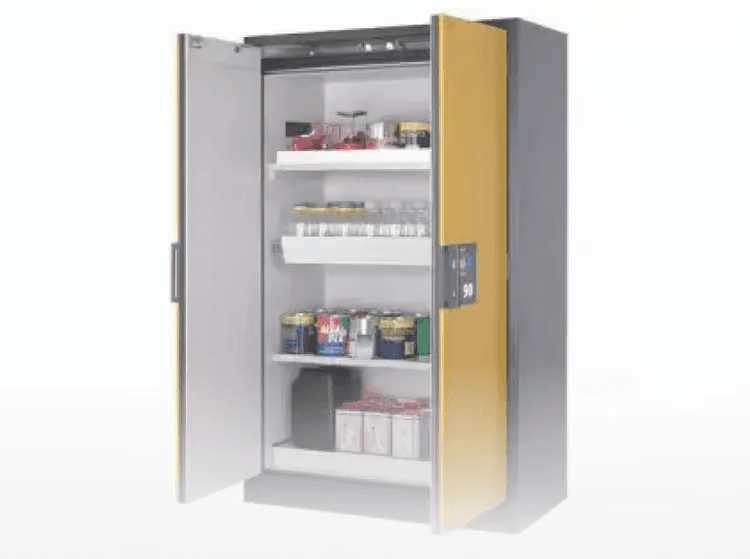
Gas Cylinder Cabinets for Technical Gases – Safety and Ventilation Requirements
A gas cylinder cabinet protects laboratory personnel from fire and explosion by safely isolating pressurized cylinders containing technical gases. In this article, we explain the requirements set out in the EN 14470-2 standard, what the G90 fire resistance class means, and how to select the right ventilation and grounding for the cabinet.
What is a gas cylinder cabinet and what does it protect against?
A gas cylinder cabinet is a specialized piece of laboratory furniture designed for the safe storage and isolation of pressurized cylinders inside a building. Its primary purpose is to protect personnel and laboratory equipment from the consequences of an incident involving compressed gas.
The construction is selected individually, depending on the number and size of the cylinders to be stored – typical variants include cabinets designed for 1, 2, or 4 cylinders with a capacity of 50 litres. This parameter affects the dimensions, ventilation capacity, and the method of securing the cylinders.
An enclosed, ventilated cabinet provides a significantly higher level of safety than an open rack, as it limits the spread of a potential leak and protects against access by unauthorized persons. The basic features of such equipment include a fire-resistant construction, forced ventilation, a cylinder-securing system, and lockable doors.
This type of furniture belongs to the broader category of safety cabinets used in laboratories, alongside solutions designed for storing chemicals.
What risks does storing gas cylinders in a laboratory involve?
Pressurized technical gas cylinders present several independent hazards, which is why the rules governing their location and protection are strictly defined. Locations where cylinder storage is prohibited include stairwells, narrow passageways and emergency escape routes, garages, and rooms situated below ground level. These restrictions stem from the risk of hindering evacuation and the accumulation of gases heavier than air in low-lying areas.
The main hazard factors include fire, excessive heating of the cylinder, corrosion of the valve and cylinder shell, mechanical damage from transport or tipping over, and unauthorized access by outside persons. This last factor is eliminated by lockable cabinet doors, which also reduce the risk of the valve being opened accidentally.
There is an important difference between an ordinary steel cabinet and a certified fire-resistant cabinet that meets the requirements of the EN 14470-2 standard. A standard metal cabinet only protects against mechanical damage and access by unauthorized persons, but it does not guarantee that a safe internal temperature will be maintained in the event of a fire. A certified construction undergoes fire testing that confirms a specific resistance time.
Safely introducing a gas installation into the cabinet requires the use of properly protected cable/pipe entries, most often located in the ceiling section, leading to the pressure regulators. This solution prevents gas from uncontrollably escaping into the room in the event of a leak at the connection.
The rules for positioning cylinders in the cabinet are unambiguous: cylinders are stored in an upright position, secured against tipping over with straps or chains. Cylinders containing gas in liquid form must never be laid horizontally under any circumstances, as this disrupts the proper operation of the safety valve and increases the risk of an uncontrolled release.
The appropriate distance from heat sources is also of significant importance. A gas cylinder cabinet should be positioned away from radiators, heaters, and other installations generating high temperatures, in order to avoid an excessive pressure increase inside the cylinders. During the winter period, it is also worth paying attention to ensuring that cylinders are not exposed to sudden temperature changes when moved between zones with different heating levels.
What standards govern gas cylinder cabinets – what is the G90 class?
The primary document governing the construction and testing of gas cylinder cabinets is the EN 14470-2 standard. Among other things, it specifies requirements regarding fire resistance, ventilation, and labelling methods.
The G90 class means that, under fire test conditions, the cabinet maintains a safe temperature at the valve of the stored cylinder for 90 minutes, giving personnel time to evacuate and emergency services time to respond. Construction requirements include fire-resistant walls and ceiling, self-closing fire doors, and a low-flammability floor. In rooms situated below ground level, additional quantity restrictions apply regarding the permissible number and capacity of stored cylinders. A supplementary industry reference point is the German TRGS 510 guidelines, concerning the storage of hazardous substances.
What conditions must cylinder storage in the cabinet meet?
Cylinders are loaded into the cabinet in an upright position, most often via a built-in access ramp, which protects the valve from impact against the edge of the structure. Inside, the cylinders are secured with straps or chains that prevent them from tipping over during use.
An important rule is the separation of flammable gases from oxidizing ones – storing both groups together is only permitted when a certified cabinet meeting the requirements of the EN 14470-2 standard has been designed with this solution in mind and provides adequate zone separation. The cylinder valve should also be additionally shielded against accidental impact, which reduces the risk of mechanical damage.
Indoor cabinet or outdoor gas storage – which to choose?
An indoor cabinet, placed inside the laboratory building, must have certified fire resistance (e.g., class G90) and forced mechanical ventilation, since its task is to protect personnel present in the same room. This solution works well where the gas draw-off point is located close to the workstation.
An outdoor gas storage facility operates on a different principle – its construction is open on at least two sides, which provides natural airflow and eliminates the need for mechanical ventilation. It additionally requires protection against sun exposure, UV radiation, and excessive heating, and its location must take into account safety distances from property boundaries and other zones. The choice of variant depends on the type of gas, its quantity, and the spatial layout of the facility.
What ventilation and grounding must a gas cylinder cabinet have?
Exhaust ventilation is responsible for removing gas vapours from the work zone in the event of an uncontrolled leak, which directly reduces the risk of an explosive or toxic atmosphere forming. The direction of air extraction (from the bottom or top of the cabinet) is selected depending on the density of the given gas relative to air.
The required air change rate depends on the hazard class of the stored medium. For flammable and oxidizing gases, at least 10 air changes per hour are assumed, whereas for toxic and highly toxic gases these values are considerably higher, reaching several dozen or even over a hundred air changes per hour.
Another requirement is permanent grounding of the cabinet, which protects against the accumulation of electrostatic charges that could initiate ignition. When storing flammable gases, the electrical installation surrounding the cabinet and any electrical equipment it contains must be executed to an explosion-proof standard.
Given the complexity of these issues, the design of the mechanical ventilation and the fire-resistant cabinet (including the selection of mechanical ventilation and the parameters of the gas installation) should always be consulted with a sanitary installation designer and a fire protection safety expert.
How do you connect a gas cylinder cabinet to an extraction system?
Connecting the cabinet to the mechanical ventilation system is done using an extraction spigot, linking the interior of the cabinet to the building's exhaust duct. A grounding connection is made in parallel, eliminating the risk of the structure becoming electrically charged.
The gas installation is introduced through protected entries usually located in the ceiling of the cabinet, leading to the pressure regulators mounted on the cylinders. Correctly executed entries protect against gas escaping into the room at the point where the piping passes through.
Due to safety requirements, the installation should be carried out exclusively by a licensed installer, and the entire project of integrating the laboratory equipment with the ventilation system is worth consulting with a fire safety expert as early as the planning stage.
Where should a gas cylinder cabinet be placed in the laboratory?
The location of the cabinet depends on the nature of the facility – different requirements apply in research laboratories, industrial plants, medical facilities, or storage zones. However, a common rule remains: positioning the cabinet as close as possible to the gas draw-off point, which shortens the length of the installation and reduces the risk of failure along the piping route.
Cabinets must not be located on evacuation routes, in traffic corridors, or near heat sources. It is also worthwhile for the entire laboratory equipment layout (furniture, ventilation, and the gas workstation) to be planned coherently already at the design stage.
How does a gas cylinder cabinet eliminate the explosion hazard zone?
In the event of a gas leak, a cabinet with forced ventilation immediately removes vapours from the room, which limits the extent of the explosion hazard zone around the workstation. Permanent grounding also plays a key role here, eliminating the risk of electrostatic sparking as a potential ignition source.
An additional protective element is the stable securing of cylinders with straps, which prevents mechanical damage to the valve that could lead to an uncontrolled leak. The combination of these three factors – ventilation, grounding, and securing – means that a certified cabinet genuinely reduces the occupational health and safety risk associated with storing technical gases.
August 12, 2026