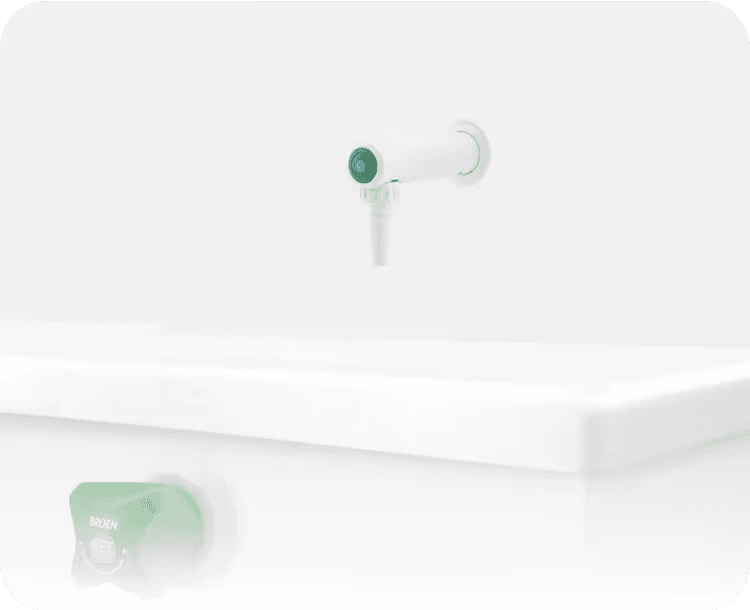
How to choose and design valves for demineralized water?
Dedicated valves for demineralized water prevent secondary contamination of the medium and eliminate corrosion risks in installations. Selecting PVDF diaphragm valves allows maintaining conductivity below 0.06 µS/cm. Swiss manufacturer Renggli supplies zero-dead-leg point-of-use outlets integrated with laboratory furniture.
Valves for demineralized water: application and standards
Dedicated laboratory fittings for pure water prevent secondary contamination of the medium. Standard laboratory installations can release minerals, making chemically inert components necessary. A properly selected deck-mounted laboratory faucet made of PP eliminates this risk, protecting samples. What to avoid when choosing fittings for demineralized water? Above all, random sanitary components. Appropriate laboratory equipment protects the investor from losses, which is why it is worth relying on professional B2B advisory. The lack of minerals makes water destructive to traditional metals.
Why does pure water destroy standard metal valves?
Demineralized water seeks to absorb missing ions from its surroundings, which causes corrosive aggressiveness toward brass installation components. The "hungry water" phenomenon describes the pure medium's drive to extract ions from its environment. Ordinary brass fittings undergo rapid corrosion in such an environment (water leaches out zinc and copper). For this reason, metal laboratory valves without appropriate coatings cannot be used, as laboratory water quickly destroys them. Pure demineralized water achieves conductivity below 0.06 µS/cm, which means extremely high resistivity. For comparison, heating systems require conductivity below 100 µS/cm to limit boiler scale, as just 1 mm of scale drastically reduces system efficiency. It is worth analyzing surface properties, checking how stainless steel compares to HPL laminate. Distilled water presents different challenges than demineralized water.
Where and under what pressure to install point-of-use outlets?
Demineralized water point-of-use outlets are installed directly at workstations at a typical operating pressure of 3 to 6 bar. Strategic demineralized water points are integrated directly into the workspace. Demineralized water faucets are installed near glass washing zones, which modern laboratory furniture is equipped with. A standard water loop installation operates at a pressure of 3 to 6 bar, ensuring optimal flow and stable cooperation with a device such as a laboratory demineralizer. Fittings are mounted through laboratory countertops or dedicated laboratory sinks. Media distribution systems must be free of stresses. The safety of the loop depends on tightness and rigorous component selection.
What seals to choose for pure water?
Safe sealing of valves for demineralized water requires the use of EPDM elastomer or chemically inert PTFE. In pure water installations, it is crucial to avoid the extraction of chemical compounds from seals. Standard rubbers contain plasticizers that demineralized water easily leaches out, destroying the purity of the medium. Technical requirements demand uncompromising purity of internal surfaces and the use of polymers with complete chemical inertness. The foundation is a pharmaceutical-grade EPDM seal and an inert PTFE diaphragm. EPDM seals provide flexibility and resistance to disinfection, while the PTFE diaphragm shows zero reactivity. This design isolates the valve's control mechanism from the liquid. Even workstations where weighing and anti-vibration tables or a stainless steel sink are installed require points free from microbiological growth.
How to install a valve without dead zones?
Proper installation of a valve for ultrapure water requires a flangeless connection and total elimination of dead zones in the system. Correct installation of valves determines whether ultrapure water maintains sterility. The main threat is dead zones (dead legs), i.e., blind sections of pipes where stagnant water favors the multiplication of microorganisms and biofilm formation. To eliminate the risk, a PVDF diaphragm valve connected without flanges is recommended. An alternative is a wall-mounted bibcock valve with minimum body volume. The movable valve head presses the diaphragm against the seat, shutting off the flow. In designs, these components are integrated by the RL6 modular system, which eliminates pipe bends and stagnation zones.
What materials to use for the valve body for ultrapure water?
Dedicated faucets for distilled water are made of chemically inert plastics such as PP, PVC, PVDF, and acid-resistant 316L steel. The choice of body material determines the operating parameters of the installation and its lifespan. Modern faucets for distilled water are produced from selected polymer materials (PP, PVC-U, PVDF) and high-grade AISI 316L stainless steel. Plastics are characterized by a complete absence of metal ion release, making the polypropylene (PP) faucet commonly used in general laboratories. Polypropylene exhibits excellent biological purity and chemical inertness, although it has limitations regarding pressure and high temperatures. On the other hand, polyvinylidene fluoride (PVDF) is a material of extreme hardness and an exceptionally smooth internal surface, which drastically reduces the risk of biofilm and allows for steam sterilization. An alternative to polymers is a stainless steel 316L faucet, commonly used where the highest mechanical resistance is required. It is worth remembering that the high resistivity of water and its neutrality mean that the chemical resistance of plastics exceeds traditional metals, eliminating the risk of pitting microcorrosion.
Comparison of body materials
- Polypropylene (PP)
- Chemical resistance: High (handles most acids and bases perfectly).
- Thermal resistance: Good (continuous operation up to +90°C).
- Project price: Economical (most cost-effective choice for standard laboratories).
- Biofilm risk: Low.
- Polyvinylidene fluoride (PVDF)
- Chemical resistance: Outstanding (complete inertness across a wide chemical range).
- Thermal resistance: Very high (up to +140°C, allowing full autoclaving).
- Project price: High (investment dedicated to advanced systems).
- Biofilm risk: Minimal (thanks to extreme smoothness of the internal surface).
- 316L Stainless Steel
- Chemical resistance: High (pure water does not affect the alloy, but there is sensitivity to high chloride concentrations).
- Thermal resistance: Extreme (up to +180°C, ideal for pure steam sterilization).
- Project price: Medium-high.
- Biofilm risk: Low (provided electrotechnical polishing is applied).
Media distribution systems take space ergonomics into account. When choosing a laboratory sink and a faucet, care is taken to ensure the consistency of equipment. In laboratories, a complete environment is created by weighing tables, dedicated medical furniture, ergonomic laboratory chairs, and laboratory stools. In offices, medical clinic equipment and functional office furniture are installed.
July 29, 2026