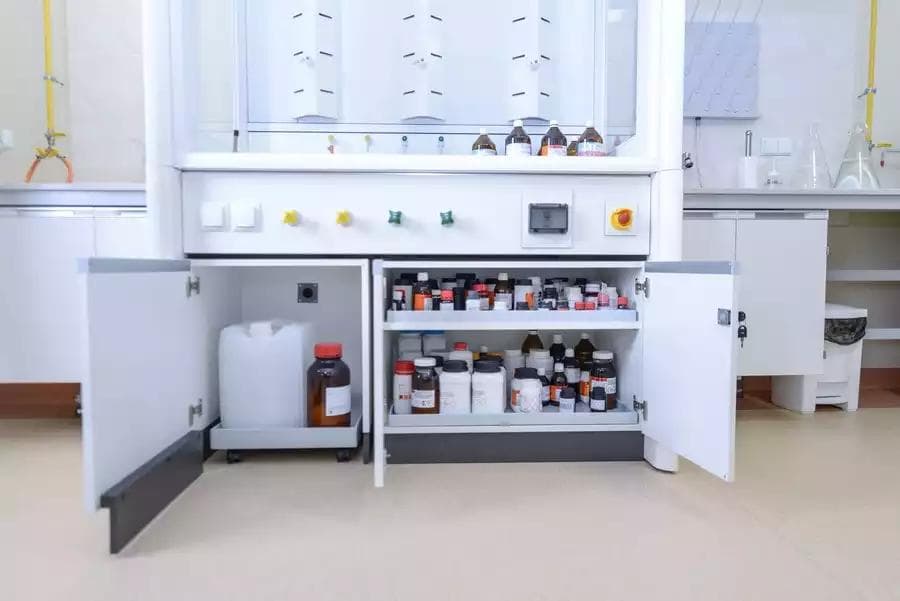
Fume Hood Maintenance and Inspections - How to Maintain Efficiency and Safety?
Regular laboratory fume hood maintenance and timely technical inspections are the basic conditions for maintaining operational continuity and safety in any modern laboratory. A properly serviced laboratory exhaust hood effectively removes dangerous substances, protecting personnel from poisoning and ensuring a stable airflow velocity. Negligence in this area leads not only to mechanical failures but, above all, to the loss of protection guaranteed by certified laboratory furniture and integrated exhaust systems.
What is a laboratory fume hood and what is it used for?
A fume hood is a specialized exhaust cabinet protecting workers from toxic vapors, dusts, and chemical particles. It is a crucial protective device equipped in every modern laboratory. This device is responsible for the effective evacuation of hazardous substances from the operator's working zone. Depending on the specifics of the work, there are standard fume hoods, special application variants, models with a water filter (fume scrubber), with closed ventilation, large walk-in structures, weighing boxes, benchtop exhausts, as well as units with HEPA filters. Properly selected laboratory fume hoods and professional laboratory furniture constitute the foundation of occupational health and safety. It is worth remembering that the servicing of a ducted and ductless (filtering) fume hood differs in the scope of tasks. The ducted model requires inspection of ducts and the fan, whereas a ductless fume hood involves filter replacement.
What airflow must an efficient fume hood have?
The correct inflow air velocity at the working window is between 0.3 and 0.5 m/s. Maintaining this value guarantees the extraction of harmful vapors before they leave the working chamber. Modern equipment and laboratory furniture have a built-in air monitoring system. A dedicated airflow sensor registers operating parameters in real time. When a drop in inflow velocity occurs, automatic optical and acoustic signaling is immediately triggered. Every laboratory periodically verifies this system using an anemometer.
How to clean and maintain a fume hood step by step?
Maintenance includes cleaning the working chamber, inspecting seals and the sliding sash, and checking fan efficiency. A properly planned inspection of a laboratory fume hood is the foundation of safe operation. The first stage is cleaning and decontaminating the working chamber while observing health and safety rules. How to clean a laboratory fume hood step by step? All reagents must be removed from the worktop, and then the walls washed with neutralizing preparations. All equipment and laboratory furniture must be protected against potential contamination in every research facility.
The second step is the verification of all moving elements that the exhaust cabinet has. A thorough inspection of the sliding sash mechanics is necessary. The tension of cables, the efficiency of pulleys, counterweights, and smoothness in the guides are checked. Any mechanical resistance may signal component wear, which creates a risk of sudden glass dropping and endangers the operator, especially when highly harmful substances are being analyzed. A regular inspection of the running system reduces the risk of mechanical failure during an ongoing chemical experiment.
The third stage answers the question of how to check the efficiency of the exhaust in the laboratory. The effectiveness verification is carried out by performing a smoke test and measuring airflow. The smoke test allows visualization of the air trajectory, which flawlessly indicates whether toxic vapors are discharged through the laboratory exhaust and ventilation duct outside the building. Suction force measurements should be stable and free from turbulence occurring at the working window of the station.
Why does the exhaust efficiency in a fume hood decrease?
Most often, the cause is the deposition of acid vapors in the ducts, which leads to the narrowing of the pipe lumen. A common phenomenon is also corrosion of the installation or wear exhibited by the exhaust fan. Solid pollutants and tarnish limit the draft, which causes the laboratory exhaust to undergo gradual degradation in an aggressive chemical environment and requires periodic removal of deposits. Knowing when to call for laboratory fume hood service helps avoid critical failures. In case of any deviations from the norms (disturbing fan noises, a jamming window, or loud flow alarms), immediate intervention by professionals is required. Let's also remember that laboratory fittings and valves installed inside fume hoods require simultaneous verification. Similar rigors apply to a school fume hood, although it operates under lower chemical loads. The culmination of the work is documentation: a post-inspection protocol and an entry in the device's exploitation logbook. All mechanical repairs of windows, ventilation system, and sensor diagnostics must absolutely be carried out by qualified specialists. Some service works, including critical mechanics and electrical installation, for safety reasons require an authorized technician with specialized technical certificates and qualifications necessary for working with protective devices.
Who conducts the technical inspection of a fume hood?
The technical inspection is performed by an authorized service or an authorized technician with appropriate qualifications. This is the foundation of safety and responsibility in every research facility. Who is responsible for equipment inspections in the laboratory? For the technical examination to be fully reliable, physical control over the equipment must be taken over by a professional laboratory equipment service or an authorized technician with appropriate qualifications. Professional service guarantees reliability, lower energy consumption, and lower costs. The service has access to original spare parts. When servicing laboratory furniture, it is worth contacting the manufacturer.
How often should a periodic fume hood inspection be done?
A periodic technical inspection is carried out at least once every 12 months, in accordance with the PN-EN 14175 standard. This is a basic safety requirement in every laboratory facility. How to assess the technical condition of a fume hood before an inspection? Personnel should perform a daily visual inspection of the sliding window, listen to the fan's operation, and check the alarm's reaction after starting the exhaust. Such habits allow for quick detection of potential irregularities. Additionally, advanced laboratory furniture and equipment undergo validation procedures. A full periodic inspection also includes Installation Qualification (IQ) and Operational Qualification (OQ), which officially confirm the full technical and functional operational status of the device.
What standard regulates fume hood inspections?
The primary standard for fume hoods throughout Europe is PN-EN 14175. It is this standard that comprehensively regulates all specific design and operational requirements that modern exhaust cabinets must meet. The PN-EN 14175 document precisely defines the design requirements for exhausts, test methods for the efficiency of capturing hazardous vapors, and procedures including factory type testing. Compliance with this standard is a key criterion for assessing fume hoods.
When to take a fume hood out of service?
A fume hood must be immediately shut down in the event of an alarm failure, damaged glass, or lack of draft. Continued work in such conditions poses a direct threat to personnel. Critical conditions include damage to the mechanics of the sliding window (damaged glass, broken cables, pulleys, counterweights), lack of response from flow sensors, and non-functioning mechanical ventilation. In the event of a failure, reagents must be secured, laboratory furniture and equipment marked as defective, and service called immediately. A working explosion-proof flap is also useful here.
Why does a working fume hood protect the entire laboratory?
A working fume hood protects personnel from inhaling harmful substances and prevents vapors from spreading throughout the facility. What are the safety guidelines regarding laboratory exhausts? The main goal is to protect the respiratory tract from vapors, dusts, and volatile particles. Rapid movements of the operator can cause turbulence and escape of vapors, which is why a lowered sash and working in the center of the chamber are important. This is ensured by the chemical resistance of the worktops. An essential laboratory worktop and safety cabinets protect against hazardous substances.
August 10, 2026