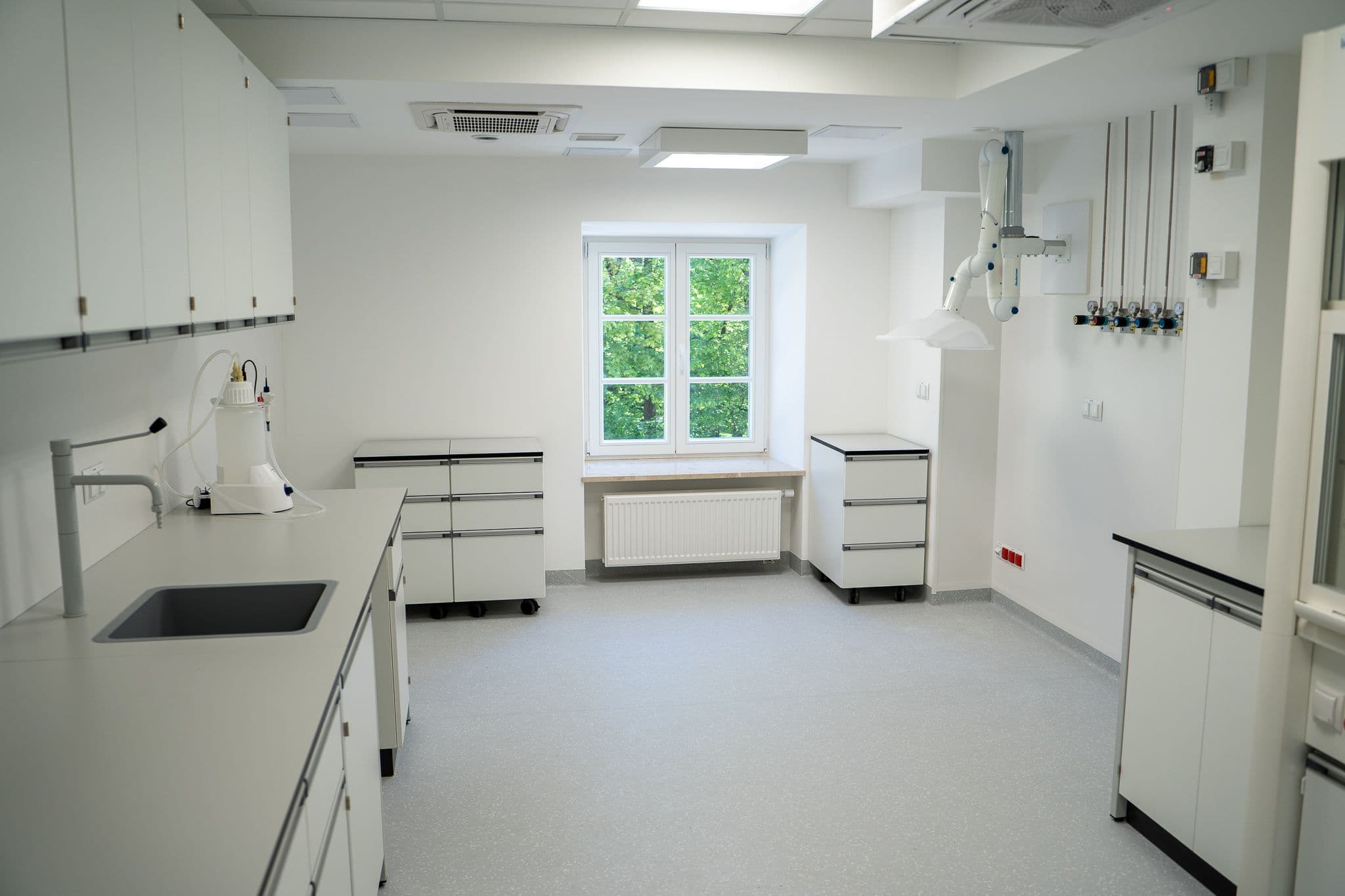
How to plan a laboratory with future expansion in mind?
The modern research environment is characterized by extraordinary dynamics. Changes in the profile of conducted research, the introduction of new analytical technologies, or even the turnover and expansion of scientific teams mean that laboratory space must be ready for evolution. Designing a laboratory solely for current needs is a trap that in a few years can lead to costly reconstructions and downtime in the facility's operation.
As experts at Renggli, we perfectly understand that the key to success is the scalability and flexibility of the infrastructure. Below we present a comprehensive guide on how to step-by-step plan a laboratory that will easily adapt to the challenges of the future.
Modular laboratory furniture systems
The concept of a static laboratory, where workbenches are permanently attached to the floor and walls, is becoming a thing of the past. Future-proof planning requires the use of solutions that will allow for a quick rearrangement of the workspace without the need for a major renovation.
The solution to this problem is modular laboratory furniture systems. By choosing the Renggli assortment, you invest in tables, cabinets, and workstations that create an advanced, fully integrated modular system.
- Mobility: Tables on castors with stable locking capabilities allow for an instant change in the laboratory layout, e.g., from individual to team work.
- Interchangeability of elements: If it becomes necessary to install a larger analyzer or new equipment in the future, the modular nature of our furniture allows for easy detachment of a single segment and integration of new equipment.
- Ergonomics and comfort: The ability to adjust the height of the worktops to specific tasks (sitting or standing work) is a standard that significantly increases the efficiency and safety of the staff.
Ceiling and utility supply systems
The expansion of a laboratory almost always involves an increased demand for utilities: electricity, technical gases, compressed air, or demineralized water. The classic routing of installations in walls or floors drastically limits the possibilities of future changes.
To ensure the infrastructure is not restricted, it is worth investing in independent, suspended media distributors. Renggli ceiling and supply systems are the peak achievement in the field of installation flexibility. They allow island laboratory tables to be supplied directly from above. Thanks to this, a research table can be moved to another location at any time without worrying about breaking up the floor.
Additionally, the modern laboratory fittings mounted in our modular systems are characterized by exceptional chemical and mechanical resistance, and the ability to easily add more quick-connect valves means that new connections can be added in just a few moments.
Modern fume hoods and space adaptation
Regardless of the direction in which your laboratory develops, staff safety remains a priority. Along with the increasing complexity of research processes comes a growing risk of exposure to harmful vapors, aerosols, and gases. Therefore, when designing a facility, it is necessary to provide space and ventilation capacity for additional chemical fume hoods.
Modern Renggli fume hoods are devices designed with the highest safety standards (compliance with the EN 14175 standard) and energy efficiency in mind.
Our fume hoods work with intelligent building ventilation systems. They optimize energy consumption by adjusting the exhaust force to the degree of opening of the sash, which is crucial from the point of view of optimizing the maintenance costs of an expanded laboratory.
Within our product lines, we offer fume hoods of various dimensions and purposes (from standard ones to fume hoods for working with acids or isotopes), which can be coherently integrated with the rest of the furnishings.
Fume hoods equipped with monitoring systems continuously analyze the airflow, guaranteeing full compliance with stringent health and safety requirements, regardless of how much the reagents used in the laboratory change.
Compliance with the highest standards and readiness for digital technologies
Future laboratory expansion very often entails the need to adapt the facility to new, more rigorous quality norms and strict safety standards. When designing a flexible research space, key organizational aspects should be considered from the very beginning, such as collision-free communication paths, appropriate zoning of air cleanliness, or safe waste logistics.
Moreover, the modern analytical environment is increasingly a digitally integrated space. In Renggli concepts, we always provide ample installation space in ceiling systems and cable trays. As a result, the entire infrastructure is fully ready for the seamless implementation of Laboratory 4.0 solutions. This allows for trouble-free expansion of the IT network, installation of intelligent environmental sensors, and integration of advanced research data management systems, bypassing the need for burdensome and costly construction work.
Comprehensive laboratory design services
Independently planning a fully flexible and compliant analytical space is a huge challenge, requiring specialized knowledge in the fields of engineering, ventilation, and ergonomics. For this reason, it is worth entrusting this task to experienced professionals.
Renggli offers comprehensive laboratory design services. Our process begins with an in-depth analysis of the investor's needs (both current ones and long-term development strategies). On this basis, we create three-dimensional space management concepts (BIM), precisely selecting laboratory furniture, fume hoods, ventilation systems, and utility distribution installations.
The future begins in the design phase
Designing a laboratory ready for expansion is an investment that pays for itself many times over. Avoiding forced technological downtime, ensuring team safety, and having the ability to instantly adapt to new research projects are competitive advantages that cannot be ignored. The use of modular systems, flexible ceiling installations, and top-class fume hoods is the only right path to creating an innovative space.
July 15, 2026