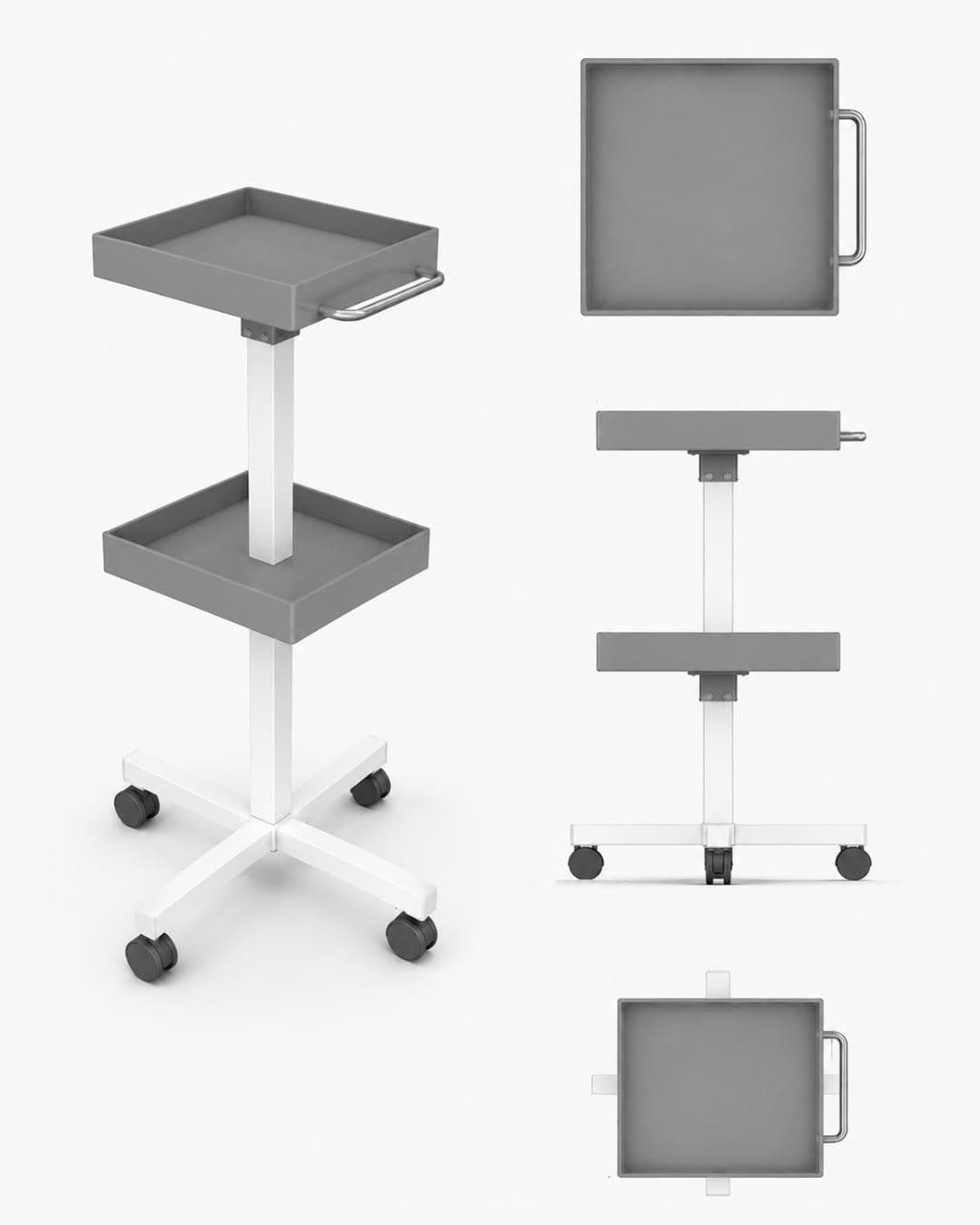
Laboratory cart - construction, materials, and equipment
A professional laboratory transport cart made of AISI 304 or 316L acid-resistant steel provides a load capacity of up to 300 kg and allows for safe, repeated sterilization. What characterizes such an assistant? It is advanced equipment where every structural element has a strictly defined protective and logistical function. The frame must be fully resistant to corrosive processes, and solid shelves with a safety rim effectively limit the risk of hazardous substances spilling onto the floor or lower levels. An important detail is the closed surface of the worktop, which prevents liquid penetration into the structure.
A mobile laboratory cart is equipped with locking swivel casters and a non-marking tread, ensuring smooth maneuvering even in narrow corridors. An ergonomic pushing handle facilitates navigation, and corner bumpers protect other furniture and walls against accidental impact. In areas protected against electrostatic discharge, specialized versions equipped with conductive casters are standardly used, thoroughly protecting sensitive equipment.
A stainless steel or HPL laminate laboratory assistant cart. What to ultimately choose? Both variants have specific applications. A cart with a troughed top made of acid-resistant steel perfectly withstands intensive disinfection. On the other hand, high-pressure laminate (HPL) on a metal frame provides a lighter and quieter alternative during movement, although slightly less resistant to mechanical damage. The designations of stainless steel grades (e.g., 304 or 316L) should primarily be considered in terms of differences in their physical resistance to pitting corrosion in a chemical environment, as neither is a universal standard for absolutely every laboratory.
Hygiene requirements for transport carts and racks
Transport equipment in clean zones and cleanrooms must strictly allow for intensive alcohol disinfection and autoclaving. In such areas, transport racks in the laboratory rely on smoothly finished welded structures. They have a huge advantage over bolted versions made of open profiles. Eliminating hard-to-reach crevices from the frame means that contaminants have nowhere to accumulate, significantly facilitating the work of cleaning and biocidal agents.
Requirements in strict-regime laboratories are uncompromising. Transport carts and racks in medical laboratories must allow disinfection of the entire unit, including the casters. The materials used absolutely cannot contain any absorbent elements. In sterile cleanrooms, internal transport systems are subject to exactly the same material rigors as typical stationary laboratory furniture.
Designing laboratories working with hazardous biological materials also requires a hard, process-based separation of clean and contaminated streams. The dual-circuit principle applies directly at the level of all transport equipment used. Clean platforms never come into contact with infectious zones.
Chemical resistance of mobile transport racks
A mobile transport rack made of acid-resistant steel ensures full resistance to aggressive acids, bases, and solvents, protecting against pitting corrosion from chlorides. With constant chemical contact, a higher grade of steel is a necessity.
High-pressure laminate tolerates most reagents well, but is vulnerable at the edges. Mechanical damage clears the way for liquids to reach the core, threatening mainly horizontal shelves, not the vertical frame.
Budget furniture made of powder-coated profiles is completely useless; paint damage immediately exposes the metal and initiates corrosion. Regardless of the chosen solutions, any spilled chemicals must always be removed immediately.
Safety of transporting delicate glassware and reagents
Using unsuitable carts without edge protection increases the risk of glass breakage and chemical leaks. The lack of dedicated equipment risks tipping a vessel on uneven surfaces, colliding with furniture, or spilling a corrosive substance on the operator.
These incidents are limited by raised shelf edges and dedicated transport inserts for beakers and flasks. Casters with a larger diameter handle threshold strips much better, and their solid lock reliably stabilizes the platform while loading equipment.
Established organizational rules are also crucial: transporting reagents only in secondary containers, a ban on overloading the top shelf, and having one person operate the assistant cart. The method of moving chemicals is dictated by safety data sheets and internal procedures.
How to match the cart's load capacity and dimensions to the tasks?
An optimal laboratory cart should feature a load capacity of 150 to 300 kg and a height of up to 900 mm. How to match the load capacity and casters for a laboratory cart? Always follow a specific sequence. First, the height is matched to the worktops, and the width to the doors. Next, the number of shelves is determined, and finally, the load capacity.
Two shelves are standard for transporting equipment, and a larger number facilitates glassware logistics. The declared load capacity applies to the entire cart; an even weight distribution between levels guarantees a safe center of gravity.
Spatial logic is key. A cart wider than the aisles between working rows is useless, regardless of its lifting capacity. Accurately selected dimensions are a prerequisite for smooth operation.
Organization of material flow in the laboratory
Implementing mobile racks and FIFO stations streamlines sample logistics and reduces unnecessary personnel movements. How to organize a safe flow of materials and samples in the laboratory? The foundation of this process is a rigorous workspace design: strictly establishing the sequence of activities performed, physically assigning them to designated zones, as well as setting fixed drop-off points and precise, collision-free transport routes.
A properly planned quality of research processes absolutely requires that the paths of clean and contaminated materials never cross. Analytical stations are therefore arranged to enforce natural separation. The number of transits made is excellently limited by: intermediate points right next to the workstations, designated, fixed drop-off locations for glassware before and after washing, and the use of bulk containers, fully replacing the transport of single test tubes.
These types of fundamental principles are most often formulated and structured by the lean management methodology, which is increasingly applied in chemical environments. However, logistical conclusions and solutions remain universally effective in any setting, completely regardless of the strict definition and official name of the management concept used.
Types of flows: samples, reagents, glassware, and waste
Logistics distinguishes between linear flow, loop flow, and FIFO stations. What are the types of flows in logistics? Such material flow covers four paths: samples, reagents, glassware, and waste. Where routes intersect, sealed containers are used.
Glassware after washing and before it cannot be transported using the same equipment without decontamination. Therefore, mobile wheeled laboratory furniture requires strict assignment to a given work zone in the laboratory, completely eliminating the risk of contamination.
How to match internal transport to a mobile furniture system?
In a mobile furniture system, part of the transport tasks is taken over by the furniture itself - cabinets are moved to the workstation. How to adapt transport carts to the RL6 laboratory furniture system? Modular cabinets on casters can be freely moved, gaining valuable workspace, and extensions allow the workstation to be expanded without construction work.
Such an arrangement drastically reduces the number of trips across the room. It requires easy access to installations to quickly disconnect utilities. Importantly, transport equipment must be selected so that its height precisely matches what the laboratory worktops offer. Moving heavy equipment then comes down to safely sliding it over the edges.
Laboratory cart vs. catering cart: key differences
When choosing mobile furniture, laboratory carts must not be equated with catering carts. Chemical resistance fundamentally divides them: food-grade steel cannot withstand solvents, whereas an acid-resistant cart or a mobile rack are reliable. On the other hand, antistatic casters with a lock almost never occur in food-grade variants. The lack of raised edges means that spilled liquid immediately floods the floor, and open profiles block decontamination.
Savings during purchase disappear when equipment destroyed by a reagent goes to disposal. A simple two-shelf cart with a pushing handle and corner bumpers is only suitable for transporting office documentation. Clean zones mean extremely strict chemical rigor, so a dedicated acid-resistant frame is the only proper work ergonomics.
September 08, 2026