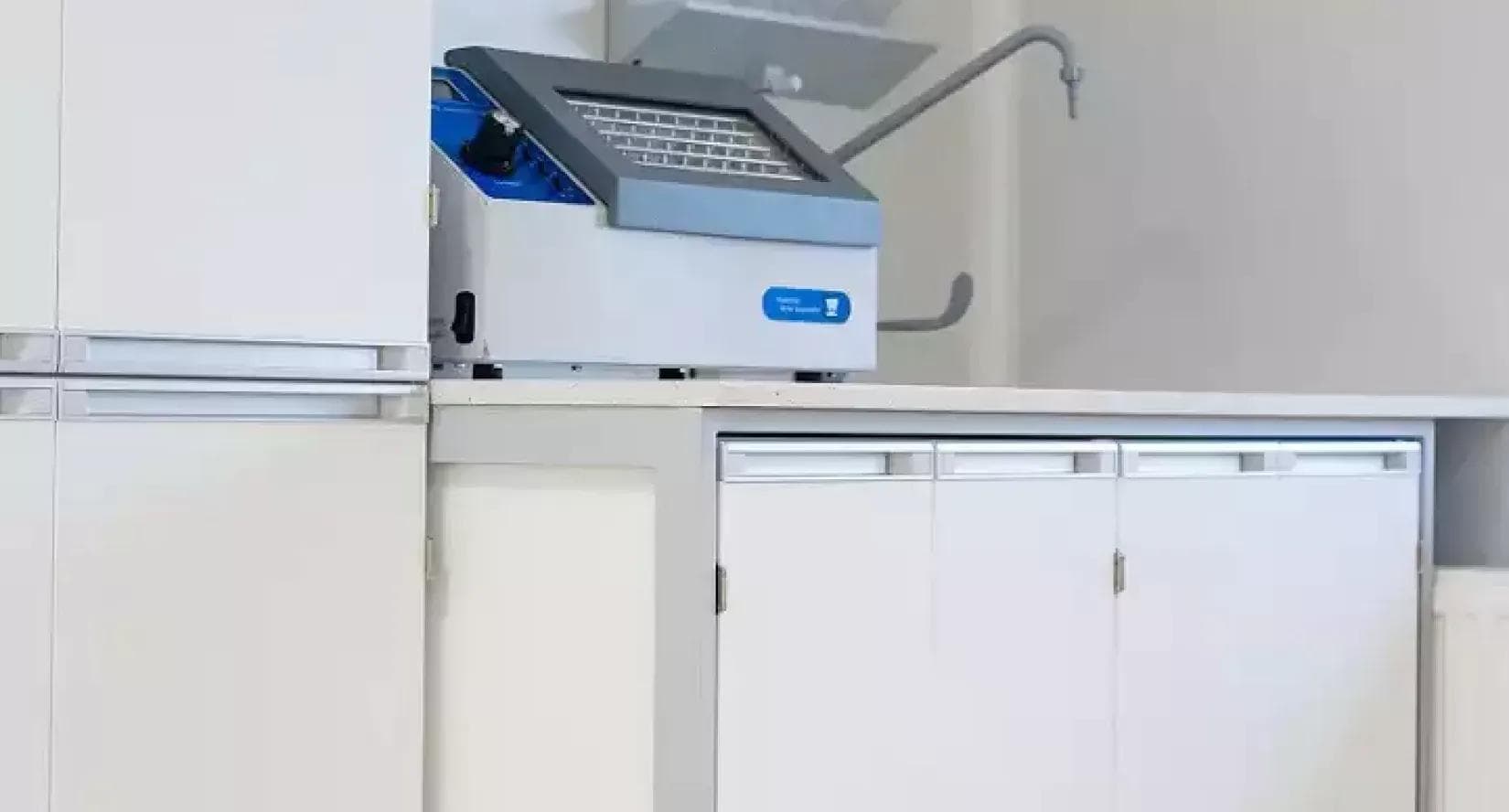
Many investors start equipping a laboratory with furniture, worktop colors, or cabinet layouts instead of equipment and technological processes, which should dictate architectural and installation conditions. Such an order can be costly to fix. A holistic approach treats furniture as a flexible enclosure for technology, not the other way around.
Understanding process needs: Equipment in the foreground
Large research devices, such as mass spectrometers, liquid and gas chromatographs, or bioreactors, have very specific size, weight, and thermal requirements. Their dimensions, weight, and the amount of heat generated directly affect the choice of room, ceiling height, and the layout of workstations.
The arrangement of individual devices imposes a specific logic of moving around the laboratory. Before designing worktops and furniture lines, one must first plan the movement paths of personnel and samples, from material reception, through analysis, to waste disposal, while maintaining the separation of clean and dirty zones. Only such an established workflow should be enclosed with functional furniture.
At the conceptual stage, designing in a 3D and BIM (Building Information Modeling) environment is becoming increasingly important. It allows for early detection of potential collisions between equipment, installations, and building structural elements even before the investment begins, significantly reducing the risk of costly design changes at a later stage of work.
Installations and utilities - the hidden nervous system of a laboratory
Every advanced research equipment requires access to specific technical utilities. This includes technical gases, such as argon, nitrogen, or helium, used e.g., for sample inertization or as a carrier gas in gas chromatography, as well as compressed air, vacuum, cooling water, and three-phase power. Without a properly planned utility network, no device will operate according to the manufacturer's specifications.
Increasingly common solutions are ceiling supply systems, including service boom arms and media columns, which deliver all necessary utilities directly above the workstation. Such columns can combine electrical sockets, gas draw-off points, and local lighting in one housing, which frees up space under the worktops and along the walls, while facilitating servicing and ongoing inspection of the installation.
Routing installations from above, bypassing rigid wall connections, provides the ability to freely move equipment in the future. This is a significant advantage in laboratories where the machinery park changes with the development of research methods; rearranging the workstation layout then does not require interfering with installations hidden in the walls or floor.
It is also worth planning an adequate reserve of utility draw-off points relative to current needs. Redundant connections, seemingly generating additional costs at the start of the investment, in practice eliminate the need to forge walls and ceilings with every subsequent change in the equipment park.
Modular laboratory furniture as an answer to equipment requirements
Once it is known where the equipment will be placed and how utilities will be supplied to it, you can move on to designing the furniture. Their task is to support the equipment and processes, not to limit them; this is a fundamental change in order that distinguishes conscious technological design from purely aesthetic interior furnishing.
Modular laboratory furniture allows for easy reconfiguration of space along with changing needs. If a laboratory decides to purchase a larger analyzer in the future, table and cabinet modules can be relatively easily expanded, lowered, raised, or moved without having to replace the entire setup.
In practice, this means tables with electric height adjustment, mobile under-bench cabinets and cabinets on wheels, and interchangeable, chemically resistant worktops that can be instantly adapted to a new workstation. Such a design also allows for convenient routing of cabling and utility lines regardless of the current furniture configuration, which reduces the time to retool a workstation when changing research methodology.
Equally important is adjusting the height of the worktops and the depth of the tables to the dimensions of specific devices. A lab technician should have comfortable, ergonomic access to control panels, service ports, and sample loading zones, both in sitting and standing positions.
Safety and load-bearing capacity: Weighing tables, fume hoods, and loads
High-precision equipment, such as electron microscopes or analytical balances, is extremely sensitive to vibrations. In practice, this means the necessity to use dedicated weighing tables equipped with anti-vibration systems and worktops with increased dead weight, mechanically separated from the rest of the furniture line, so that vibrations from adjacent workstations do not interfere with the measurement.
Modern research equipment, especially analytical devices and bioreactors, can weigh hundreds of kilograms. The furniture design must take this into account by using reinforced support frames, including C-frame or H-frame structures, designed to carry extreme point loads without the risk of deformation or damage to the worktop.
Devices generating heat, dust, or harmful vapors require integration with fume hoods or local extraction arms placed directly at the emission source. It is crucial here to synchronize the building's general ventilation (HVAC) capacity with exhaust systems to avoid negative pressure or uncontrolled mixing of air streams that could affect analysis results.
Designing from the general to the specific
Starting an investment by selecting furniture usually ends with costly installation modifications and a lack of ergonomics at the final workstations. The opposite approach, starting with technology, allows you to consciously plan every element of the infrastructure and create a laboratory ready for future changes.
August 25, 2026