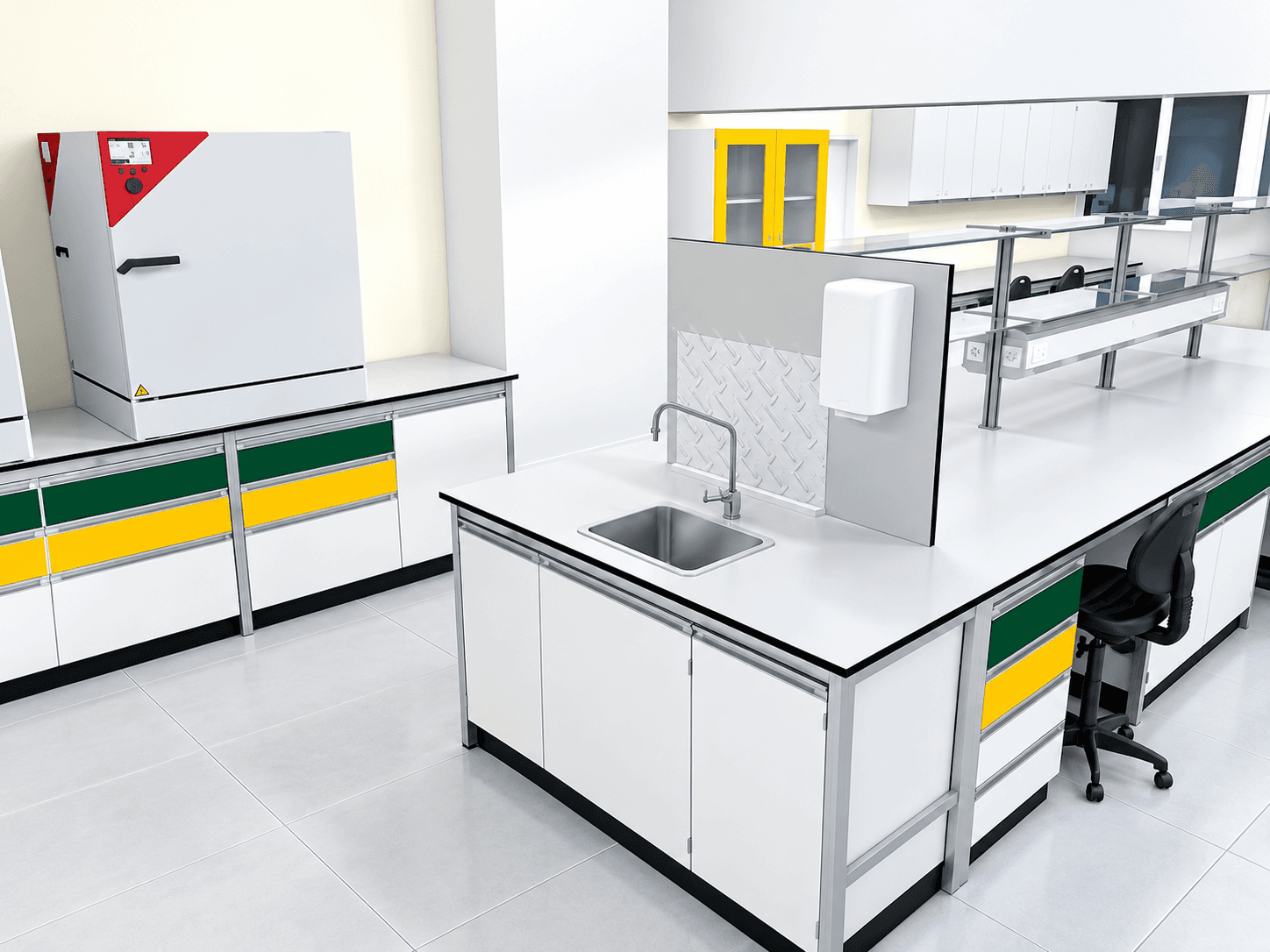
The importance of professional equipment in school laboratories
Education in the field of exact sciences requires appropriate technical facilities. Professional equipment of laboratories in high schools and universities plays a fundamental role in the teaching process. It is a modern, well-thought-out working environment that effectively motivates students to explore knowledge and allows for a smooth transition from dry theory to fascinating practice.
Ordinary school desks are not adapted to the specificity of chemistry, physics or biology classes. Replacing them with certified workstations opens up completely new possibilities for institutions. Teachers gain the opportunity to safely conduct advanced experiments that illustrate the discussed phenomena much better than traditional lectures conducted at the blackboard.
Contact with professional equipment is also of great importance for the future careers of young people. Using strictly designed workstations familiarizes students with the standards that prevail on a daily basis in real research units and in modern industry. Thanks to this, school education becomes a real preparation for a future scientific career.
Student safety as the highest priority in the laboratory
Occupational health and safety (OHS) issues are the absolute foundation when designing any school laboratory. Modern laboratory systems are created with the aim of almost completely minimizing the risk of potential accidents. These structures must actively prevent the most common threats, such as uncontrolled spills of corrosive substances or dangerous short circuits of the electrical installation.
All equipment approved for use in educational institutions must have appropriate certificates. Meeting strict European standards is an absolute guarantee that the materials and construction solutions used have passed rigorous endurance tests. For the school management, this means certainty that the students are in a safe and controlled environment.
A key aspect from the perspective of the teacher is full control over laboratory utilities. Teaching stations are equipped with intuitive access to water and gas valves, as well as power sockets. An essential safety standard are emergency, central power cut-off systems, which allow the teacher to react immediately and block the supply of utilities in the entire room using a single button.
School fume cupboards – essential protection against fumes
Performing experiments using volatile, irritating or toxic chemicals requires the use of specialized fume hoods. Fume cupboards in versions dedicated to teaching purposes are an absolute necessity in every modernly equipped chemistry lab. Their main task is to effectively isolate the working zone from the rest of the room where students are present.
Models intended for schools are distinguished by a specific design, usually glazed on several sides, and sometimes on all four. Such a transparent structure allows the entire class to safely and clearly observe the course of chemical reactions from any place in the room. Students can follow the experiment without the need to dangerously approach the worktop.
The high effectiveness of fume cupboards is based on advanced ventilation systems. Precisely directed airflow and efficient exhaust mechanisms protect the respiratory tracts of students and teachers. They effectively separate the people present in the room from contact with dangerous fumes, microscopic dusts, and harmful aerosols.
Ergonomics and working comfort during chemistry and biology classes
Proper ergonomics of laboratory stations has a direct impact on the health and posture of students. The use of professional laboratory chairs and stools with an anti-slip coating allows for stable and safe manual work. Adjusting the appropriate height of the worktops to the age and height of the users prevents slouching and develops proper habits when working at a microscope or with beakers.
It should be remembered that class blocks in laboratories often last for several lesson hours. Adequate physical comfort prevents rapid fatigue of the musculoskeletal system, which directly translates into a longer ability to maintain concentration. A focused student is a student who makes fewer mistakes when measuring reagents and follows the teacher's instructions more carefully.
An important element of ergonomics is also the ease of keeping the workstations impeccably clean. The use of perfectly smooth surfaces of laboratory furniture, devoid of unnecessary crevices, makes it easier to maintain a high level of hygiene and sterility. It also significantly accelerates the process of tidying up the laboratory after exhausting practical exercises.
Modular furniture systems – flexibility in education
Contemporary school laboratories must be characterized by multifunctionality, allowing for a smooth combination of theoretical lectures with practical work in smaller groups. The answer to these needs is the modularity of the equipment. The use of flexible structural frames and installation extensions allows for maximum utilization of the available space, regardless of the room's size.
Thanks to mobile modules on wheels and easy desk connection systems, the layout of the laboratory can be quickly rearranged. The teacher can change the setup in a few minutes from a traditional, row-based lecture layout to working islands, ideal for project work and team experiments. Such flexibility dynamically supports various teaching methods.
The modular furniture concept is also a huge advantage in the context of the future of the educational institution. It ensures the ease of subsequent expansion or modernization of the school laboratory. Adding new workstations or replacing individual components is done non-invasively, eliminating the need for a costly and time-consuming general renovation of the entire building.
Durable worktops resistant to damage and reagents
The heart of every laboratory station is the worktop, which in school conditions is constantly exposed to intensive use. The selection of appropriate construction materials is of key importance. The highest standards are currently met by solid ceramics, specialized epoxy resins, and advanced HPL laminates, which are able to survive decades in a demanding educational environment.
In school realities, worktops must be characterized by extreme resistance to various destructive factors. High tolerance to scratches and mechanical impacts is required, as well as to extremely high temperatures, generated for example by Bunsen burners. Equally important is complete inertia to the action of corrosive acids, bases and strong solvents.
To further raise the safety level during classes, special worktop profiles are used. Solutions such as raised edges (so-called marine edges) effectively stop liquids from uncontrolled spilling. In the event of an accidental spill of a dangerous reagent by a student, the substance remains on the desk surface, protecting the floor and the users' clothing.
Weighing tables and precision in a school laboratory
Even in educational analytical laboratories, the precision of measurements plays a key role in the proper understanding of the laws of physics and chemistry. Learning to accurately weigh microscopic amounts of reagents, however, requires meeting strict environmental conditions. The basic requirement for sensitive analytical balances is a perfectly stable and completely vibration-free substrate.
Ordinary laboratory tables transmit micro-shocks generated by the operation of devices, and even students' footsteps in the school corridor. To eliminate this problem, specialized weighing tables are installed in laboratories. Their design is based on separating the worktop from the weighing zone, which prevents the transmission of vibrations from the leaning student's hands to the sensitive mechanism of the device.
A key element of a professional weighing table are very heavy stone tops, most often made of polished granite. In combination with built-in, advanced vibration isolation systems (special polymer vibration isolators), the table completely dampens any shocks from the surroundings. This allows learning reliable analytics and completely eliminating bothersome measurement errors during classes.
Safety cabinets and storage of chemicals
Storing reagents at school requires absolute adherence to strict procedures and legal regulations. Chemicals cannot be stored in ordinary furniture due to the risk of dangerous fumes and the possibility of spontaneous combustion. Only certified, specialized safety cabinets are used for this purpose.
Depending on the type of stored materials, the laboratory equipment should include fire-resistant models (protecting flammable liquids from fire for a specific time, e.g., 90 minutes) and cabinets with an integrated extraction system. Constant ventilation of the furniture interior ensures that harmful fumes accumulating around reagent bottles are continuously removed outside the building.
Proper storage of acids, bases and toxic substances is a legal obligation imposed on the management of every educational institution. Certified laboratory equipment guarantees 100% compliance with safety requirements, while offering solid lock systems. Locking with a key is crucial to completely prevent unauthorized persons from accessing dangerous chemicals.
October 07, 2026