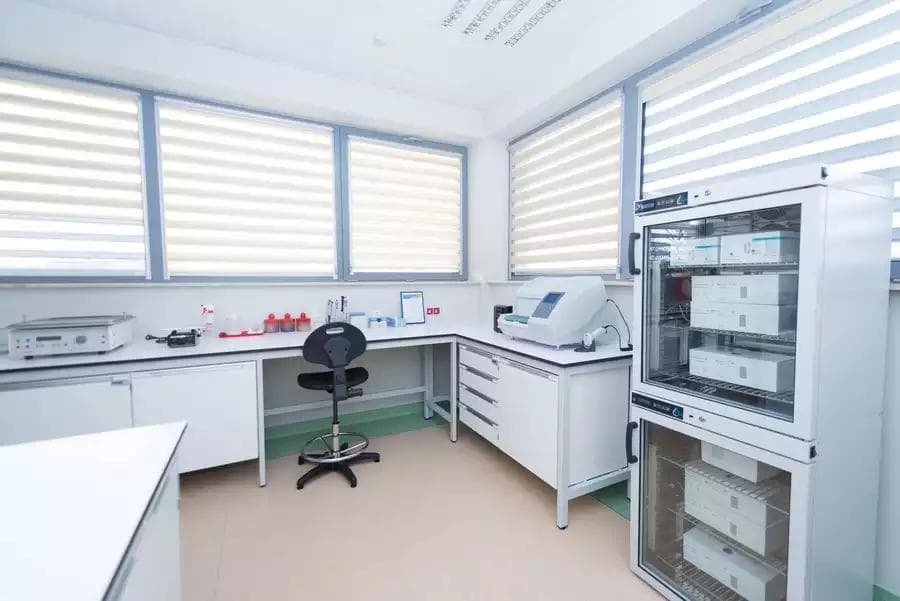
Perchloric acid fume hood - special design requirements
Safe operation with concentrated perchloric acid requires the use of a specialized fume hood. The laboratory fume hood must feature a water wash-down system and guarantee a minimum airflow velocity of 0.5 m/s. The Swiss manufacturer Renggli supplies tailor-made, chemically resistant installations from its factory in Białystok.
What is a laboratory fume hood for perchloric acid?
It is a dedicated extraction hood with a water wash-down system that isolates personnel from acid vapors and prevents the accumulation of explosive perchlorates. What is a fume hood? It is a primary measure of collective protection that isolates personnel from hazardous chemical vapors. Its operating principle is based on negative pressure inside the chamber, which forces a constant influx of fresh air through the sash window. Safety and protection efficiency are guaranteed by maintaining an inflow velocity of approximately 0.5 m/s.
What distinguishes a perchloric acid fume hood from a conventional extraction hood is its absolute chemical resistance and non-flammability. The interior must be constructed of acid-resistant stainless steel 1.4404 (AISI 316L) or monolithic ceramics. The bottom of the chamber, in turn, consists of a monolithic ceramic worktop equipped with a raised marine edge to prevent spills. A properly designed acid-resistant fume hood or a fume hood with a ceramic chamber completely eliminates the risk of vapors reacting with the walls of the cabinet. Another difference is the double rear baffle and an integrated water wash-down system. A spray manifold located inside delivers water to the walls and extraction ducts. Regular washing of deposits is necessary to prevent the crystallization and accumulation of explosive perchlorate salts.
What technical requirements must such a fume hood meet?
A perchloric acid fume hood must feature exclusively inorganic seals and smooth, washable work surfaces. The construction of an extraction hood intended for concentrated perchloric acid requires the absolute elimination of all organic components. In joint areas and seals, only inorganic materials such as PTFE (polytetrafluoroethylene) or fluoropolymers are used, fully replacing classic natural rubber. The work chamber itself is characterized by an ideally smooth, washable surface devoid of micropores. This prevents the deposition of chemical microparticles and facilitates water runoff during the cleaning procedure. No wooden elements or flammable laminates can be present in the support structure of the device.
Modern extraction hoods are equipped with advanced safety systems. These include modules responsible for the continuous monitoring of airflow and automatic alarm signaling that notifies personnel of any fan operation irregularities.
Why does perchloric acid pose a risk of explosion in a standard fume hood?
Using standard extraction hoods when working with perchloric acid poses a risk of explosion due to the reaction of vapors with organic materials. Concentrated perchloric acid heated during laboratory analyses emits hot vapors with strong oxidizing properties. Standard laboratory furniture and commonly used fume hoods contain organic seals, synthetic resins, or traditional lubricants that enter into a violent chemical reaction upon contact with this acid. As a result of vapor deposition in the ventilation ducts, anhydrous explosive perchlorates are formed. These compounds exhibit extreme sensitivity to mechanical shocks, friction, and elevated temperatures, which can lead to an uncontrolled explosion. Ensuring full operational safety in accordance with GLP standards requires the absolute use of dedicated extraction devices.
How does the water wash-down system work in a fume hood?
The wash-down system flushes the back wall and ducts with water after each use, washing away perchlorate deposits before they become dangerous. The installation cleaning procedure is activated immediately after the completion of acid evaporation processes. The integrated water wash-down system delivers a stream of liquid under appropriate pressure to the double back wall, spray manifolds, and internal sections of the extraction ducts. Water thoroughly washes away all chemical condensates and streaks. Cyclic flushing prevents water from evaporating from acid solutions and prevents the formation of dangerous, dry perchlorate crystals. The washed-away contaminants are safely discharged into the laboratory drainage system through an acid-resistant rinse water settler. These types of OHS safety systems are a mandatory requirement for syntheses involving hot perchloric acid. A properly designed fume hood with a wash-down system guarantees stable operating conditions and neutralizes hazards at the very source of their formation.
How to design the ventilation and dedicated extraction for a fume hood?
A perchloric acid fume hood requires a completely independent extraction system made of acid-resistant materials, separated from the building's ventilation. Each extraction hood intended for perchloric acid must be connected to an autonomous ventilation system. It is strictly forbidden to connect these ducts to the general ventilation of the building or to extractions from other workstations to avoid mixing vapors with other reagents. Ventilation ducts should be made of materials resistant to strong oxidants; the use of AISI 316L acid-resistant steel or plastics (e.g., PP, PVDF) is recommended. An acid-resistant fan should be installed at the end of the extraction main, ensuring negative pressure along the entire length of the ducts. It is essential to design a constant slope of the ducts towards the fume hood, which enables the free gravitational runoff of water originating from the system wash-down. A correct ventilation installation must not have sharp bends or dead zones where deposits could accumulate.
What face velocity and what standards apply?
Fume hoods must comply with the PN-EN 14175 standard, and the face velocity through the sash window is usually maintained at around 0.5 m/s. The primary reference document in the field of design and verification of fume hoods is the PN-EN 14175 standard. It specifies requirements regarding safety, type test methods, and commissioning procedures performed directly at the workstation. The key indicator of protection efficiency is the airflow velocity through the aperture of the open sash window, maintained at approximately 0.5 m/s. This value prevents harmful substances from escaping outside the chamber while eliminating turbulence that disturbs the airflow. Full validation of the device includes KI-Diskus tests and the ASHRAE 110 methodology. The handover documentation must contain appropriate certificates and test reports confirming the correctness of the installation qualification (IQ) and operational qualification (OQ).
What materials are used to construct the fume hood chamber and worktop?
Monolithic ceramics and 1.4404 (316L) acid-resistant steel are best for perchloric acid – they are resistant to concentrated mineral acids. The choice of chamber finishing materials determines its chemical lifespan. Concentrated mineral acids lead to the rapid degradation of standard furniture materials, which is why HPL laminates or traditional resin boards are excluded from specialized fume hoods. Laboratory stoneware and fully monolithic ceramic slabs exhibit excellent parameters. These materials show total chemical and thermal resistance, and their non-porous structure prevents the penetration of reagents. A good structural alternative is 1.4404 (AISI 316L) acid-resistant steel.
An appropriately profiled laboratory worktop prevents the spilling of liquid substances. When outfitting a research workstation, matching the auxiliary components is also crucial. It is recommended that dedicated laboratory fittings and acid-resistant laboratory sinks be made of raw materials completely insensitive to the action of perchloric acid.
How to prevent the crystallization of explosive perchlorates in the extraction system?
Regular water flushing and smooth, seamless surfaces prevent the deposition of explosive, dry perchlorate salts. A lack of regular cleaning of the extraction ducts causes escaping vapors to settle on the walls and dry out. This creates dry, explosive perchlorates that are extremely sensitive to shock and friction, posing a risk of detonation. To prevent this, the work chamber must feature continuous monitoring of the airflow and seamless bonding of materials. The absence of micro-gaps and systematic wash-down effectively remove hazardous deposits.
Custom-made laboratory fume hood - how to order from Renggli?
A dedicated perchloric acid fume hood is ordered to size, based on a needs audit and technical consultancy. Ordering specialized extraction equipment tailored to individual process requirements begins with a detailed analysis of technological needs. This process includes support from technical advisors, the development of a dedicated executive design, and adjusting dimensions to the existing space. The extraction hood can be integrated with various modules, such as an under-bench safety cabinet or the RL6 modular system.
August 06, 2026