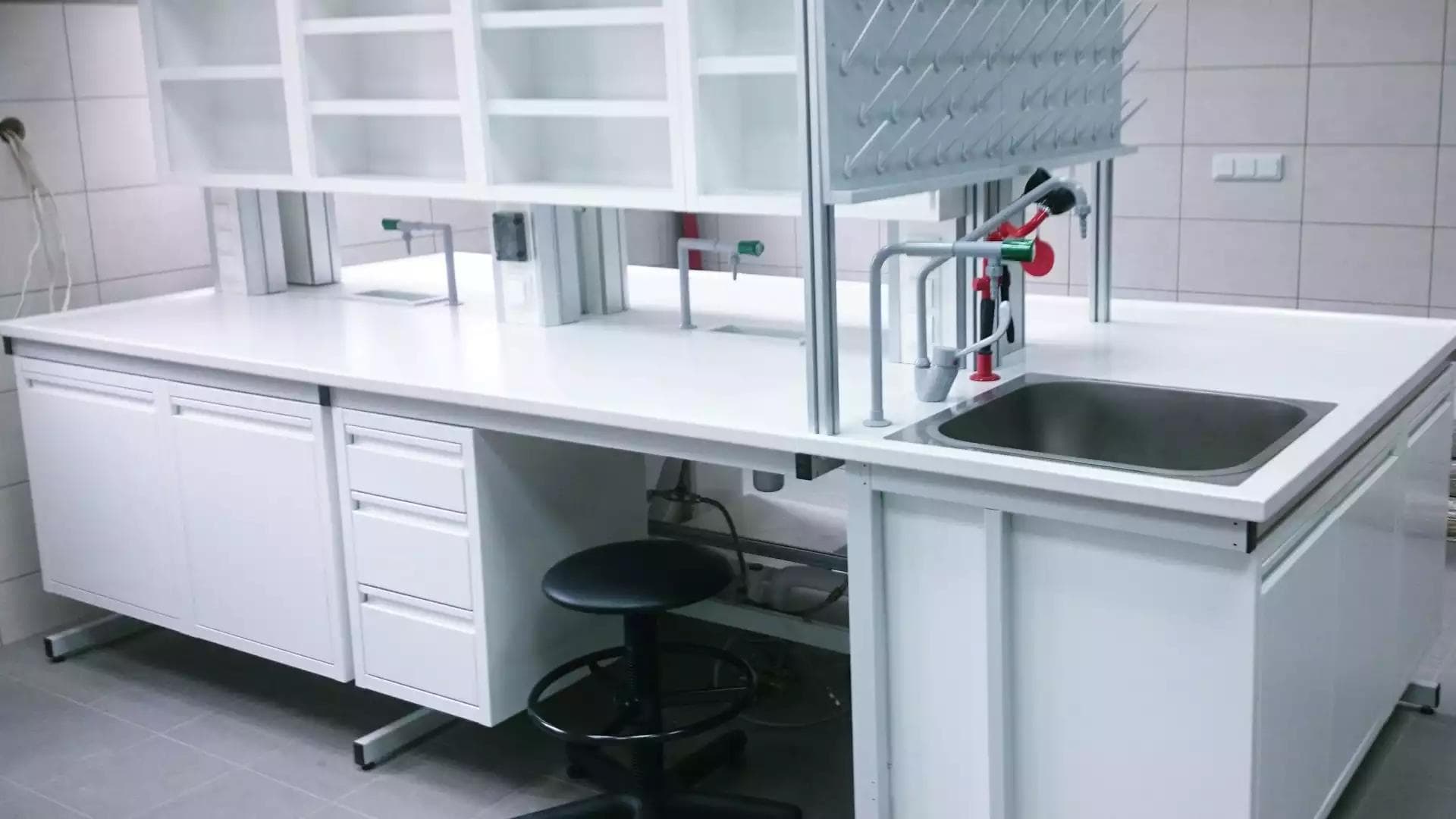
Laboratory sink: how to choose the size and design the chamber depth?
Choosing the dimensions of a laboratory sink prevents reagent splashes and glassware damage. Renggli, a Swiss manufacturer of laboratory equipment, designs custom-made sinks at its factory in Białystok, tailored to the specifics of the work.
How to choose the dimensions and depth of a laboratory sink chamber?
The dimensions of the chamber are matched to the size of the washed glass and the width of the base cabinet. Proper determination of these dimensions allows for maintaining full ergonomics and optimal workflow in the wet zone. A wide selection of available solutions, from small sinks to large, multi-liter sink chambers facilitates the precise configuration of any workstation. The selection is usually made individually through a request for quotation, as professional laboratory sinks are made directly to measure.
What sink dimension for an 80 cm cabinet will be best?
In such a layout, an appropriate technical reserve for connections and siphons must be included, which allows maintaining an ergonomic layout. Experienced designers support investors in the functional arrangement of washing zones. Analyzing daily processes guarantees that modern laboratory furniture and the sink chamber will be perfectly adapted to the specifics of the research work being carried out.
Chamber depth vs. size of washed glassware
Tall vessels such as measuring cylinders, flasks, and burettes require a deeper chamber so that they do not hit the faucet spout. Cleaning apparatus of considerable height becomes cumbersome and highly risky in shallow tanks. Delicate laboratory glassware is then easy to chip or completely break while maneuvering. A properly selected sink chamber with increased depth allows for free operation of vessels under a direct stream of water. This ensures the safe course of daily procedures and effectively prevents damage to the equipment. For cleaning tall flasks, tanks with a depth of up to 300 mm or more are recommended. Thanks to this, cleaning the apparatus proceeds smoothly, and the risk of accidental collisions with the fittings is eliminated to a minimum.
How is a laboratory sink installed?
The decision on how to install a laboratory sink directly affects the tightness, hygiene, and subsequent lifespan of the entire workstation. The main installation methods in the industry include inset mounting, overlay mounting, flush mounting with the work surface, and under-mounting to the bottom of the countertop (also called suspended mounting). A particularly recommended solution in environments with rigorous cleanliness requirements is a sink under-mounted under a chemically resistant laboratory worktop. By hiding elements such as the mounting flange under the countertop plane, gaps and edges where dirt, chemical residues, or microorganisms could settle are permanently eliminated. On the other hand, classic overlay and inset installations are valued primarily for easier service access. Regardless of the technology ultimately selected, sanitary laboratory installations must be integrated in a way that guarantees long-term, trouble-free resistance to liquid penetration into the base cabinets.
Polypropylene, ceramic, resin, or steel sink - what to choose?
Polypropylene is resistant to impacts, technical ceramics to heat and acids, epoxy resin to solvents, and stainless steel ensures hygiene. The choice of material depends on the research profile. A high-quality polypropylene sink shows excellent resistance to mechanical impacts, although it carries a risk of deformation at extreme temperatures. In turn, a monolithic ceramic sink is exceptionally heat-resistant and acid-resistant (except for hydrofluoric acid), but can be sensitive to impact and thermal shock. A durable ceramic sink will prove itself wherever hot substances are handled. When deciding whether to choose a laboratory sink made of polypropylene or ceramic, one should rely on a cool analysis of the reagents used. Evaluating the required chemical resistance and extreme thermal loads allows you to choose a safe solution tailored to the specifics of a particular laboratory.
Chemical resistance of a laboratory sink
For aggressive chemistry, a sink material made of epoxy resin or acid-resistant steel is selected, which is resistant to acids, solvents, and disinfection. This choice directly determines the durability of the work zone, in which the laboratory table with the sink is subjected to intensive use. In laboratories where the priority is working with concentrated acids and solvents, an epoxy resin sink is ideal. It has a smooth, non-porous, and monolithic seamless structure. This provides excellent chemical resistance and prevents the penetration of contaminants into the substrate. In turn, in medical and microbiological laboratories, an acid-resistant stainless steel sink is commonly used. It is characterized by high hygiene, corrosion resistance, and easy disinfection. However, one should remember its weaker resistance to concentrated inorganic acids. Modern laboratory fittings and laboratory furniture must form a coherent, chemically resistant system. A properly selected sink for a chemical laboratory guarantees complete work safety. It is worth knowing which laboratory sink will work with concentrated acids to avoid damage to the countertop. Custom laboratory sinks, integrated with solutions such as the RL6 system, are a fully coherent and perfectly suited complement to any research station.
Where to place the sink: wall table, island, fume hood?
The location of the laboratory sink depends on the technological layout, including island tables, wall tables, and fume hood chambers. The correct placement of washing points shapes communication routes and determines the team's efficiency. A sink placed at a workstation such as an island table provides free access from multiple sides, which facilitates teamwork. In turn, a wall table with a sink set into the countertop is an ergonomic and space-saving solution. A separate role is played by a small cup sink mounted inside the fume hood. It serves as a discharge point for chemical waste directly in the fume extraction zone.
How to ergonomically design a washing station?
An ergonomic workstation adjusts the depth of the chamber to the height of the countertop to limit the laboratory technician's bending over. A modern design of the wet zone takes into account the principles of washing ergonomics in the laboratory. Properly selected furniture and a laboratory table reduce the load on the employee's spine while washing dishes. Dimensional consistency and systemic modules connecting the countertop, cabinet, and an ergonomic laboratory sink increase the comfort of use. A carefully thought-out workstation ergonomics eliminates unnecessary movements and increases safety.
How does sink depth protect against reagent splashes?
Increasing the depth of the sink chamber limits the spread of chemical aerosols and minimizes the risk of burns to personnel during pressure washing. Cleaning the apparatus and washing glass with concentrated acids generates the risk of dangerous liquid droplets forming. A deep laboratory sink creates an effective physical barrier protecting the employee against contact with chemicals. Appropriate chamber geometry retains hazardous substances inside the bowl, meeting strict safety and health regulations.
Custom laboratory sinks - Renggli production
As a manufacturer of custom laboratory sinks, Renggli provides personalized solutions integrated with RL6 furniture systems, designed at its factory in Białystok. Creating workstations in the B2B model requires moving away from universal catalogs in favor of full dimensional and material flexibility. A dedicated project takes into account the specifics of the research, the geometry of the room, and chemical loads. Professional technical advice at the planning stage allows for perfectly matching custom sinks to proprietary equipment systems. Comprehensive laboratory design by the recognized manufacturer of laboratory furniture, Renggli, guarantees durability, tightness, and compliance with safety standards.
August 04, 2026