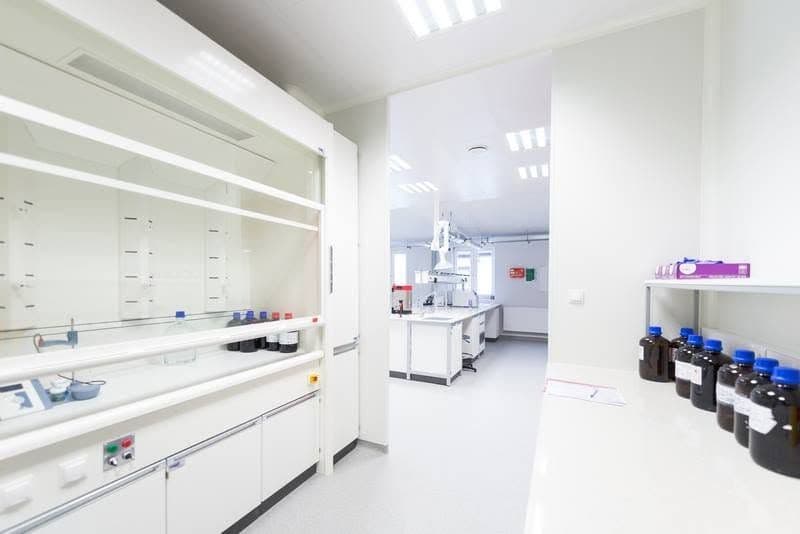
What is a ventilated chemical cabinet and how does it work?
A standard laboratory cabinet serves purely a storage function; it separates reagents from the environment but does not affect the air quality inside. A ventilated chemical cabinet differs fundamentally: it has a forced air circulation system that continuously removes vapors accumulating in the chamber.
Ventilation can be achieved in two ways: by connecting the chamber to the facility's exhaust system, which discharges air outside the building, or by using an independent fan with a filter that neutralizes vapors at their source.
Crucial here is the continuous air exchange in the chamber, maintained at a specific, minimum air exchange rate per hour, ensuring that the concentration of volatile substances does not reach dangerous levels. The vapor extraction works regardless of whether the cabinet doors are open or closed, distinguishing it from a fume hood designed for working with open vessels.
When is a ventilated cabinet in a laboratory absolutely necessary?
The decision to use a ventilated cabinet should stem from the characteristics of the substances used in the laboratory. If volatile reagents emitting intense vapors or a distinct, irritating odor are stored in the workspace, a standard closed cabinet will not provide sufficient protection; vapors will accumulate inside and be released every time the door is opened.
The second criterion is the risk of corrosion to equipment located in the same room. Vapors from acids or halogenated compounds can damage metal parts of the apparatus, electrical contacts, and ventilation systems. Ventilated chemical storage limits vapor migration into the environment and extends the lifespan of the equipment.
Respiratory protection of the personnel is a third, equally important argument. Even brief, repeated exposure to low concentrations of harmful vapors can lead to irritation of mucous membranes or headaches, and in the long term, to chronic respiratory diseases.
Therefore, the necessity of using a ventilated cabinet is determined by a combination of three factors: the volatility and toxicity of the substances, the presence of corrosion-sensitive equipment in the vicinity, and the frequency of personnel contact with a given storage zone.
What substances require storage in extraction cabinets?
Acids and bases are among the substances that most often require storage in extraction cabinets. Their vapors are harmful to the respiratory tract and highly corrosive, which is why such cabinets should be made of chemically resistant materials, acid-resistant plastics, or properly protected sheet steel.
Another category is organic solvents, classified as volatile organic compounds (VOCs). They are characterized by high vapor pressure, meaning rapid evaporation even at room temperature, which without adequate ventilation risks exceeding permissible concentration limits in the air.
Toxic and carcinogenic substances require special attention regardless of the frequency of use. Even minor, long-term exposure to their vapors can carry serious health consequences, which is why storing them in a forced-air circulation cabinet should be standard practice.
It is worth distinguishing between two solutions: a standard ventilated cabinet extracts vapors and protects against inhaling them, while a fire-resistant cabinet additionally protects against fire and is intended for flammable liquids, e.g., solvents with a low flash point.
Types of ventilated cabinets and their integration with laboratory furniture
Ventilated cabinets come in several structural variants. Tall freestanding cabinets work well where larger quantities of reagents need to be stored, while under-bench cabinets mounted under fume hoods allow for the utilization of space at the workstation, shortening the transport route for hazardous substances.
Regardless of the type, the consistency of the cabinet with the rest of the laboratory furniture infrastructure is of key importance. The vapor extraction system should be integrated with the building's general ventilation installation in such a way as not to disturb the air balance or generate excessive noise.
Increasingly, laboratory designers opt for modular solutions, adapted to existing furniture lines, as in systems based on the RL module, where ventilated cabinets naturally complement worktops, base cabinets, and shelving. Modularity allows for future expansion without replacing all the equipment.
The aesthetics of the finish are not a secondary issue. A uniform appearance of the fronts, consistent colors, and precise adjustment of the cabinet dimensions to the rest of the furnishings influence the professional perception of the workspace, which matters during both audits and client visits.
OHS regulations and safety standards versus laboratory equipment
Working with chemical agents is subject to general OHS regulations, which impose an obligation on the employer to ensure appropriate storage conditions for hazardous substances and to limit personnel exposure to harmful vapors.
Laboratory furniture, including reagent storage cabinets, should meet the requirements of the EN 14727 standard, and fire-resistant models intended for flammable liquids must additionally meet the EN 14470-1 standard. Compliance with these standards confirms the structural durability and effectiveness of the ventilation solutions.
The lack of a properly selected cabinet is not only a threat to staff health but also a legal and financial risk. During a safety audit, equipment non-compliance with standards and OHS regulations may result in the costly replacement of furniture and, in extreme cases, the suspension of the laboratory's operations.
Renggli solutions - tailor-made precision and safety
Renggli, as a laboratory furniture manufacturer and an entity implementing comprehensive laboratory projects, offers advisory support at the stage of selecting appropriate ventilated cabinets for the specific nature of a given laboratory. This selection takes into account both the type of stored substances and the characteristics of the existing ventilation installation in the building.
The offered solutions are designed with integration into the building's general ventilation systems in mind, avoiding installation conflicts and ensuring stable fume extraction operation regardless of the load on the entire laboratory ventilation network.
The high quality of the materials used and the ergonomics of the design are adapted to the specific nature of the industry for which the laboratory is built, ranging from pharmaceutical and biotechnological facilities, through research centers, to heavy industry plants, where the scale and intensity of chemical use can be significantly greater.
September 09, 2026