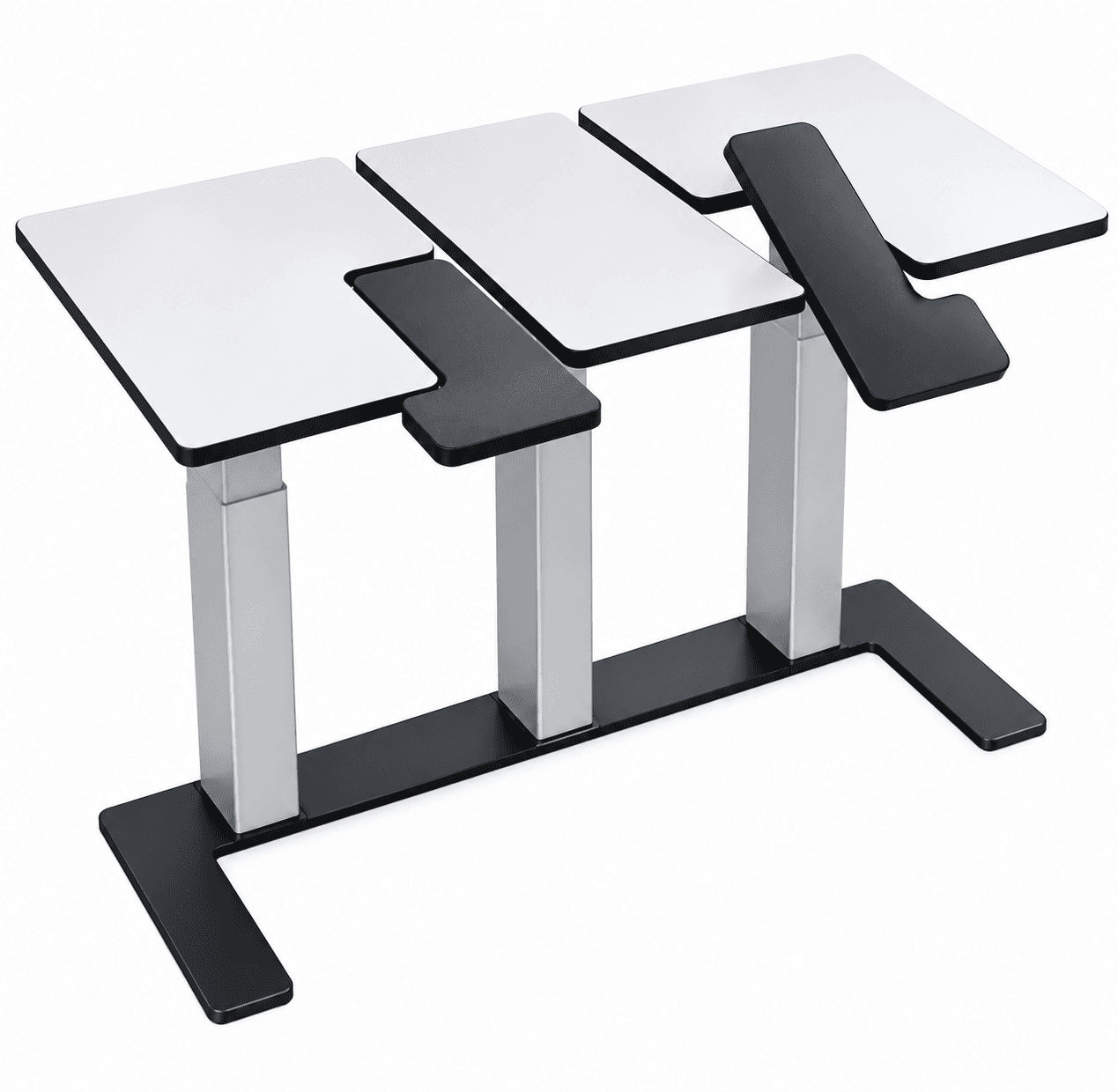
The role of a standard table in laboratory space
A standard laboratory table, usually based on A-frame or C-frame structures, constitutes a universal workstation in every laboratory. It works well during preparatory work, conducting chemical reactions, storing apparatus, and operating equipment that does not require special measurement precision.
The key advantage of such a piece of furniture is its modularity and high load-bearing capacity, allowing the configuration to be adapted to the changing needs of the research team. The worktop easily handles the loads associated with the daily, dynamic work of many people simultaneously.
However, it is worth remembering that the entire surface of such a table absorbs vibrations from the surroundings, both from the ground and from nearby operating equipment. For most laboratory tasks, this is not a problem, but for high-precision measurements, it becomes a significant limitation.
What characterizes a professional weighing table?
A weighing table, also known as an anti-vibration table, is a specialized workstation designed with one goal: isolating measuring devices from mechanical vibrations. Analytical balances and microbalances record mass with an accuracy of up to thousandths of a gram, which is why even minimal shocks transmitted through the building's structure can falsify the reading.
The sources of such disturbances are not only internal laboratory processes, but also external factors: street traffic, elevator operation, vibrations generated by the ventilation or air conditioning system, and even the footsteps of personnel walking near the workstation. The weighing table neutralizes these impulses before they reach the plate on which the balance stands.
In laboratories operating in accordance with GLP and GMP standards, the use of a properly designed weighing table ceases to be a matter of comfort and becomes an essential element to maintain the reliability and repeatability of results.
Structure and vibration damping - the main axis of division
The fundamental difference between the two types of furniture lies in the structure itself. A standard laboratory table is a uniform structure: the worktop, the frame, and any base cabinets form a coherent, integrated piece of furniture in which each element mechanically interacts with the others.
A weighing table operates on a completely different principle, which is most simply described as a "table within a table" design. It consists of an external working casing, on which the laboratory technician rests their hands and places accessories, and a completely independent, massive central block on which the balance actually stands.
This internal block is mounted on special vibration isolators, which are elastomeric or pneumatic shock-absorbing cushions. The key point is that the external casing physically does not come into contact with the weighing element at any stage of the structure. Thanks to this, vibrations transmitted through the floor or generated by the user leaning on the external worktop have no physical path to reach the balance.
The importance of materials in vibration isolation systems
The heart of most weighing tables is a massive block of polished granite. The choice of this material is no coincidence - the high density of granite gives it a naturally low resonant frequency, which means that it dampens rather than amplifies micro-vibrations coming from the environment.
Additionally, the large mass of the granite block has a stabilizing effect on the entire measurement system, and its hard, homogeneous structure ensures a perfectly flat and rigid reference surface. It is precisely this combination of density, mass, and rigidity that protects the delicate mechanism of the analytical balance from microgram-level disturbances.
The impact of vibrations on measurement accuracy
The theory behind vibration isolation translates directly into daily laboratory practice. An analytical balance placed on a regular table can react to events seemingly unrelated to the measurement itself: starting a centrifuge in an adjacent room, closing a fume hood, slamming a door, or even an employee leaning on the worktop.
The result of these disturbances is a characteristic "drifting" of the result on the display. The mass indication does not stabilize but oscillates around a certain value, forcing the laboratory technician to repeatedly take readings or average the results. In the case of trace analyses and measurements in the range of milligrams or micrograms, such instability can realistically affect the reliability of the final result.
The weighing table eliminates this phenomenon at its source, cutting off the mechanical connection between the environment and the measurement point. The reading stabilizes faster, and laboratory personnel do not have to limit natural movement near the workstation.
Types of worktops and their properties
The choice of worktop material remains independent of the type of table structure. Both standard laboratory tables and the external casing of weighing tables can be made of the same materials: epoxy resin, solid ceramics, quartz conglomerate, or laminate.
Each of these materials is characterized by high chemical resistance to acids, bases, and organic solvents, as well as resistance to scratches and localized high temperatures. The selection of a specific material depends primarily on the profile of the research being conducted and the individual aesthetic preferences of the team.
Thanks to this, the weighing table can be visually matched with other furniture in the laboratory, maintaining the consistency of the entire equipment line. The different internal structure therefore does not affect the uniform appearance of the entire workspace or the chemical resistance parameters of the surface.
Work ergonomics - operator independence from the device
The structural aspect of the weighing table has a direct impact on the working comfort of the laboratory technician. Precise weighing of substances requires space to put down a notebook, pipettes, beakers, or spatulas, as well as the ability to freely and stably support one's elbows during longer measurement sessions.
If the table structure were uniform, every movement of the operator's hand could disturb the balance readings. Separating the measurement block from the working zone eliminates this risk entirely.
The laboratory technician can freely operate on the outer part of the table without worrying about the impact of their own movements on the calibration and reading stability. Work becomes smoother, and the risk of accidental measurement errors resulting from the human factor is significantly reduced.
When is a standard laboratory table perfectly sufficient?
Investment in a specialized weighing table is not always necessary. Precision balances and lower-resolution devices in the range of 0.1 g or 0.01 g successfully operate on solid, standard laboratory tables without the need for additional vibration isolation.
The situation is similar for moisture analyzers, simpler measuring apparatus, or equipment used mainly for preparatory and control work. In these applications, the level of ambient vibrations has no practical impact on the final result.
An anti-vibration table should be reserved for workstations where trace analyses are conducted or high-resolution balances, in the range of milligrams and micrograms, are used. Rational planning of equipment allows optimizing the investment budget without sacrificing accuracy where it is truly required.
September 14, 2026