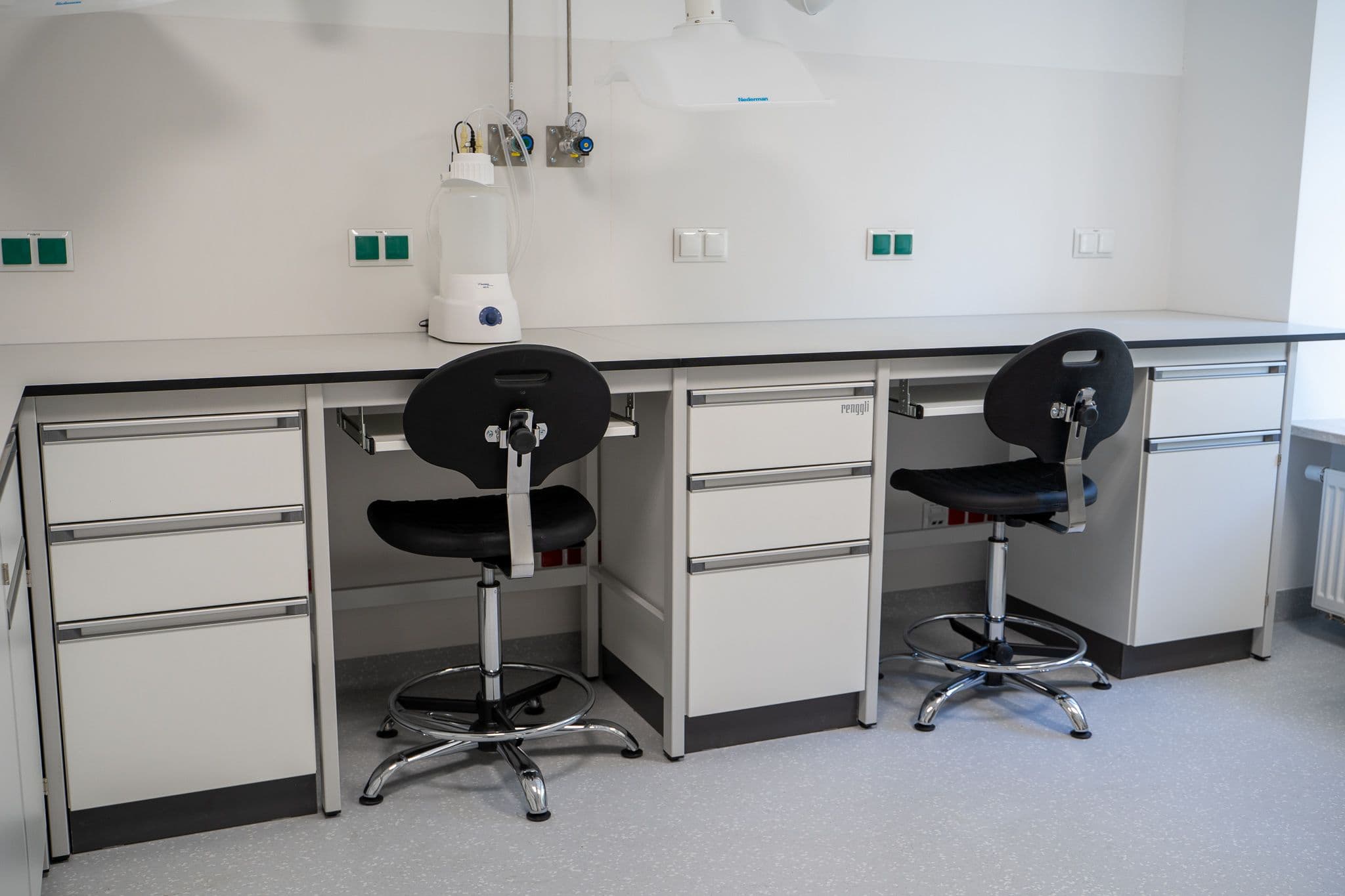
A laboratory chair is a specialized laboratory seat designed to work in conditions that require prolonged sitting, high ergonomics and resistance to intensive use and contact with chemicals. Unlike standard furniture, it is an element of laboratory furniture that must meet strict health and safety standards and have appropriate certificates, including often the PZH certificate, guaranteeing safety of use in the research environment. In practice, laboratory chairs are designed to support proper posture and minimize the strain on the spine when working at a laboratory workstation.
What features determine the ergonomics of a laboratory chair?
An ergonomic laboratory chair is primarily intended to help maintain a natural body posture and relieve the spine, especially in the lumbar region. The well-designed seat supports lumbar lordosis, thus reducing back tension during long work at the station.
To make the chair comfortable, it should have a few basic adjustments:
- height adjustment (usually by pneumatic mechanism),
- adjustment of the backrest and angle of inclination,
- Seat depth adjustment to suit the user.
In more advanced models, the CPT mechanism is used, which allows for a smooth change of position without "jumping", and the synchronous mechanism, where the seat and backrest move together and better adapt to body movements.
Accessories are also of great importance. The armrests relieve the strain on your shoulders and arms, and the headrest helps keep your neck in a comfortable position. This makes it easier to avoid tension and fatigue when working for long periods of time.
How to match the type and height of the seat to the laboratory worktop?
The choice of seat in the laboratory always depends on the height of the worktop and whether the work is done in a sitting or partially standing position at the laboratory workstation. A station for precise analyses will have different requirements, and a different place for quick technical activities.
A low laboratory chair works well with standard countertops, where the user works mainly in a sitting position. On the other hand, a high laboratory chair, often the so-called laboratory stool, is used at higher tables or when work takes place alternately in a sitting and standing position.
In the case of tall models, the footrest is very important – usually in the form of a ring (ring). It provides support for the legs, relieves the thighs and improves comfort during longer work. Without it, sitting on a high seat for a long time quickly becomes uncomfortable.
Other solutions are also used in laboratories.Laboratory stoolsor medical stools are suitable for short, dynamic activities, where mobility and fast movement between stations are important. A saddle chair, on the other hand, supports the so-called active sitting, i.e. a position in which the body is more involved and blood circulation is not as limited as in a classic sitting.
The final choice should always take into account the user's height, weight and way of working. Even the best-chosen seat will not be comfortable if it cannot be adjusted to a specific person and working conditions.
What materials provide chemical resistance and easy disinfection of the chair?
In laboratory chairs, chemoresistance, i.e. resistance to contact with aggressive substances used in laboratories, is of great importance. That is why polyurethane and integral foam are often used, which tolerate contact with acids, alkalis and many solvents well. These materials are also resistant to intensive disinfection and frequent cleaning, which is important in maintaining sterility and high occupational hygiene.
Vinyl and eco-leather are also often used in medical laboratories, as their smooth surface facilitates quick cleaning and meets sanitary requirements. Such materials are eagerly chosen where quick ease of cleaning and regular disinfection of the stations are important.
The structure of the surface is very important – the more smooth and non-porous, the lower the risk of dirt and microbes accumulating. That is why materials with high resistance to disinfectants and antibacterial materials are used to support the maintenance of cleanliness in the workplace.
Seats made of polyurethane often have an additional texture that createsa non-slip seat, increasing the user's safety when working on the move or when changing positions.
Should a work chair have castors or non-slip feet?
The choice between castors and feet depends on the type of work. The castors provide greater mobility, making it easier to reach for tools and move between stations. Versions with a locking function combine the convenience of movement with the ability to immobilize the chair when more stability is needed.
Non-slip feet, on the other hand, provide maximum stability, which is why they are often chosen for precise tasks, e.g. when working at a microscope, where reliable and stationary support is important.
A 5-point chair is a model based on a five-spoke star base, usually made of polyamide or chrome steel. This design ensures durability, balance and prevents the chair from tipping over, which is standard in many industrial chairs.
How to choose equipment for clean room zones and ESD antistatic environments?
In electronic environments, ESD (Electrostatic Discharge) protection, i.e. controlled discharge of electrostatic charges, is crucial. In practice, this means that the antistatic seat and all equipment must have the appropriate electrostatic properties so as not to damage sensitive components. That's why ESD chairs are often equipped with special conductive elements, such as castors, that help to safely disperse loads.
In clean room areas and environments that meet GMP (Good Manufacturing Practice) standards, there are very strict cleanliness requirements. It uses emission-free materials that do not release particles or pollutants into the air. Such cleanrooms must provide controlled, often aseptic conditions, so all equipment – including chairs – must be designed so that they do not disturb air quality.
Specialized chairs for such applications must combine antistatic protection with ease of cleanliness and resistance to intensive disinfection. As a result, they support the requirements of a laboratory environment where both occupational safety and the highest standards of cleanliness are important.
What health and safety standards and approvals must a laboratory chair meet?
A laboratory chair must meet the requirements of health and safety (Health and Safety at Work) standards and general ergonomics rules to ensure safe and comfortable working conditions in a laboratory environment. It is primarily about a stable structure, adjustability and adaptation to long-term sedentary work without burdening the spine.
The PZH (National Institute of Hygiene) Certificate is very important, which confirms that the materials used are safe for health and can be used in places requiring high occupational hygiene. This is especially important in laboratories, where contact with various substances and frequent disinfection are a daily occurrence.
Laboratory chairs should also have appropriate safety certificates and attestations, including:
- certificates for mechanical strength and load-bearing capacity,
- confirmation of the durability of the structure,
- in some cases also certificates concerningthe non-flammability of materials,
- and grounding requirements in ESD models.
Such strength certificates and attestations are a guarantee that the product remains stable even under intensive use.
To sum up, choosing a certified chair is not only about meeting formal requirements, but also about a real investment in occupational safety, user health and higher work efficiency in the long term.
May 05, 2026