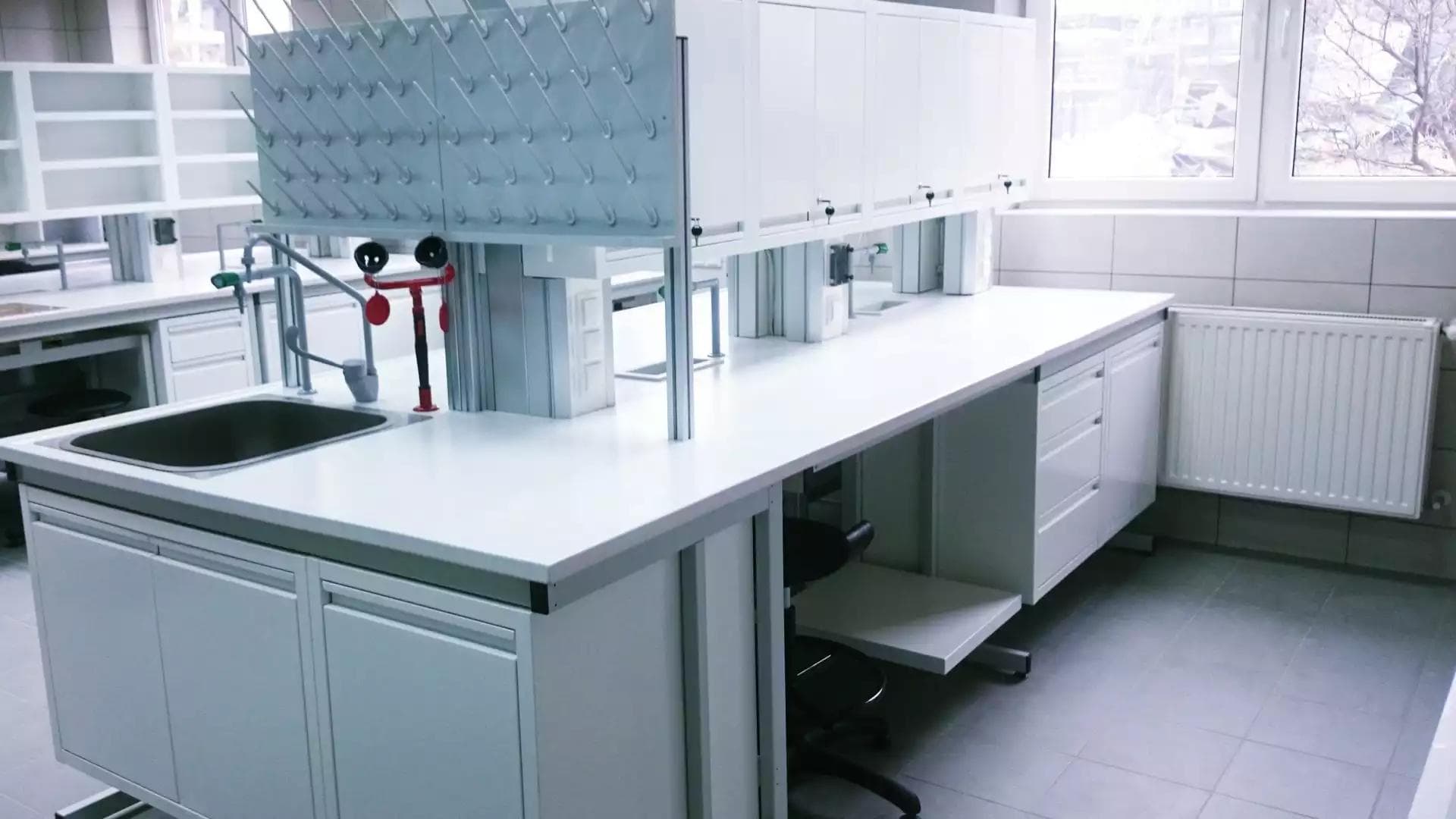
Laminar flow chamber is one of the basic equipment of modern laboratories, without which it is difficult to imagine work requiring sterile conditions. It enables safe procedures in which even the slightest contamination can disrupt the result, which is why it is used in many fields of science and industry.
What is a laminar flow chamber?
A laminar flow chamber is a specialized laboratory device that provides sterile working conditions, i.e. an environment based on the principles of aseptic. In practice, this means that it creates a controlled, free of germs and dust, where experiments that require high cleanliness can be carried out safely.
This device, often also referred to asa laminar cabinet or laminar flow room, is commonly referred to as a "clean bench". Its main task is to isolate the test material from external factors such as dust, bacteria or fungal spores, which effectively prevents contamination of samples.
The laminar flow chamber thus creates a sterile station, i.e. an environment with controlled cleanliness, in whichsafe work in aseptic conditions is possible. As a result, it is a key piece of equipment in laboratories and in the so-called clean rooms, where the highest level of air and surface cleanliness is required.
Materials such as stainless steel are often used in the construction of such devices, which make it easier to maintain hygiene and disinfect the work surface. As a result, the laminar flow chamber is becoming one of the most important elements of modern laboratory equipment.
How does a laminar flow chamber work?
The laminar flow chamber works in such a way that there is as clean and stable a working environment as possible inside. The key here is laminar flow, i.e. the movement of air in one direction, at a constant speed and without turbulence. This prevents the air from "mixing" and transferring impurities towards the sample.
The whole thing starts with an air circulation system that sucks in air and directs it through the subsequent stages of air filtration. First, a pre-filter works to trap larger mechanical contaminants such as dust.
The air then passes througha HEPA (High Efficiency Particulate Air) filter that removes 99.97% of fine particles as small as 0.3 microns. In more demanding devices, a ULPA (Ultra-Low Penetration Air) filter is also used, which ensures even more thorough cleaning. As a result, almost sterile air is created.
The purified air returns to the chamber as an even stream, creating a stable laminar air movement and maintaining a constant airflow velocity. In addition, overpressure is maintained inside, which prevents impurities from the outside.
A UV lamp (UV-C) is also often used before and after work, which helps to sterilise thework surface and provide additional decontamination.
What is the difference between vertical and horizontal airflow?
The difference between these two types of chambers is in the direction in which the vertical airflow and horizontal airflow move, and thus what is best protected during operation.
In a vertical airflow chamber, theairflow is directed from top to bottom, directly over the work area. Such an arrangement acts as an air curtain that createsa protective barrier. This ensures bothsample protection and partial protection for the operator, as contaminants are "pushed" down and drained away from the work area. This type is chosen when both product protection and greater user safety are important.
In a horizontal airflow chamber, on the other hand, the airflow flows from the rear wall towards the operator. The air first passes through the diffuser and then creates a stable stream that primarily protects the product. This design focuses on isolating samples from external contaminants, but does not provide as good operator protection as vertical flow.
In practice, the choice between these solutions depends on priority: ifprotecting the operator and the product at the same time is crucial, vertical flow is more common, while when purity and sample protection are paramount, horizontal flow is chosen.
What are the safety classes of laminar flow chambers?
Laminar flow chambers, also referred to as MSCs (Microbiological Safety Cabinets) or BSCs (Biological Safety Cabinets), are divided into three basic safety classes, depending on the level of protection and the type of work with biological material.
Class I primarily ensures microbiological safety for the operator and the environment. This means that it protects against contaminants escaping to the outside, but does not provide full protection for the product, i.e. the sample itself. It is used where the risk to the material is not crucial, and it is more important to limit exposure to biological hazards.
Class II, or Safety Class II, is the most common solution in laboratories. It provides simultaneous protection for the operator, the environment and the product. These chambers comply with the PN-EN 12469 standard(EN 12469 certificate) and are a standard for working with biological material with moderate risk. As a result, they are commonly used as a biosafety chamber in most laboratories.
Class III is the highest level of protection. It is a fully isolated workspace, or so-called glove chamber or isolator, often referred to asa biohazard chamber. The operator works in it through tight gloves, without direct contact with the interior. Such solutions are used when working with extremely dangerous pathogens and in environments requiring full hermetics, e.g. in RABS (Restricted Access Barrier Systems) or when working with high-risk materials, such as an isolator for cytostatics.
Where are laminar flow chambers used?
Laminar flow chambers are used wherever cleanliness of work and no risk of contamination of biological or technical material are crucial. Depending on the industry, they perform slightly different functions, but it is always about creating a controlled, sterile environment.
- Microbiology and molecular biology - work with cell culture, tissue culture, bacteria and viruses. The chambers are also used for PCR tests and work with DNA/RNA in the PCR chamber, where the purity of the PCR reaction (polymerase chain reaction) and in vitro operation are important.
- Medicine and pharmacy - preparation of sterile prescription drugs, e.g. eye drops, oncological drugs or parenteral nutrition in the conditions of the pharmaceutical industry and the medical sector.
- Biotechnology and food industry - quality control and microbiological testing in food processing, detection of bacteria and other contaminants in food products.
- Electronics and optics - assembly of dust-sensitive components in high purity (ISO 5) conditions, m.in. in electronics manufacturing and areas such as nanotechnology.
It is worth remembering that a laminar flow chamber is not the same as laboratory fume hoods – the chamber protects sterility and biological material, and the fume hood is used to work with chemical fumes and protects mainly the user.
How is the laminar flow chamber validated and serviced?
A laminar flow chamber must be regularly serviced and validated in order to function properly. It is these activities that confirm that the device provides proper environmental control, effective filtration and safe working conditions.
The process begins with the IQ (installation qualification), during which it is checked whether the device has been installed correctly and whether it meets the manufacturer's requirements. Next, the OQ qualification (operational qualification) is performed, which confirms that the chamber works as intended – m.in. it maintains proper airflow and meets the required cleanliness classes.
Specialized measuring tools are used during performance tests. A thermoanemometer is used to control the air velocity, and the level of purity and particle number is evaluated by a laser particle meter. This allows you to check exactly whether the filtration is working properly and whether there is no decrease in the quality of the device's operation.
In modern laboratories, laminar flow chambers often operate in a space equipped withlaboratory furniture and ergonomic laboratory chairs that support the comfort and safety of the operator.
The chambers must also undergo regular filter leak tests and meet the requirements of standards such as PN-EN ISO 14644, as well as have the appropriate material certificates, declaration of conformity and CE marking. In many cases, this also applies to quality systems such as ISO 9001 and the general safety certificate of the device.
June 04, 2026