Why is laboratory ventilation crucial for personnel safety?
Laboratory ventilation is one of the most important safety systems in any chemical and biological laboratory. Its primary task is to protect the health and life of staff through the effective removal of toxic fumes, flammable gases, aerosols and bioaerosols that are generated during research and technological processes.
Efficiently designed general mechanical ventilation prevents the accumulation of hazardous substances in the air, minimizing the risk of poisoning, explosions and biological contamination. Equally important is the role of ventilation in shaping the correct work microclimate, which directly affects the concentration and comfort of staff.
Laboratory comfort parameters:
- temperature: 20–22°C
- Relative humidity: 50% ±10%
- Noise level: 40 - 45 dB(A)
Ventilation also eliminates the risks associated with the presence of flammable gases and biological agents, which is crucial for maintaining chemical and biological safety.
What legal requirements and standards determine the frequency of air exchange?
One of the basic design parameters of laboratory ventilation is the Air Changes per Hour (ACH). It determines the number of times the total room air volume is replaced per hour.
Typical ACH values:
- 5-15 exchanges/h – low-risk laboratories,
- 10–12 exchanges/h – chemical laboratories,
- 12–20 exchanges/h – BSL-2 / BSL-3 biological laboratories,
- >20 exchanges/h – emergency ventilation or BSL-4 laboratories.
Emergency ventilation is activated in critical situations, rapidly increasing the intensity of air exchange.
Key Standards and Guidelines:
- PN-EN 14175 – laboratory fume hoods,
- PN-EN 12469 – biosafety chambers,
- ISO 14644 – cleanrooms,
- ATEX Directive – Hazardous Areas,
- ASHRAE air balance guidelines.
How do fume hoods and other local ventilation systems work?
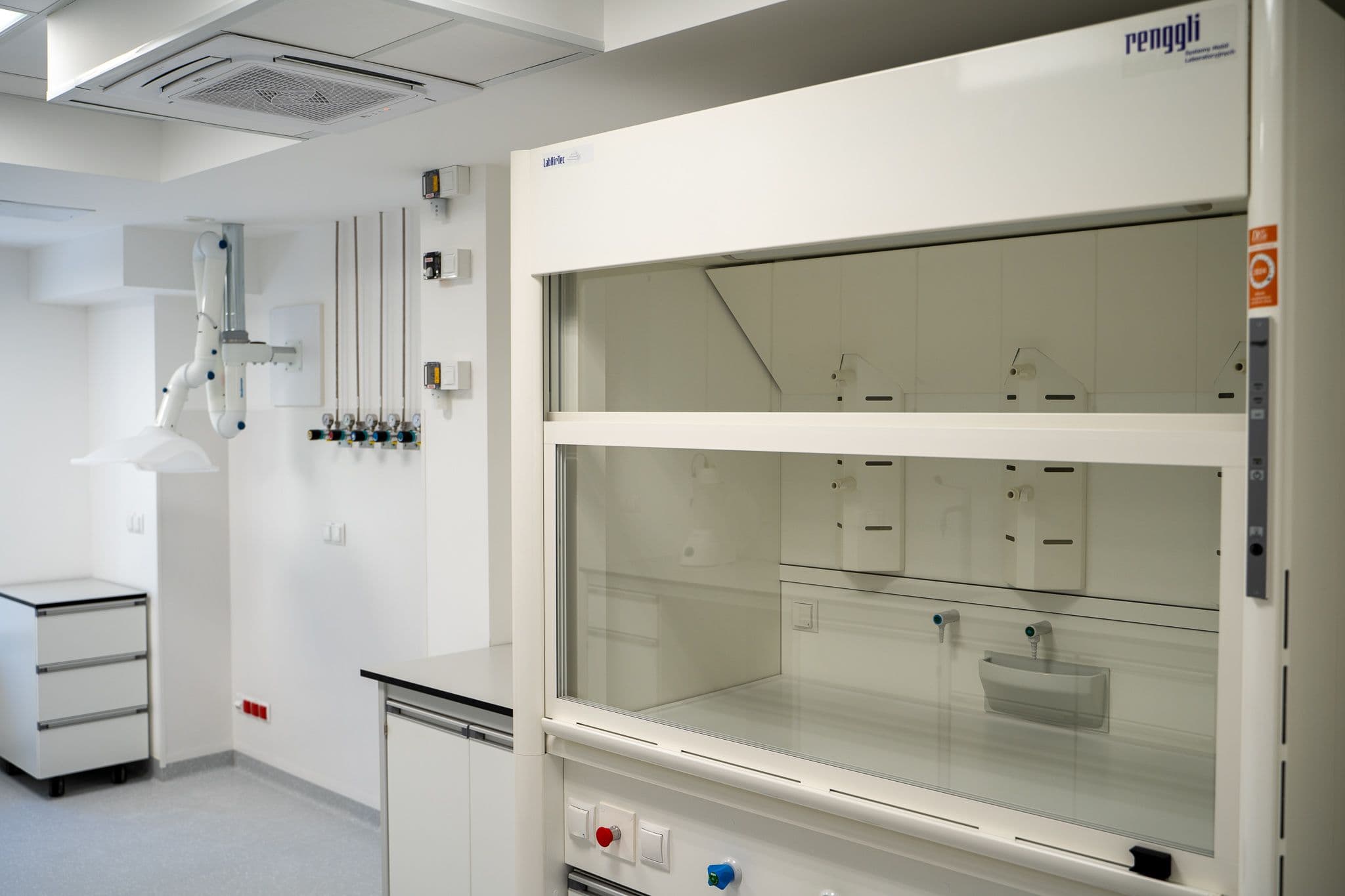
Local ventilation complements general ventilation and is responsible for removing contaminants directly at the source. Its most important element is fume hoods, which are the basic personal protective equipment in laboratories.
Fume hoods:
- work continuously,
- ensure the air velocity in the working window approx. 0.5 m/s,
- They effectively trap vapors before they spread throughout the room.
Other local ventilation systems include:
- hoisting arms,
- laboratory hoods,
- ventilated cabinets and safety cabinets,
- exhaust chambers and technological suction cups.
These solutions are widely used in technological processes where the fume hood is not sufficient or feasible. More information: digestoric kits
What is the control of the gradient of straits and the direction of airflow?
A key safety principle in laboratories is to control the pressure gradient, i.e. the direction of air flow between zones. Air mustmove from clean zones to dirty zones, creating a so-called pressure cascade.
- Vacuum – used in chemical and biological laboratories; protects the environment from the emission of pollutants.
- Hypertension – used in cleanrooms; protects samples and processes.
To maintain the vacuum, the following balance is used:
- air flow approx. 10% less than exhaust.
These systems are supported by a safety lock, differential pressure sensors and control automation.
How do VAV controllers and BMS automation support laboratory management?
Modern laboratories use advanced HVAC automation. The basic control systems are:
- CAV (Constant Air Volume) – constant air volume,
- VAV (Variable Air Volume) – variable volume, adapted to current needs.
VAV controllers allow for significant energy savings, taking into account the non-simultaneous operation of fume hoods and stations. The whole thing is integrated with the BMS system, which:
- monitors flows and pressures,
- detects failures,
- works with flow sensors and transducers,
- controls fans (EC motors, frequency converters).
Find out more: extractor hoods.
What materials and filters are used in chemically and biologically aggressive environments?
Only chemically resistant materials are used in laboratory ventilation systems:
- PVC (polyvinyl chloride),
- PP (polypropylene),
- acid-resistant steel.
Types of filtration:
- HEPA / ULPA filters – biological laboratories, BSL, radioactivity,
- carbon filters – VOCs, chemical fumes, odors.
In explosion hazard zones, explosion-proof fans are used, and air outlets are located on the roof, away from intakes and window openings.
Is it safe to use heat recovery in laboratory ventilation?
In laboratories, there is an absolute ban on air recirculation when working with toxic substances – 100% of outdoor air is used. This means that classic recuperation is not acceptable.
However, heat recovery is possible using:
- exchangers with an intermediate medium (e.g. glycol),
- hygienic air handling units,
- maintaining full tightness of the ducts.
Such solutions allow you to reduce energy losses without the risk of mixing air streams.
Find out more: hoodless fume hoods.
March 07, 2026