Skip to content

Laboratory fume hoods

Laboratory extraction fume hood

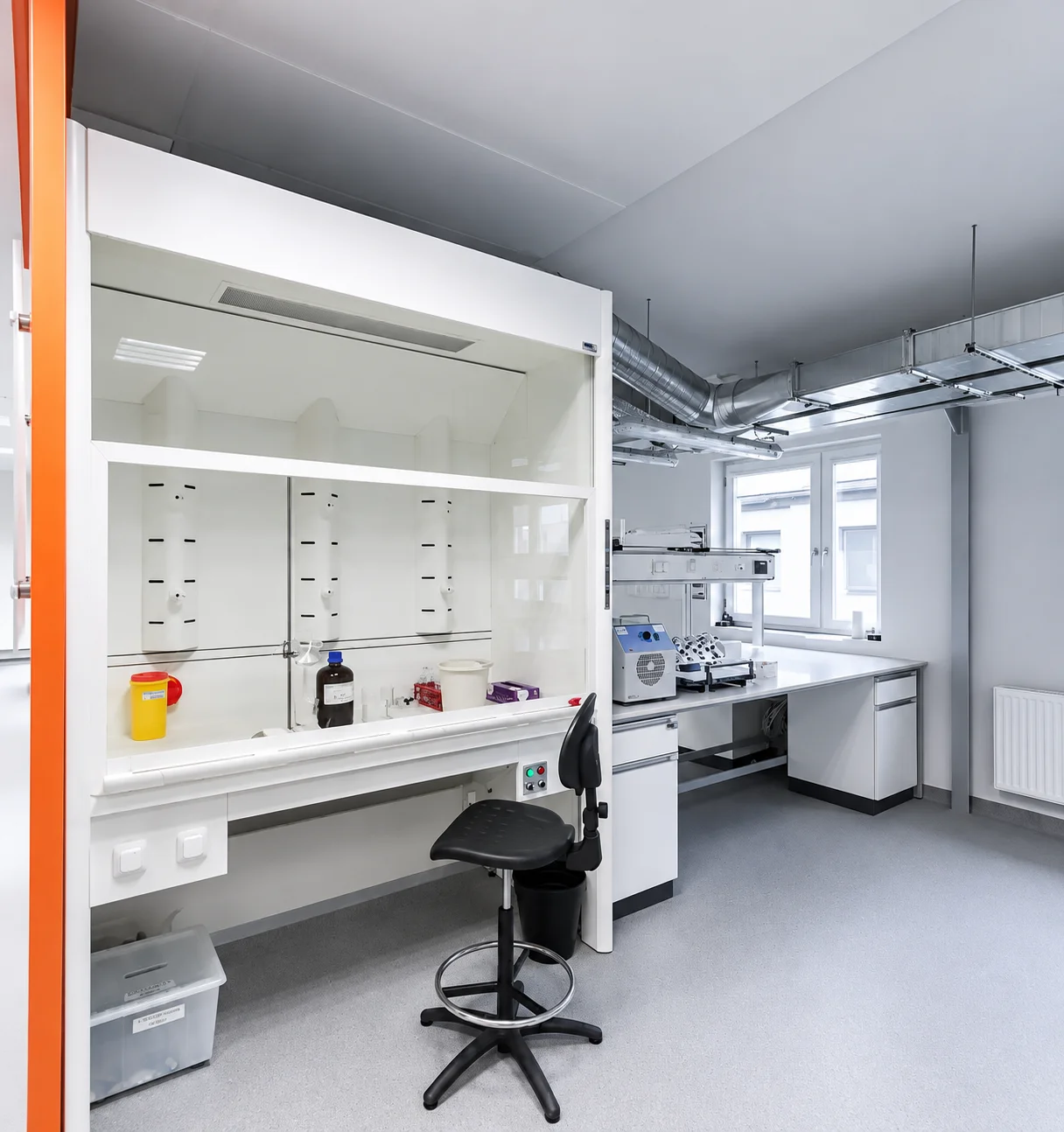
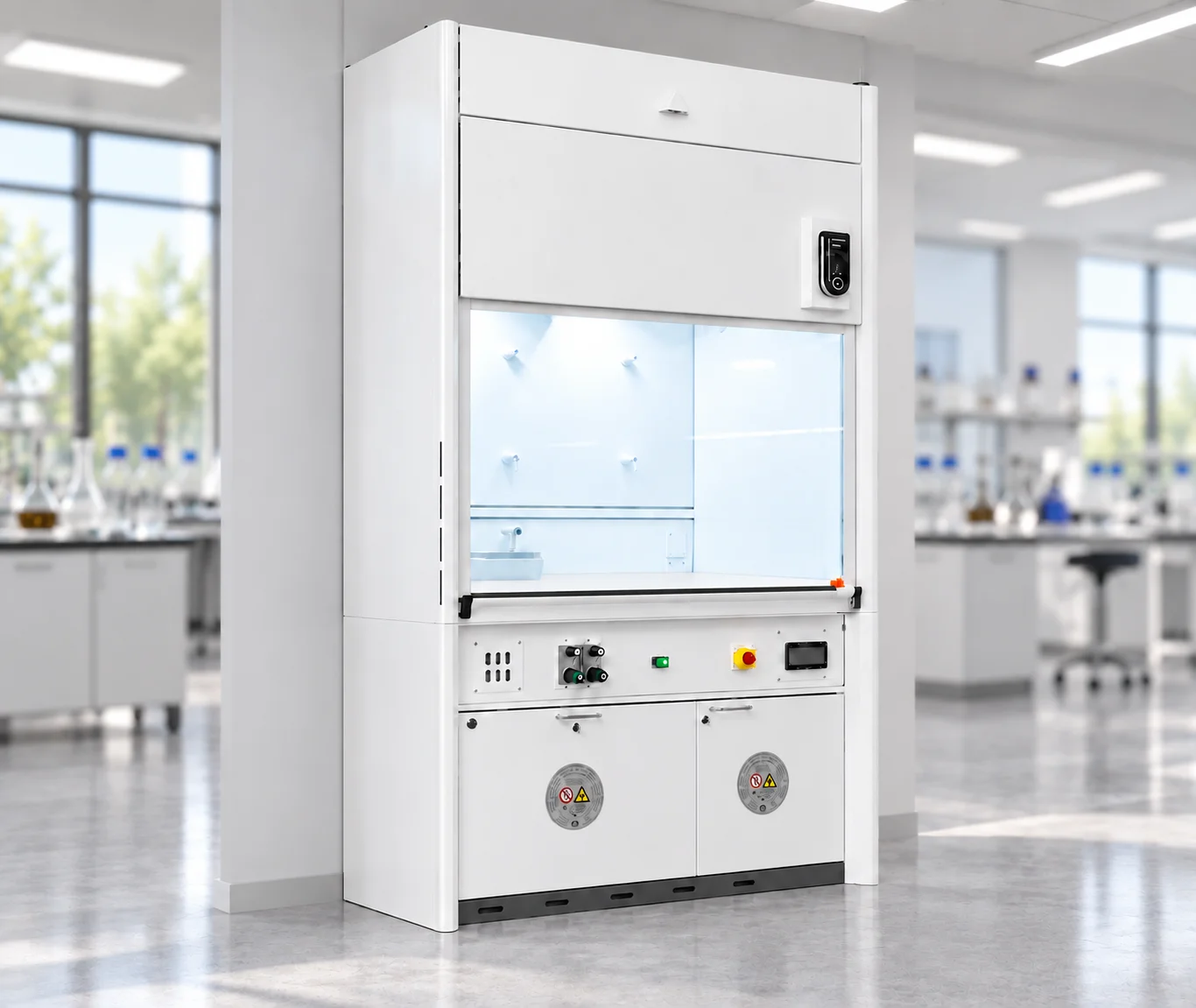
A ducted laboratory fume hood (also called a fume cupboard) is a glazed laboratory enclosure connected to the building's ventilation system, which extracts vapours, gases and dust from the work chamber and carries them through a duct to the outside.

Interested in this product?

Add to enquiryAddedIn enquiry

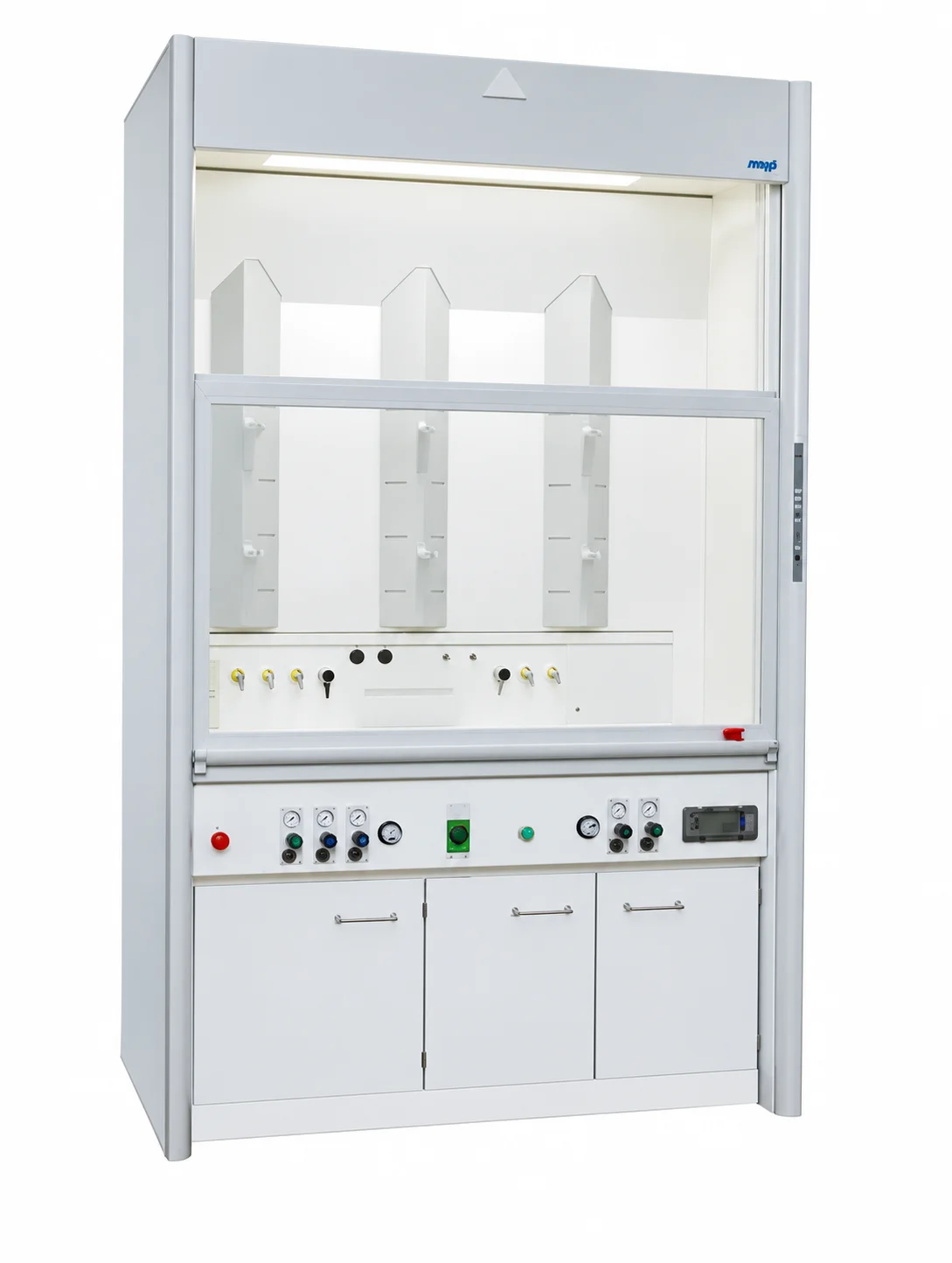
Renggli ducted fume hood with an illuminated work chamber, sliding sash and under-bench cabinets
Stages

Safety Pyramid Concept

  1. S1 Standard Version

    • Bypass System - laminar airflow
    • Air extraction modules routed in special profiles to enhance extraction efficiency
    • Monitoring and control of the fume hood through an intuitive eye-level panel
    • Media drawer for easy handling and simple media upgrades
  2. S2

    Control of the discharged air volume concerning the position of the front limiter. The condition-dependent air volume indicator significantly increases safety.

  3. S3

    Automatic closing of the front limiter increases work safety and significantly reduces costs.

  4. S4

    Active air intake. Maximum safety with significantly reduced operating costs.

Dimensions

Basic dimensions

Basic dimensions

  • height

    2400 / 2600mm

  • width

    1200 / 1500 / 1800mm

The higher the configuration level, the greater the operating cost savings for LabAirTec fume hoods.

About the category

Contents

How a fume hood connected to building ventilation works

A fume hood connected to the ventilation system keeps the work chamber under negative pressure. Air from the laboratory therefore flows continuously into the chamber through the sash opening and leaves with the fumes through a duct to the outside. The extraction runs continuously, and the air velocity at the sash opening is approximately 0.5 m/s. A slot system extracts vapours of different densities evenly. In a VAV system, the extracted air volume changes with the sash position, and an airflow sensor triggers a visual and audible alarm when the velocity drops. Ducted fume hoods are covered by the EN 14175 series of standards.

In LabAirTec fume hoods, successive levels of airflow protection form the S1 to S4 safety pyramid, developed with Renggli engineers. The first level is the standard S1 version, and all levels are described further down this page. The design of the chamber, sash and service connections is explained in our article on what a laboratory fume hood is.

How much extract air a fume hood needs

The extract airflow follows from the area of the sash opening and the air velocity through it. A sash 1.2 m wide, opened to 0.5 m, gives an area of 0.6 m², so at 0.5 m/s the fume hood extracts 1,080 m³/h. A single fume hood connected to central ventilation is designed for 400 to 1,200 m³/h. The duct carries the exhaust to a chemically resistant fan, and the whole system forms part of the room ventilation design. A chemical laboratory is typically designed for 10 to 12 air changes per hour. Supply air about 10% lower than exhaust air keeps the whole room under negative pressure. Our guide on how to calculate fume hood airflow shows how to work out the airflow for other sash dimensions.

Ducted or ductless fume hood

A ducted fume hood is the choice wherever an exhaust duct can be run and the reagents and their concentrations change at the workstation. Protection then depends on the extraction capacity and the airflow through the sash opening, so changing the reagent does not require changing a filter. The LabAirTec green ductless (filtered) fume hood captures vapours in an activated carbon filter and returns the air to the room, so the workstation can be relocated. It is covered by EN 17242:2025. The ducted version has a fixed position next to the duct, and its running costs include the energy for extraction and for heating the supply air.

We compare the two types in our article on choosing a carbon-filter or ducted fume hood, and explain how to match a unit to the type of work in our guide on how to choose a laboratory fume hood. Both LabAirTec versions are part of our laboratory fume hood range.

What determines the price of a ducted fume hood

The price of a ducted fume hood depends on the chamber dimensions, the protection level and the services supplied to the workstation. The cost is affected by:

  • the width and height of the chamber, sized to the equipment and the room,
  • the level in the S1 to S4 safety pyramid: the higher the configuration level, the greater the operating savings,
  • the worktop material inside the chamber, for example a ceramic worktop, epoxy resin or polypropylene,
  • a design for special substances such as perchloric acid, with a chemically resistant chamber and water washdown,
  • services inside the chamber: water, gases, electricity and a cup sink, also as ready-made fume hood service fitting sets,
  • airflow control: VAV, sensors and alarms,
  • an under-worktop cabinet for reagents, including a ventilated version.
FAQ

Questions about ducted fume hoods

In practice, yes. Both terms refer to a glazed enclosure with extraction that contains fumes and removes them from the user's breathing zone. Sometimes the term "laboratory extraction" also covers extraction arms, canopy hoods and capture nozzles. These remove contaminants at source, but without an enclosed chamber. The differences in terminology are explained in our article on laboratory extraction versus fume hoods.

At least once every 12 months. The inspection covers installation and operational qualification, a smoke test, airflow measurement with an anemometer, an alarm check and sensor calibration. In a ducted model, the ducts and fan are also checked. The cables, pulleys and counterweights of the sliding sash are inspected as well. The full list of tasks is given in our guide to step-by-step fume hood maintenance.

From 0.3 to 0.5 m/s at the sash opening. For work with concentrated perchloric acid, at least 0.5 m/s is required. At this velocity, fumes stay in the chamber and do not reach the operator's breathing zone. Turbulence in the sash opening can push contaminants back towards the user, so the laboratory checks the velocity periodically with an anemometer.

No. Hot perchloric acid fumes react with organic seals and resins. They also deposit in the ducts, where they form explosive perchlorates that are sensitive to shock and friction. This work requires a fume hood with a chamber made of acid-resistant stainless steel 1.4404 (AISI 316L) or monolithic ceramic, with PTFE seals and water washdown of the walls and ducts. Details are given in our article on fume hoods for perchloric acid.

From the blog

We write about it

Newsletter

Stay up to date with Renggli

New projects, products and guides on laboratory furniture, in one place.

By subscribing you agree to receive messages from Renggli and accept the privacy policy. You can opt out at any time.

Let us plan your laboratory

Tell us what has to happen in the room. We will pick the furniture and work out the rest.

Add to enquiryAddedIn enquiry

See the projects

Free project quote.