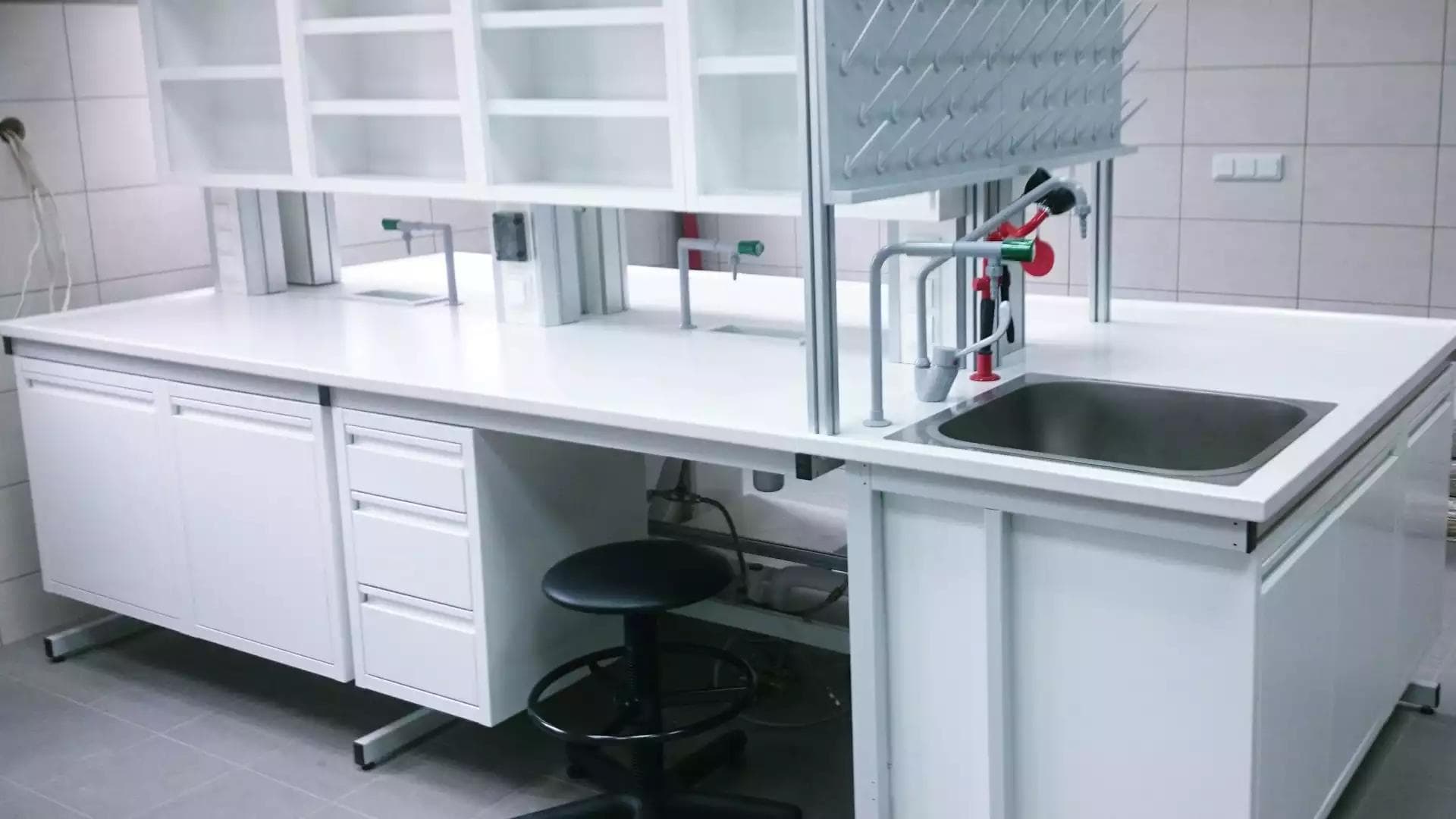
The choice of the right laboratory sink is not accidental – it depends primarily on the type of work and the aggressiveness of the substances used. In practice, materials such as ceramics and resins are considered to work best in chemical laboratories, while stainless steel is more commonly used in medical and diagnostic environments. Each solution has its own strengths and weaknesses, so it is worth comparing their properties in terms of resistance, durability and daily use before making a decision.
What determines the choice of material for a laboratory sink?
The choice of a laboratory sink is primarily determined by the type and degree of aggressiveness of the substances used, including corrosive substances and various types of chemical reagents. The more demanding the working environment, the higher the demands on the material.
The key technical parameters are:
Chemical resistance – protects against acids, alkalis and solvents
Mechanical resistance – important for intensive use and risk of impact
High temperature resistance – important when working with hot liquids and laboratory processes
The choice is also influenced by the working environment – different solutions are used in a chemical laboratory and different in medical or microbiological environments, where more emphasis is placed on hygiene and ease of disinfection. Investment costs and subsequent operating costs are also an important factor, which can vary significantly depending on the material.
What are the properties of a ceramic laboratory sink?
A ceramic sink made of precious stoneware (often based on Cambrian clay) is distinguished by its very high resistance to aggressive chemicals. It is also characterized by exceptional heat resistance and fire resistance, thanks to which it tolerates contact with high temperatures and hot liquids well.
The most important advantages include:
very high chemical resistance – especially to most concentrated acids and bases
Scratch and heavy wear resistance
stability in high temperature conditions (heat resistance and fire resistance)
widely used in working with aggressive dyes and reagents
However, it is worth remembering about the limitations. Ceramics are susceptible to mechanical damage – strong impacts can lead to cracks. A significant disadvantage is also sensitivity to thermal shock, i.e. rapid changes in temperature.
In addition, precious stoneware is not resistant to hydrofluoric acid, which can cause its degradation.
Due to their properties, ceramic sinks are often used in chemical laboratories as well as small sinks mounted in fume hoods where high standards of chemical resistance are required.
What are the advantages of epoxy resin sinks?
Theepoxy resin sinkis one of the most advanced solutions used in modern laboratories, especially where the highest chemical resistance is required. Such structures are often based on a monolithic composite (e.g. DURCON technology), which creates a uniform, smooth and very dense structure.
Key benefits:
very high chemical resistance – resistance to strong acids, alkalis and aggressive reagents
resistance to organic solvents and petroleum products
high mechanical strength and stability under intensive use
radiation resistance(including radioactive agents in specialized applications)
smooth, non-porous surface that reduces the penetration of contaminants and microorganisms
In addition, epoxy resin sinks tolerate rapid temperature changes well, which increases their functionality in demanding laboratory processes.
Although their price is usually higher than other solutions, they are considered standard in laboratories with a high degree of chemical stress and intensive use.
Will a stainless steel sink work well in a chemical laboratory?
A steel sink, i.e. a sink made of stainless steelor AISI-304 acid-resistant steel,is not the best choice for working with very aggressive chemicals. Compared to ceramics or epoxy resin, it shows lower resistance to strong acids and some chemical reagents, which limits its use in typical chemical laboratories.
At the same time, it has many important advantages:
high corrosion resistance
very good ease of cleaning and disinfection
no porosity, which reduces the accumulation of contaminants
good antibacterial properties in combination with disinfectants
high durability and mechanical resistance
For this reason, steel sinks are especially recommended for medical, microbiological and industrial laboratories, where hygiene and frequent disinfection are key, rather than extreme chemical resistance.
How do polypropylene sinks react to concentrated acids and high temperatures?
Polypropylene is a material that works very well in laboratory conditions, as it is practically completely resistant to corrosion, moisture and bacterial growth. It has a high resistance to concentrated acids, as well as most alkalis, thanks to which laboratory sinks made of this material are often used in chemically demanding environments.
At the same time, its main limitation is its low resistance to very high temperatures – with their long-term action, the material may deform, which limits its use in thermal processes.
An additional advantage of polypropylene sinks is their good impact resistance, which increases its durability in everyday use.
In more demanding applications, modern polyolefin sinks are also increasingly used, which offer similar chemical resistance, but are characterized by extended service life and better material stability.
How to match the laboratory sink to the countertop and the method of installation?
The selection of a laboratory sink should always take into account both the type of countertops and the way it is installed in the sink tables, because tightness, hygiene and comfort of work depend on it.
The most commonly used is recessed mounting, which ensures high stability and good fit of the sink to the work surface. An alternative is overlay mounting, where the sink rests on the countertop, which facilitates quick replacement or service.
Glued mounting is also increasingly chosen, which eliminates protruding edges and creates a smooth transition between the countertop and the sink chamber. This makes it easy to scoop dirt directly into the sink, which improves occupational hygiene.
It is also important to properly match the sink material to the countertop material – different solutions are used for chemical-resistant surfaces and different solutions for standard laboratory solutions.
April 08, 2026