How to choose the right weighing table for a laboratory?
 Renggli TeamEditorial team
Published: Updated Reading time: 5 min read
Contents
Measurement precision at the microgram level is the foundation of every advanced laboratory's work. In the case of analytical balances and microbalances, the reliability of results depends not only on the class of the device itself, but above all on the environment in which it is installed. Proper preparation of the workstation is a crucial step faced by laboratory managers and engineers. The biggest challenge for sensitive equipment is vibrations. They can come from external sources, such as traffic, nearby communication routes in the building, or even seismic vibrations, as well as from inside the laboratory itself. The daily operation of centrifuges, fume hoods, ventilation systems, or the simple movement of personnel generate micro-vibrations that relentlessly disrupt the stable operation of balances.
Why is a professional anti-vibration table the foundation of precise analyses?#
The lack of an appropriate weighing station becomes immediately apparent during daily work with samples. The most common and frustrating phenomenon is the so-called "floating" of the result. The value on the balance display constantly changes, which prevents an accurate reading and raises serious doubts about the actual mass of the weighed substance.
Difficulties in stabilizing the device entail a series of negative consequences. The measurement stabilization time increases, which, with a large number of samples, drastically reduces personnel efficiency. Worse still, vibrations transmitted from the ground noticeably increase the repeatability error. This directly leads to analytical errors, which may result in the need to repeat tests and the loss of extremely expensive reagents and reference materials.
The physics behind an anti-vibration table is based on separation. A weighing table does not physically eliminate the vibrations present in the room itself, but effectively isolates the measuring system from the vibrating ground. This is achieved through the use of the system's high dead weight and advanced damping systems that absorb kinetic energy before it reaches the balance sensors.
Key parameters of a weighing table - what to look for before buying?#
Choosing an effective weighing table requires an analysis of specific engineering solutions. To facilitate this process, the most important parameters and design features that determine the effectiveness of the device's vibration isolation are summarized below:
- Mass and material of the worktop (block): The market standard that ensures optimal conditions is a granite block. This is due to its unique physical properties. Granite is characterized by a very high density, which ensures adequate inertia, as well as high thermal stability. The lack of magnetic properties also eliminates the risk of electromagnetic interference in the sensitive internal mechanisms of the balance.
- Anti-vibration system: The weight of the material alone is not enough to completely reduce vibrations. The role of shock-absorbing elements, such as specialized elastomers or pneumatic systems, placed directly under the granite block, is crucial. It is extremely important that the point of contact between the block and the rest of the structure is completely mechanically isolated.
- Frame construction (inner and outer frame): Top-class weighing tables use the proven "table within a table" concept. The outer casing, on which the operator leans during work, must not have any physical contact with the inner core supporting the weighing block. Thanks to this, accidental impact on the top or leaning against the frame does not affect the ongoing measurement.
- Chemical resistance of the block's surroundings: Although the anti-vibration block itself is made of durable granite, the remaining workspace must be adequately protected. The worktops surrounding the balance must be strictly matched to the specificity of acids, bases, and aggressive solvents used in a given laboratory.
Construction of Renggli weighing tables - precision and work ergonomics#
The design solutions used in Renggli weighing tables are a direct response to the rigorous requirements of modern analytical environments. The reliability of the load-bearing systems is based on precise materials engineering and advanced damping of structural vibrations. Such specific construction allows for safe and trouble-free work even with the most sensitive microbalances, requiring absolute stability of environmental parameters.
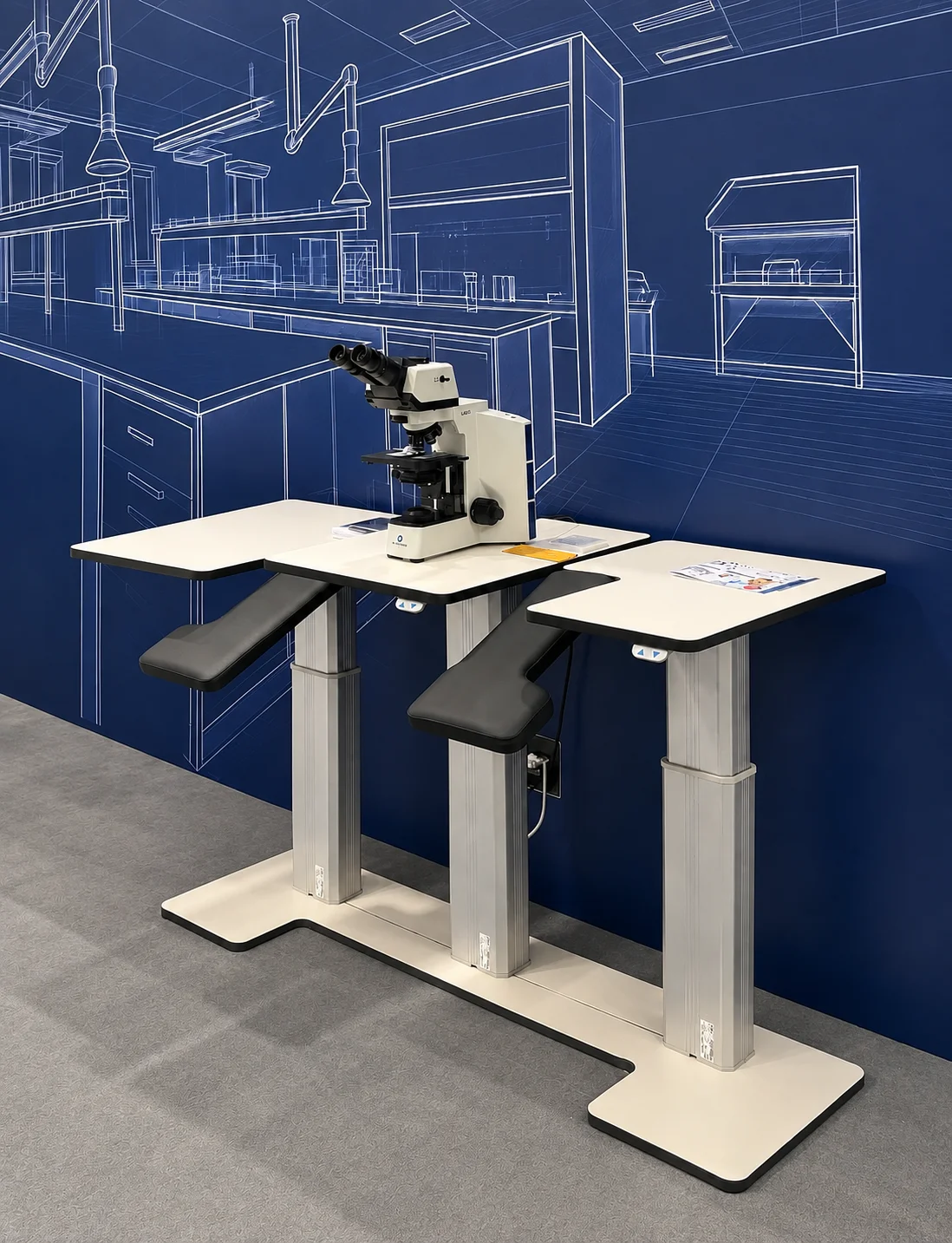
Strict technical parameters are only one dimension of effective work; the other is the human being. The design of Renggli tables places a very strong emphasis on the ergonomics of the entire workstation. The optimized height of the worktop and proper profiling of the working area provide the operator with a comfortable, physiological position for the arms and forearms. This significantly reduces musculoskeletal fatigue during long, monotonous series of pipetting and weighing.
Another important aspect from a technical point of view is occupational hygiene and the ease of keeping the workstation clean. The well-thought-out design eliminates unnecessary technological gaps between the anti-vibration block and the surrounding worktop. Such surface integration prevents the accumulation of biological or chemical contaminants that are difficult to remove, which is a critical requirement in units operating under GLP (Good Laboratory Practice) standards.
Modularity and integration with other laboratory furniture#
Purchasing a single, isolated weighing table is rare in the laboratory market; this workstation usually represents only a fraction of a larger investment in research infrastructure. A significant advantage of the systems offered by Renggli is their full modularity. Weighing tables of this brand have been designed to enable their collision-free integration into existing and newly designed workflows.
This integration covers not only technical but also visual aspects. Aesthetic consistency and maintaining precise dimensional modularity with the rest of the building systems available at renggli.pl guarantee that the weighing table harmonizes with the rest of the equipment, creating a uniform interior architecture. The continuity of the lines of worktops and the consistent color scheme of profiles, frames, and furniture fronts are maintained.
The system architecture also allows for its extensive expansion. A standard weighing table can be easily retrofitted with dedicated functional extensions and safe routing systems for power and IT cables. Depending on process needs, the workstation is supplemented with local extraction arms and specialized shadowless lighting, offering the user a fully complete workplace.
Why is it worth investing in a weighing table#
A professional weighing table is much more than just a piece of laboratory furniture; it is a strategic investment in the accuracy and repeatability of the measurement results obtained. The effective elimination of external interference is the basis of certified research work. For an analytical workstation to strictly fulfill its function for years, its final selection must always be dictated by a cool analysis of the technical requirements of the equipment and the architectural physics of the building.