Laboratory reagent cabinets - how to choose the design and safety features?
A reagent cabinet is not an ordinary piece of furniture, but the first element of a laboratory's safety system. A poorly chosen design quickly makes itself known: through housing corrosion, leaks, the risk of uncontrolled chemical reactions, and remarks during health and safety inspections. The choice of a cabinet depends on five factors: the method of storing substances, material resistance, ventilation efficiency, leak protection, chemical segregation, and adapting the format to the laboratory.
 Renggli TeamEditorial team
Published: Updated Reading time: 6 min read
Contents
Storing reagents starts with the right cabinet#
Many laboratory users treat reagent storage as a secondary issue. In practice, regulations impose much higher requirements than just preventing access by unauthorized persons. What matters is the construction material, tightness, and the method of exhausting fumes.
An ordinary office cabinet was not designed for contact with corrosive or flammable substances. A specialized safety cabinet differs in construction from the ground up, from the sheet steel to the varnish coatings and ventilation systems, which are simply absent in a standard piece of furniture.
The consequences can be costly. Vapors of volatile substances cause corrosion of equipment, and the improper proximity of chemical groups increases the risk of reactions. During health and safety inspections, the lack of a properly selected chemical reagent cabinet is a frequent irregularity.
Therefore, choosing a cabinet should be treated as an investment in safety. The market offers solutions with varying levels of security, tailored to the scale of the laboratory's work.
Material resistance: what a good chemical cabinet should be made of#
The foundation of a chemical cabinet's durability is properly selected steel, most often powder-coated with finishes resistant to acid and base vapors. Additional anti-corrosion protection and internal linings made of chemically resistant materials extend the lifespan of the furniture.
Equally important is the resistance of countertops and shelves on which the reagents stand directly. Work surfaces should withstand contact with acids, bases, and solvents without swelling or losing tightness.
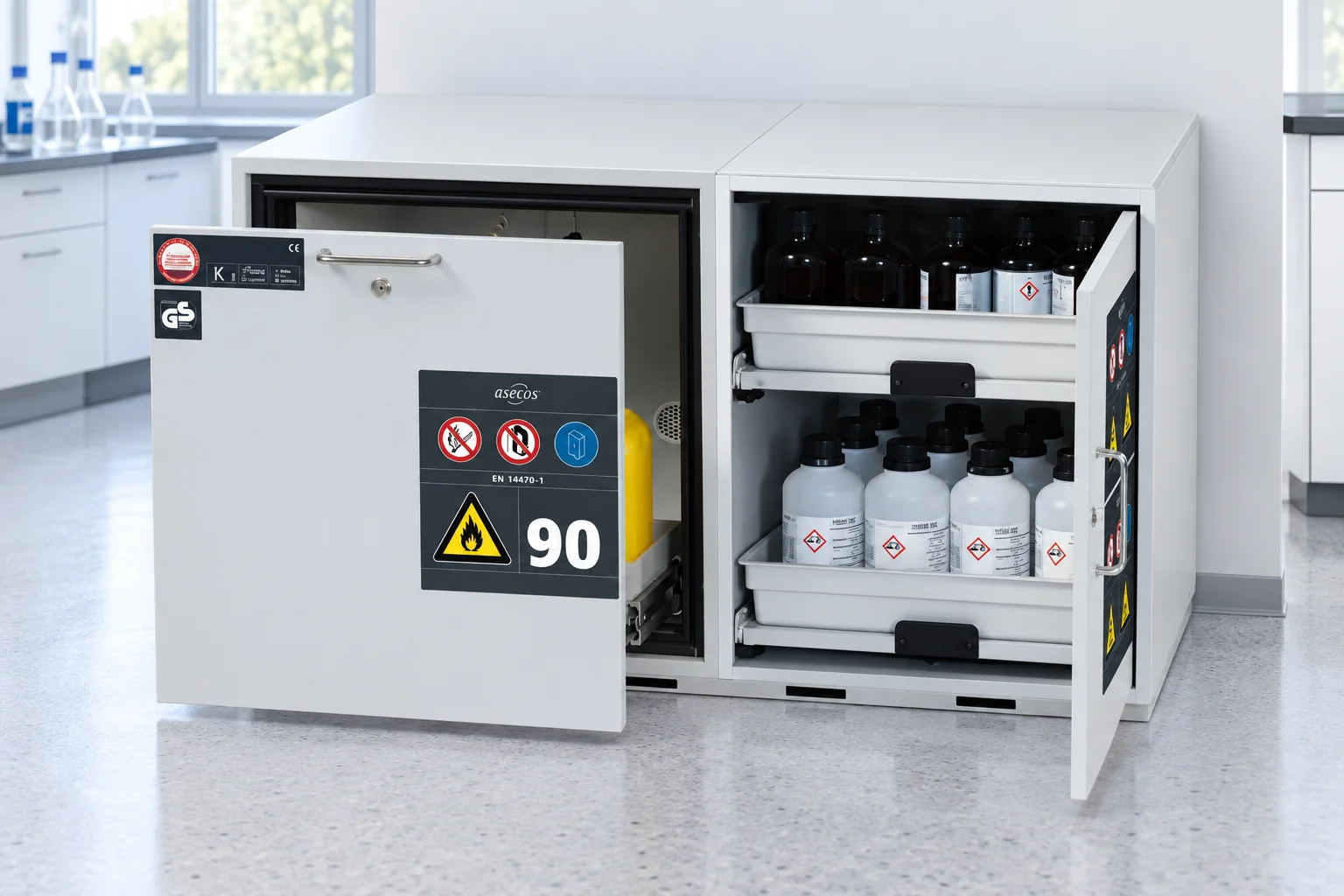
A separate issue is the fire resistance of the structure, defined by the EN 14470-1 standard, which distinguishes between 30 and 90-minute classes - the time the cabinet protects its contents from fire. 30-minute safety cabinets work well with smaller quantities of flammable substances, while 90-minute safety cabinets are used where the scale of storage requires a longer response time.
When choosing a supplier, it is worth paying attention to quality certificates, which confirm the verification of declared parameters in independent tests.
Cabinet ventilation: invisible protection against vapors#
Even a tightly closed reagent cabinet does not eliminate the problem of vapors. Volatile substances penetrate through seals and accumulate inside if they are not provided with constant extraction. Therefore, ventilation is just as important as the construction of the furniture itself.
In practice, two solutions are used: connecting the cabinet to the laboratory's central exhaust system or equipping it with its own independent extractor. The choice depends on the layout of the room and the technical capabilities of the existing installation.
Continuous air flow is important not only for working comfort but primarily for safety (it limits the accumulation of vapor concentrations within the explosive range and reduces personnel exposure when opening the cabinet doors).
Reagent cabinet ventilation should be consistent with the rest of the laboratory's infrastructure. Efficiently designed fume hood ventilation and well-thought-out installations in laboratory furniture together create a coherent system.
Shelves and leak protection systems#
The way the interior of the cabinet is organized directly affects the daily safety of working with reagents. Pull-out shelves facilitate inventorying contents without reaching deep into the cabinet, which reduces the risk of accidental contact with containers at the back of the structure.
Equally important are spill trays and catch basins placed under liquid containers. In the event of packaging damage, they limit the spread of the leak, protecting the interior of the cabinet and adjacent substances.
Access to the cabinet should be restricted solely to authorized persons. Properly selected pull-out shelves and security locks serve this purpose, combining space organization with access control.
Clear labeling of contents cannot be overlooked either. Labels and GHS pictograms on containers and cabinet doors allow for immediate identification of the type of hazard in an emergency situation.
Segregation of substance groups: a rule that cannot be ignored#
Storing different chemical groups in direct proximity is one of the most common mistakes in laboratories. Oxidizers placed next to flammable materials or acids adjacent to bases pose a risk of uncontrolled reactions, even without direct liquid contact.
The solution is the physical separation of substances - within a single structure using partitions and separate compartments or, on a larger scale, by allocating distinct units. The choice of an appropriate cabinet for hazardous substances should be made taking into account the full list of compounds present in the laboratory.
Safety Data Sheets (SDS) and GHS pictograms are the primary source of information when planning segregation. They indicate compatibility groups and warn against combinations that should not be in the same space.
In practice, mapping the reagents used in the laboratory beforehand works best; only such an overview allows for consciously selecting the number and type of cabinets.
Under-bench or tall cabinet? Adapting the format to the laboratory#
The format of the reagent cabinet should correspond to the actual workflow in the laboratory, not just the available space. Under-bench cabinets integrate with the rest of the workstation equipment, saving space and shortening the path to frequently used substances.
Tall, freestanding cabinets serve a different role - as a storage for larger reagent reserves, located in utility rooms or dedicated chemical storerooms, away from the current workstation.
The choice between formats should be based on three criteria: the frequency of reaching for a given reagent, the amount of stored substance, and the space the laboratory can allocate for storing chemicals.
In practice, both formats often complement each other. A well-designed laboratory furniture system allows for combining under-bench cabinets at workstations with tall storage units.
Reagent cabinets from Renggli: experience that translates into safety#
Selecting a reagent cabinet is a process in which none of the discussed elements operates in isolation from the others. Resistant material loses its significance without efficient ventilation, and the best ventilation will not replace proper substance segregation or leak protection. Only the combination of appropriate design, fire resistance class, ventilation, safety systems, chemical segregation, and a format tailored to the workflow creates a cabinet that meets the real requirements of a laboratory.
Renggli offers solutions that take all these aspects into account, from safety cabinets in 30 and 90-minute fire resistance classes, through ventilation and safety systems, to flexible under-bench and freestanding formats that can be combined within a single laboratory.