Chemical resistance chart: what changes countertop look
In the countertop chemical resistance chart, 19 of 80 reagents change the look of at least one board; polypropylene has no ratings. Test date unknown.
 Renggli TeamEditorial team
Published: Reading time: 14 min read
Contents
When choosing laboratory countertops, a lab usually asks for a chemical resistance chart that gives a rating for every board next to every substance. The chart discussed here covers 80 substances and 5 countertop boards, from epoxy resin to polypropylene (test date unknown). Each board was made by a single manufacturer, so it represents its material with only one specimen. Strong acids have the greatest effect: concentrated nitric acid and 40% chromic acid leave discoloration on as many as 3 of the four boards that have ratings. The scale, however, describes only the colour of the surface, not whether a substance destroys it.
How many reagents change the look of each board?#
Each of the four boards with ratings changes its look with a different number of reagents, and polypropylene has no ratings at all. In the chart, each board has 80 cells: ratings from the scale, “Do not use” corrections and withheld cells.
How ratings are distributed in the chart: five boards side by side
Number of cells by rating per board, n = 80 reagents per board (400 cells); the scale describes the change in the look of the surface, test conditions unknown; 81 withheld cells (the entire polypropylene column and 2-butanone on the composite); “Do not use” is an editorial correction, not a test result; countertop chemical resistance chart, test date unknown, extract in version 2026-10-21 of the base dataset in version 2026-09-24
- No effect
- Slight discoloration
- Discoloration
- Do not use
- withheld
Show data
| Category | No effect | Slight discoloration | Discoloration | Do not use | withheld | n |
|---|---|---|---|---|---|---|
| Epoxy resin | 74 | 3 | 3 | 80 | ||
| Quartz-granite composite | 58 | 12 | 6 | 3 | 1 | 80 |
| Phenolic resin | 73 | 2 | 5 | 80 | ||
| Monolithic ceramics | 79 | 1 | 80 | |||
| Polypropylene | 80 | 80 |
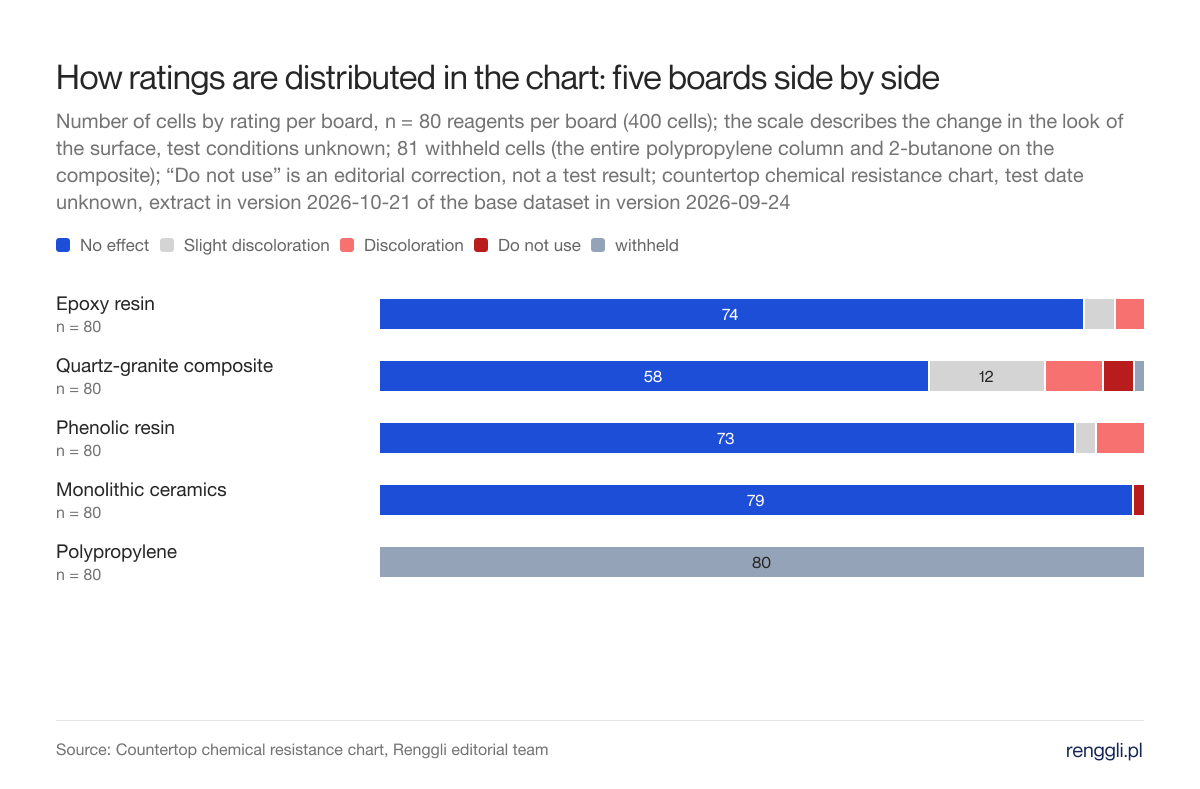
The same chart as an image. Data: Durcon Company of Poland Sp. z o.o., under the source's terms; Renggli grants no licence for it.
Quartz-granite composite changes its look with 18 of 80 reagents. They include specimen stains (eosin, crystal violet, both fuchsins), strong acids and chlorinated solvents. For three reagents, the editors of the base dataset entered a recommendation for this board in place of a rating; these corrections are described in the section on damage. The rating for 2-butanone is withheld because it was transcribed incorrectly in the Renggli chart (see the note in the caption of the full table).
Epoxy resin changes its look with 6 of 80 reagents, only with strong acids and furfural. For some of them, the chart has a note about surface etching, described in the section on damage.
Phenolic resin changes its look with 7 of 80 reagents: with three stains, crystalline iodine and three strong acids. With 96% sulfuric acid, the phenolic board in this chart shows no change on the scale, but the note stresses that this is the result of a single board. The note compares it with a newer edition of the source table, which gives a poorer result for the same board, and with another phenolic board from the same test. Dataset note: Result for a single board from the source test: a newer edition of the table gives “Slight discoloration” for this board, and another board of this material had “Discoloration” in the same test.
Monolithic ceramics shows no change in look on the scale with any of the 80 reagents, with one exception: an editorial recommendation for a strong acid, described in the section on damage.
For polypropylene, the chart gives no number of reagents that change its look. All 80 cells of this column are withheld, because the column is not in the source table and the origin of its ratings is unknown.
Which reagents change the look of several boards at once?#
For 19 of 80 reagents, at least one board changes its look, but no reagent changes the look of all four boards with ratings.
The largest group is reagents for which only one board shows a change: 9 of 19. It is always the composite, and the reagents are seven stains and two chlorinated solvents.
Two boards change their look with 8 reagents, and three boards with 2. The two reagents that change three boards are concentrated nitric acid and 40% chromic acid. With both of these acids, both resins and the composite show a change.
Does the chemical resistance chart say what damages the surface?#
Not directly: the scale describes only the change in the look of the surface after a test whose temperature, method and date are unknown. The chart speaks about damage in two places that are not test results: in editorial corrections and in etching notes.
There are 4 “Do not use” corrections: 3 on the quartz-granite composite and one on monolithic ceramics. A correction is a recommendation from the editors of the base dataset, entered in place of a rating when the source test and other sources say something different.
The sources of the notes for these corrections are still being prepared, so the text does not cite them, and the table below leaves out these rows. Hydrofluoric acid with all the boards and its storage are covered in a separate text on hydrofluoric acid and countertops. University safety guidance points in the same direction: the guidelines of the University of Wisconsin-Madison (opens in a new tab) recommend storing hydrofluoric acid separately from, among other things, glass and ceramics.
For epoxy resin, 3 ratings with a change in look have an etching note: with the chromic acid cleaning mixture, concentrated nitric acid and 96% sulfuric acid. Dataset note: The source does not define the levels of the scale, and for this reagent independent tables indicate etching of the surface.
How do you read the ratings and statuses in the chart?#
A rating in the chart is one of three levels of the scale: “No effect”, “Slight discoloration” or “Discoloration”. The source does not define these levels, so “No effect” means only that no change in look was recorded after the test.
The temperature, method and date of the test are unknown. The concentration is given by the name of the reagent, and for some stains and salts the source does not give it, which the chart marks with the note “concentration unknown”. Each column is one board from one manufacturer in the source table, not the whole material.
Besides ratings, the chart has two kinds of cells that are not a test result:
- Do not use: an editorial correction by the editors of the base dataset, that is, a recommendation in place of a test result; each has a note with the reason.
- withheld: the rating awaits verification or its origin is unknown; the text does not give it, and the table shows only the status label.
Full table of reagents and boards#
Below are the reagents in dataset order, with the rating of each board that has ratings; the dataset notes are in the table caption. The table leaves out six of the 80 rows whose note sources are still being prepared; their names are given in the caption. The table does not repeat the polypropylene column, because all of its cells are withheld.
| Reagent | Epoxy resin | Quartz-granite composite | Phenolic resin | Monolithic ceramics |
|---|---|---|---|---|
| Acetone | No effect | No effect | No effect | No effect |
| Acetonitrile | No effect | No effect | No effect | No effect |
| Alizarin (concentration unknown) | No effect | Slight discoloration | No effect | No effect |
| Ethanol 50% | No effect | No effect | No effect | No effect |
| Ethanol 95% | No effect | No effect | No effect | No effect |
| Giemsa stain (concentration unknown) | No effect | Discoloration | No effect | No effect |
| Benzene | No effect | No effect | No effect | No effect |
| Acetic anhydride | No effect | No effect | No effect | No effect |
| Aniline blue (concentration unknown) | No effect | Slight discoloration | No effect | No effect |
| 2-Butanone (methyl ethyl ketone) | No effect | withheld | No effect | No effect |
| Sodium chloride 10% | No effect | No effect | No effect | No effect |
| Iron(III) chloride (concentration unknown) | No effect | No effect | No effect | No effect |
| Chromic acid cleaning mixture | Discoloration | Slight discoloration | No effect | No effect |
| Carbon tetrachloride | No effect | No effect | No effect | No effect |
| Congo red (concentration unknown) | No effect | No effect | No effect | No effect |
| Dichloroethane (ethylene chloride) | No effect | Slight discoloration | No effect | No effect |
| Potassium dichromate (concentration unknown) | No effect | No effect | No effect | No effect |
| N,N-Dimethylformamide | No effect | No effect | No effect | No effect |
| Dioxane | No effect | No effect | No effect | No effect |
| Eosin (concentration unknown) | No effect | Slight discoloration | No effect | No effect |
More rows: 54
| Reagent | Epoxy resin | Quartz-granite composite | Phenolic resin | Monolithic ceramics |
|---|---|---|---|---|
| Diethyl ether | No effect | No effect | No effect | No effect |
| Phenol (concentration unknown) | No effect | No effect | No effect | No effect |
| Crystal violet (concentration unknown) | No effect | Discoloration | Discoloration | No effect |
| Methyl violet (concentration unknown) | No effect | Discoloration | No effect | No effect |
| Formaldehyde 37% | No effect | No effect | No effect | No effect |
| Carbol fuchsin (concentration unknown) | No effect | Slight discoloration | Discoloration | No effect |
| Basic fuchsin (concentration unknown) | No effect | Discoloration | Discoloration | No effect |
| Furfural | Slight discoloration | Discoloration | No effect | No effect |
| Ethylene glycol | No effect | No effect | No effect | No effect |
| n-Hexane | No effect | No effect | No effect | No effect |
| Heptane | No effect | No effect | No effect | No effect |
| Isooctane | No effect | No effect | No effect | No effect |
| Iodine, crystalline | No effect | Slight discoloration | Discoloration | No effect |
| Potassium iodide 10% | No effect | No effect | No effect | No effect |
| Carmine (concentration unknown) | No effect | No effect | No effect | No effect |
| Xylene | No effect | No effect | No effect | No effect |
| Nitric acid 10% | No effect | No effect | No effect | No effect |
| Nitric acid, concentrated | Slight discoloration | Discoloration | Slight discoloration | No effect |
| Chromic acid 40% | Slight discoloration | Slight discoloration | Slight discoloration | No effect |
| Citric acid 10% | No effect | No effect | No effect | No effect |
| Phosphoric acid 85% | No effect | No effect | No effect | No effect |
| Acetic acid 5% | No effect | No effect | No effect | No effect |
| Acetic acid, glacial | No effect | No effect | No effect | No effect |
| Oleic acid | No effect | No effect | No effect | No effect |
| Sulfuric acid 33% | No effect | No effect | No effect | No effect |
| Sulfuric acid 60% | No effect | No effect | No effect | No effect |
| Sulfuric acid 96% | Discoloration | Slight discoloration | No effect | No effect |
| Potassium permanganate (concentration unknown) | No effect | No effect | No effect | No effect |
| Kerosene | No effect | No effect | No effect | No effect |
| Butyl acetate | No effect | No effect | No effect | No effect |
| Ethyl acetate | No effect | No effect | No effect | No effect |
| Aniline oil | No effect | No effect | No effect | No effect |
| Cottonseed oil | No effect | No effect | No effect | No effect |
| Mineral oil | No effect | No effect | No effect | No effect |
| Transformer oil | No effect | No effect | No effect | No effect |
| Olive oil | No effect | No effect | No effect | No effect |
| Acridine orange (concentration unknown) | No effect | Slight discoloration | No effect | No effect |
| Sodium hypochlorite 5% | No effect | No effect | No effect | No effect |
| Soap solution 1% | No effect | No effect | No effect | No effect |
| Safranin (concentration unknown) | No effect | No effect | No effect | No effect |
| Copper(II) sulfate (concentration unknown) | No effect | No effect | No effect | No effect |
| Sudan III (concentration unknown) | No effect | No effect | No effect | No effect |
| Turpentine | No effect | No effect | No effect | No effect |
| Tetrahydrofuran | No effect | No effect | No effect | No effect |
| Trichloroethylene | No effect | No effect | No effect | No effect |
| Chromium oxide (oxidation state not established) | No effect | No effect | No effect | No effect |
| Toluene | No effect | No effect | No effect | No effect |
| Sodium carbonate 2% | No effect | No effect | No effect | No effect |
| Sodium carbonate 20% | No effect | No effect | No effect | No effect |
| Distilled water | No effect | No effect | No effect | No effect |
| Boiling water (5 min) | No effect | No effect | No effect | No effect |
| Hydrogen peroxide 3% | No effect | No effect | No effect | No effect |
| Hydrogen peroxide 20% | No effect | No effect | No effect | No effect |
| Malachite green (concentration unknown) | No effect | Slight discoloration | No effect | No effect |
What does this mean when choosing a countertop?#
The chemical resistance chart helps narrow down the choice of board, but a lab should base its decision on the board manufacturer's data for its own reagents.
List the reagents used at the workstation
With the name, the concentration and how long a spilled reagent may stay on the countertop.
Check the rating of each board for each reagent
A rating other than “No effect”, or a withheld cell, calls for a decision by the lab. For the composite and the ceramics, the “Do not use” corrections must also be taken into account.
Write the requirement into the description of the subject of the contract
For example: “Work countertop: no visible change in the colour of the surface after contact with eosin, crystal violet and basic fuchsin according to the manufacturer's chemical resistance chart; chart attached to the bid”. How to align such a requirement with the scoring of tenders is described in the text on award criteria for laboratory furniture tenders.
Ask the board manufacturer for data the chart does not have
Etching, hardness, prolonged contact, working temperature and other concentrations: here the requirement rests on the board manufacturer's tests under those conditions.
Method and data#
This text is based on an extract from the base dataset chemical-resistance in version 2026-09-24. The extract covers the whole countertop chemical resistance chart: 400 cells, that is, 80 reagents for each of the 5 boards. The unit of the extract is the cell, that is, a pair of a board and a reagent; the text above counts reagents, because each board has the same number of them.
A change in look is a rating of “Slight discoloration” or “Discoloration”. Editorial corrections and withheld cells are counted separately, and an etching note is a dataset note that explicitly points to etching of the surface. The extract has 315 ratings from the scale, 4 corrections and 81 withheld cells. All numbers are counts out of 80 reagents for each board, without shares and intervals, because the list is closed: it is the whole chart, not a sample.
Frequently asked questions#
They are three levels of the scale: “No effect”, “Slight discoloration” and “Discoloration”. They describe only the change in the look of the surface after the test, and the source does not define them more precisely. “Do not use” is not a rating, but an editorial correction by the editors of the base dataset.
The test temperature is unknown. The concentration is given by the name of the reagent, and for some stains and salts the source does not give it, so the chart says nothing about other concentrations.
The countertop chemical resistance chart does not point to one material for everyone. Each column is one board from one manufacturer, and the scale describes only the look of the surface, so the choice depends on the reagents at the workstation and on the board manufacturer's data.
A change in look is discoloration visible after the test. Destruction, that is, etching, loss of hardness or swelling, requires other tests, and the scale of the chart does not measure it. The dataset signals it only through “Do not use” corrections and etching notes.
There is no such certainty. The test has an unknown temperature and method, describes one board of each material and does not cover prolonged contact. It is better to attach the data of the manufacturer of the specific board to the description of the subject of the contract.