Laboratory microbalance: choosing the table and place
Laboratory microbalance installation: table, vibration and location in the RADWAG and METTLER TOLEDO manuals, and what Renggli's weighing table cards omit.
 Renggli TeamEditorial team
Published: Reading time: 12 min read
Contents
A laboratory microbalance has a chapter in its user manual on the place of installation: what it should stand on, what to avoid and how long to wait before the first weighing. The Renggli weighing table catalogue describes the table itself. It consists of model cards and a shared text on the category page, hereafter called the line text. This guide sets the microbalance manuals and weighing table catalogue side by side, that is, two manuals from balance manufacturers and the range of Renggli weighing tables. The catalogue holds 4 weighing table cards, and none of them states the mass of the plate.
What does a laboratory microbalance require from the table?#
Both manuals point to a stable place under the balance, but they describe it differently. Microbalances and ultra-microbalances are covered by the RADWAG manual “5Y series balances” (opens in a new tab) of July 2022. According to it, “the balance should be placed on a wall bracket or a stable table, not subject to vibration, far from heat sources”.
The METTLER TOLEDO manual for XPR microbalances (opens in a new tab) puts it more briefly. The balance is placed indoors on a stable table (“Place indoors on stable table”). This manual deals with vibration separately, in the choice of location.
None of the 14 sentences on the place of installation that the dataset copies from the two manuals states the mass of the table or the material of the weighing plate. The manual therefore describes the effect the table is meant to achieve. The mass and the material of the plate have to be agreed with the table supplier.
A workstation for a precision balance, which is a different instrument, is described in a separate article on the precision balance in the laboratory.
What does the catalogue say about weighing tables?#
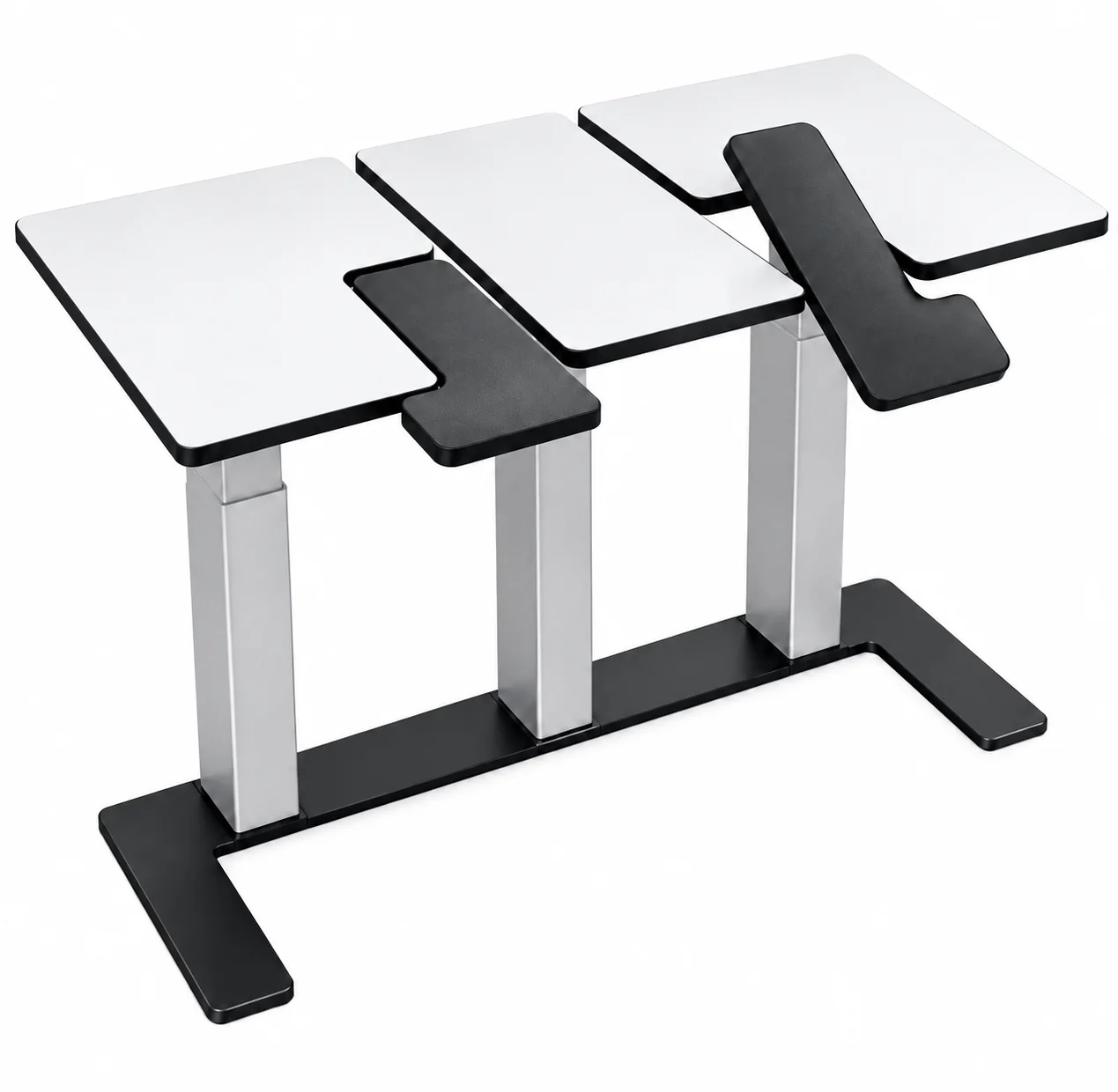
The Renggli catalogue has 4 weighing table cards, and each gives only the model name. The names show the construction: 3 tables are single-station and 1 is double-station. The name of one single-station table mentions a mobile pedestal, another a built-in frame, and the third the absence of a built-in frame. No card states the mass of the plate, and none states its material.
| Card in the catalogue | Stations (number) | Mobile pedestal | Built-in frame | Plate mass on the card | Plate material on the card |
|---|---|---|---|---|---|
| Single-station weighing table with a mobile pedestal | 1 | yes | not stated in the name | none | none |
| Double-station weighing table | 2 | not stated in the name | not stated in the name | none | none |
| Single-station weighing table with a built-in frame | 1 | not stated in the name | yes | none | none |
| Single-station weighing table without a built-in frame | 1 | not stated in the name | no | none | none |
The line text, on the other hand, describes the whole line and not a single model:
- in the “table in table” construction the outer countertop is physically separated from the inner base on which the balance stands, so leaning on the countertop does not transmit vibration to the balance;
- according to the line text, the weighing plate is made of a high-density material, most often granite with a low resonant frequency; the text does not say which models this applies to;
- the line text gives a range for the mass of the whole table across the line, not the mass of the plate of a specific model;
- the workstation is set up in a corner by a load-bearing wall, preferably on the ground floor.
The line text, however, plans the weighing table for analytical balances. The term “analytical balance” appears in 2 text fields of the category page and cards in the CMS, and “microbalance” in neither. How the vibration-damping construction itself works is described in the guide to the anti-vibration table.
Which installation topics does the catalogue omit?#
In the comparison below, based only on the transcribed manual sentences, the catalogue (cards and line text) does not touch draughts, temperature changes, sunlight, levelling, free space around the balance, acclimatisation or moving the balance, among others. The manuals may cover these topics more broadly in other chapters. The cards give only model names, so all the features in this comparison come from the line text.
Most of the omitted topics concern the room and the handling of the balance. A table will not solve them, so they are planned together with the weighing room.
| Requirement topic | RADWAG, microbalances and ultra-microbalances | METTLER TOLEDO, XPR microbalances | Renggli line text |
|---|---|---|---|
| Table or bracket under the balance | yes | yes | table in table, weighing plate, table mass |
| Vibration and shocks | yes | yes | purpose, table in table, leaning, placement |
| Draughts and air movement | mention in the sentence on vibration | yes | none |
| Temperature changes and heat sources | yes | none | none |
| Direct sunlight | none | yes | none |
| Air humidity | yes | none | humidity in the weighing room |
| Levelling the balance | none | yes | none |
| Free space around the balance | none | yes | none |
| Acclimatisation after set-up | yes | yes | none |
| Moving an installed balance | yes | none | none |
| Effect of the location on the weighing result | none | yes | placement by a load-bearing wall |
Where to put a microbalance?#
The place is chosen so that vibration, air movement and heat do not reach the balance. The RADWAG manual (opens in a new tab) speaks of rooms “free from vibration and shocks, draught-free and dust-free”. According to it, changes in room temperature should occur “gradually and very slowly”.
The METTLER TOLEDO manual (opens in a new tab) lists briefly: avoid vibration, strong draughts and direct sun, and level the balance. It also stresses that the place of installation has a great effect on the accuracy of weighing results.
The Renggli line text adds a hint about the building: the workstation is set up in a corner by a load-bearing wall, preferably on the ground floor. How to look for such a place in a laboratory is described in the article on the location of a weighing table.
Both manuals also give an acclimatisation time for the balance after set-up or after storage in the cold. The values differ in their conditions, so the section on method sets them side by side, each with its source. Once installed, a balance is not moved without need. RADWAG states that ultra-microbalances and other devices installed by its staff “must not be moved to another place or another room”.
Checklist: the table and the place for a microbalance#
Before ordering a table and setting up a microbalance, it is worth going through seven steps.
List the requirements from the manual of your balance
The starting point is the chapter on the place of installation in the manual of the specific model. The two manuals in this guide are not the whole market, and requirements differ between manufacturers.
Ask the supplier for the mass and the material of the plate
The cards in the catalogue do not state them. It is worth asking for the data of a specific model, not for a range for the whole line.
Check whether the weighing plate is separated from the countertop
In the “table in table” construction the balance stands on a base separated from the countertop on which the person weighing leans.
Choose a place free of vibration, draughts and sun
Away from heat sources. The line text suggests a corner by a load-bearing wall, preferably on the ground floor.
Leave free space around the balance and level it
The METTLER TOLEDO manual states how much free space to leave around the balance; the value for a given model is in its manual.
Plan acclimatisation before the first weighing
A balance brought in from the cold or only just set up needs time before it is used for weighing. The manual states how long.
Do not move the balance after installation
Ultra-microbalances and other devices installed by RADWAG staff must not be moved. For other models, the manufacturer's manual decides.
Method and data#
The dataset is a closed list, not a sample. It covers all weighing tables in the Renggli catalogue in the CMS on the day of reading and sentences transcribed verbatim from two open manufacturers' manuals. The article therefore gives counts, without shares or intervals.
A topic is a group of requirements, for example vibration or acclimatisation. In the dataset each sentence of a manual has one topic, and the features of the line text were assigned to topics by the editors. The RADWAG sentence on the room mentions vibration, draughts and dust, but counts as the topic “vibration”.
The numerical values in the manuals apply to the balances of those manufacturers and the conditions described in the manual. The article therefore gives them here, each with its source.
The recommendation from the RADWAG manual “5Y series balances” (opens in a new tab) speaks of acclimatisation and warming up for about 12 hours when the balance was stored at a much lower temperature. According to the recommendation in the METTLER TOLEDO manual for XPR microbalances (opens in a new tab), acclimatisation takes at least 24 hours from setting the balance up in the place of work.
The METTLER TOLEDO manual (opens in a new tab) also recommends leaving more than 15 cm of free space around the balance. According to the recommendation in the RADWAG manual (opens in a new tab), relative humidity should not exceed 80%. This is the upper limit for RADWAG balances. For the weighing room, the Renggli line text gives its own humidity range, with a lower and an upper limit.
Frequently asked questions#
The RADWAG manual points to a stable table not subject to vibration or a wall bracket, and the METTLER TOLEDO manual to a stable table and a place free of vibration. These manuals do not state the mass of the table or the material of the weighing plate in their chapters on installation.
The balance manuals do not require it. The Renggli line text says the weighing plate is most often made of granite, but none of the 4 cards states the plate material of its model, so the supplier has to be asked.
The manuals point to a place free of vibration and a stable table or wall bracket. The Renggli line text suggests a corner by a load-bearing wall, preferably on the ground floor, and a table-in-table construction, in which leaning on the countertop does not transmit vibration to the balance.
According to the RADWAG manual (opens in a new tab), relative humidity should not exceed 80%. The manual of a specific balance may give a different range.
According to the RADWAG manual, ultra-microbalances and other devices installed by the company's staff must not be moved to another place or another room. For other models, the manufacturer's manual decides.