Anti-vibration weighing table - why stability matters?
Precise analytical measurements are the foundation of reliable laboratory research. Even microscopic vibrations can disrupt the operation of sensitive balances, leading to errors and losses. Find out why a professional anti-vibration weighing table is an essential piece of equipment in a modern laboratory.
 Renggli TeamEditorial team
Published: Updated Reading time: 9 min read
Contents
The role of a weighing table in a modern laboratory#
An analytical balance is among the most sensitive measuring devices in a laboratory. The primary task of a weighing table is the absolute isolation of the device from the environment - the elimination of factors that could disturb the mass reading. Without such separation, even the most accurate balance will not guarantee reproducible results.
In pharmaceutical and chemical laboratories, as well as research and development units, analytical microbalances with microgram accuracy are becoming the standard. Working on such equipment requires rigorously controlled environmental conditions, including the complete elimination of mechanical vibrations.
Therefore, a weighing table is not just an ordinary piece of furniture, but a research infrastructure element of key importance. Its design directly affects the quality and reliability of the data obtained, and thus the credibility of the entire research process.
The invisible threat - sources of vibration in a laboratory environment#
Mechanical vibrations accompany laboratory work continuously, although they are rarely noticeable to the naked eye. Internal sources include, among others, personnel footsteps, centrifuge operation, opening of fume hoods, as well as the operation of ventilation and air conditioning (HVAC) systems.
Elevators and autoclaves also belong on this list. Air movement itself, that is, variable airflows from ventilation supply systems, also causes micro-vibrations. These reduce the repeatability of micro-weighing.
External sources include traffic near the building, the operation of industrial equipment in the vicinity, and vibrations transmitted through the building's structure. These micro-vibrations propagate through floors and walls, ultimately reaching the work surface.
As a result, even a seemingly quiet laboratory is actually an environment full of constant micro-movement. These frequencies are too low to be felt by the senses, but for a sensitive analytical balance, they constitute a real disturbance.
A standard worktop, made of typical furniture materials, does not have the dampening properties to eliminate these types of frequencies. Therefore, a dedicated structural solution is necessary in laboratory practice.
An ordinary laboratory desk has a lightweight board or steel structure and a laminate, HPL or melamine worktop. It has no massive stone plate isolated from the frame and no vibration shock absorbers, so every movement of the employee is transmitted directly to the worktop, and with it to the balance.
Consequences of a lack of proper stabilization during analysis#
The lack of proper vibration isolation manifests itself in many ways in the daily work of a laboratory technician. The most characteristic symptom is the "drifting" of the result on the balance display. The mass indication does not settle at one point but oscillates, making unambiguous reading difficult.
The consequence is extended measurement stabilization time, and often the need for frequent recalibration of the device, which additionally burdens the laboratory's work schedule. These technical inconveniences translate into tangible business costs.
An analytical error resulting from unstable measurement conditions can lead to the rejection of an entire research or production batch. This means financial losses associated with repeating analyses and delays in project implementation.
An error made at the beginning of the procedure, at the weighing stage, cascades onto all subsequent stages of the research. The analysis then has to be repeated, and with it further portions of reagents are consumed.
An unstable workstation is also an OHS problem. When weighing out toxic or hazardous substances, any uncontrolled shock increases the risk of spilling powder or a sample, which directly endangers the health of personnel.
A lack of measurement repeatability also shows up in quality audits. An unstable weighing environment can be the reason for a failed audit and an obstacle to maintaining the certification or accreditation of the facility.
How does an anti-vibration table work? Construction and materials#
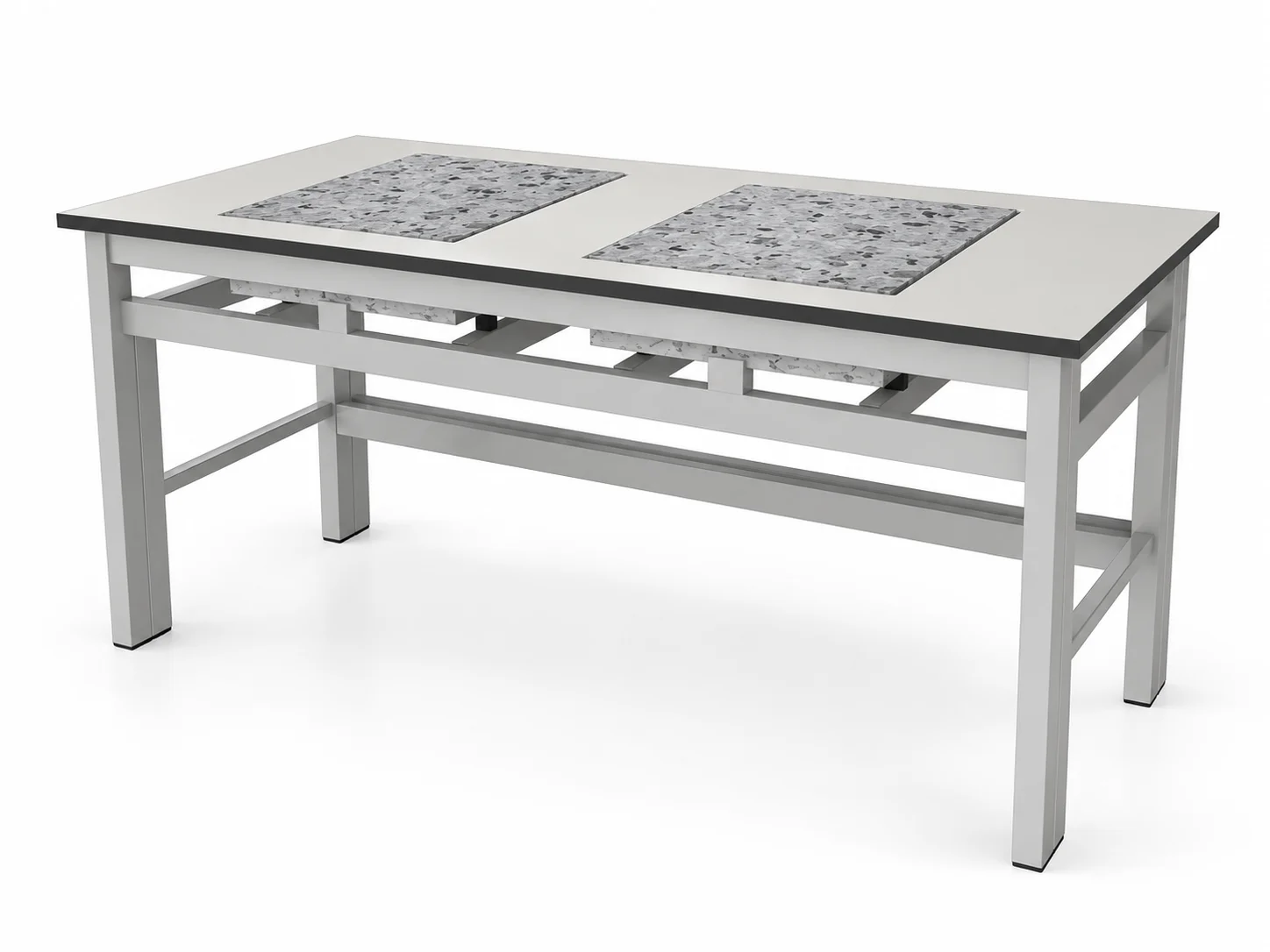
The operating principle of a professional weighing table is based on the "table within a table" concept. The external frame is equipped with its own worktop, on which the laboratory technician can rest their hands, put down notes or samples, without the risk of transferring vibrations to the balance.
Independently of this structure, a separate, much heavier weighing top functions, on which the balance is placed. It is most often made of solid granite or specialized vibration-isolating concrete.
The key element of the construction is the shock absorption system on which the weighing block rests. Specialized vibration isolators and vibration absorbers dissipate the kinetic energy coming from the environment before it reaches the surface on which the balance stands.
By separating the worktop and the independent weighing top, it is possible to simultaneously ensure working comfort and full measurement isolation, even for balances with microgram accuracy.
The separation only works if the weighing plate does not touch the steel frame at any point. If they were in contact, the frame would transmit vibrations to the balance from the floor or from a laboratory technician leaning against the furniture. The expansion joint between the plate and the frame must therefore remain clear.
The load-bearing frame is rigid and thick-walled, so it does not deform even under massive, large-scale apparatus. The powder-coated steel has an anti-corrosion coating that is not damaged by contact with the acids, bases and solvents used in sample preparation.
Choosing a table for the type of balance and specifics of research#
The choice of a suitable weighing table should be closely related to the type of equipment used. A technical balance with an accuracy of 0.01 g has different isolation requirements, and completely different ones apply to an ultra-sensitive analytical microbalance operating in the microgram range.
The basic selection criterion is the table's load capacity, corresponding to the weight of the balance and additional equipment. The dimensions of the granite slab are also important. The surface should provide a comfortable workspace without losing its anti-vibration properties.
The properties of the external worktop surface are not without significance. Depending on the nature of the analyses, epoxy resin tops, resistant to solvents and reagents, or acid-resistant ceramics, which work well in contact with corrosive substances, are used. Beyond the surface, other parameters worth checking when choosing a weighing table include the isolation system, the load capacity and the height of the working top.
For special tasks, exceptionally low tables for mass comparators and acid-resistant stainless steel workstations are also used.
Single-station or double-station weighing table?#
The choice depends on how intensively the balance is used and how much space the room has. A single-station table works well where the balance complements the main research station, or when the procedure requires full, uninterrupted operator isolation.
A double-station table suits intensively used laboratories, such as commercial laboratories and R&D departments, as well as rooms where every square meter counts. Two laboratory technicians then work at one table at the same time, so each balance must have its own independent vibration damping. The available designs are shown in the weighing tables category.
Where to place a weighing table, and where not to?#
The best location for a weighing table is the corner of a room directly against the building's load-bearing wall. Structural corners have the lowest amplitude of the building's natural vibrations. If the layout of the building allows it, the weighing station is placed on the ground floor or on the lowest foundation slab.
A weighing table should not be placed near traffic routes, ventilation grilles, doors or windows. Air movement and sudden pressure changes in these places prevent the balance from stabilizing, and routine calibration then cannot be performed with the specified precision.
How to level a weighing table and prepare the balance for measurement?#
The table is leveled using adjustable threaded feet with damping, non-slip rubber pads. First the frame is set with a spirit level, then the built-in level of the balance itself is checked. Each foot must stand stably on the floor so that the load is distributed evenly, even on an uneven floor.
After the balance has been set up and connected, it is necessary to wait until the balance and the weighing stone have reached the temperature of the surroundings. Only then can measurements begin.
Temperature, humidity and electrostatics in the weighing room#
A table cannot replace stable conditions in the room. Sudden temperature changes cause the steel elements of the table to expand and contract and lead to balance calibration errors. Electrostatic charges also falsify readings, and to limit them, plastic weighing boats are avoided.
Recommended conditions in the weighing room:
- constant ambient temperature, without sudden spikes,
- air humidity from 45% to 60%,
- glass or metal weighing boats.
Comprehensive infrastructure and laboratory technician's work ergonomics#
A weighing station is a place where a laboratory employee often spends many hours a day. Therefore, the technical aspects of vibration isolation should go hand in hand with concern for ergonomics; a properly selected worktop height has a direct impact on comfort and work efficiency.
Standard weighing tables are 900 mm wide and have a working height of 750 mm to 900 mm.
Adequate legroom is also important, allowing for a comfortable position during long measurement sessions. Weighing stations are also increasingly integrated with extensions enabling the installation of lighting or electrical installations.
Documentation and accessories can be kept close at hand in a mobile container. The container is freestanding, so it does not interfere with the stabilization zone of the anti-vibration plate.
A computer used with the balance is better placed on its own workstation, isolated by an expansion joint, with a keyboard shelf and a monitor mount. Computer fans generate small vibrations which, on a shared worktop, would reach the weighing pan of the balance.
The combination of vibration isolation technology with ergonomic solutions translates into less personnel fatigue during long analytical sessions, which is of direct importance in reducing the risk of human error.
Integration of weighing tables with laboratory furniture systems#
A modern weighing station should not function as an element isolated from the rest of the laboratory equipment. Its coherent integration with other laboratory furniture systems, in terms of aesthetics, functionality, and construction, is becoming increasingly important.
The modular design of the infrastructure allows for easy reconfiguration of the laboratory layout in the future, without having to give up the anti-vibration properties of the weighing stations.
Quality standards and cleanliness - key aspects#
In advanced environments, such as clean rooms or microbiological laboratories, furniture must meet rigorous hygiene requirements. This also applies to weighing stations, which are exposed to frequent contact with samples.
A key structural element is the absence of gaps and hard-to-reach joints where contaminants could accumulate. A design with smooth, continuous surfaces significantly facilitates decontamination and maintaining the hygiene of the station.
Equally important is the resistance of materials to aggressive cleaning agents, disinfectants, and chemical reagents used in everyday laboratory work; low surface resistance leads to its degradation over time.
Meeting these standards is a prerequisite for research safety and maintaining the quality certifications required in many areas of laboratory activity.
Summary - an investment in precision that always pays off#
An anti-vibration weighing table should not be perceived as an additional cost, but as a strategic investment protecting the reliability of research results and laboratory certifications. Measurement stability translates directly into data credibility and the reputation of the facility.