Microscope tables are specialized workstations designed for research laboratories and B2B industry, where stability, precision and elimination of vibrations affecting the microscopic image are crucial. Modern designs offer a load capacity of up to 300 kg and height adjustment in the range of 750-900 mm, which allows you to adjust the station to the ergonomics of the operator's work and the requirements of optical equipment. An individual quote depends on the vibration isolators used and the size and rigidity of the steel frame.
Based on 90 years of experience, Renggli Polska provides solutions compliant with the ISO 9001:2015 standard, ensuring repeatability of parameters and safety of work in laboratory environments.
What is a microscope table and what modules does it consist of
A microscope table is a specialized laboratory station designed to work with optical equipment, where the stability and ergonomics of the operator's work are crucial. The design is based on a modular design, allowing adaptation to various types of examinations and microscopes.
The main elements are a C-shaped steel frame, made of closed steel profiles painted with epoxy paint, and adjustable leveling feet that ensure stability even on uneven ground. Depending on the configuration, electric height adjustment of the table top is also used in the range of 750-900 mm.
Modern workstations can be equipped with under-counter cabinets and shelves for a PC, which increases functionality and organizes the workspace in accordance with the PN-EN 13150 standard.
Physics of vibration damping at a microscope station
Vibration damping at the microscope station is based on limiting the influence of seismic vibrations carried by the building structure. Vibroisolators anda damping plate play a key role, reducing the amplitude of vibrations and stabilizing the image in the microscope.
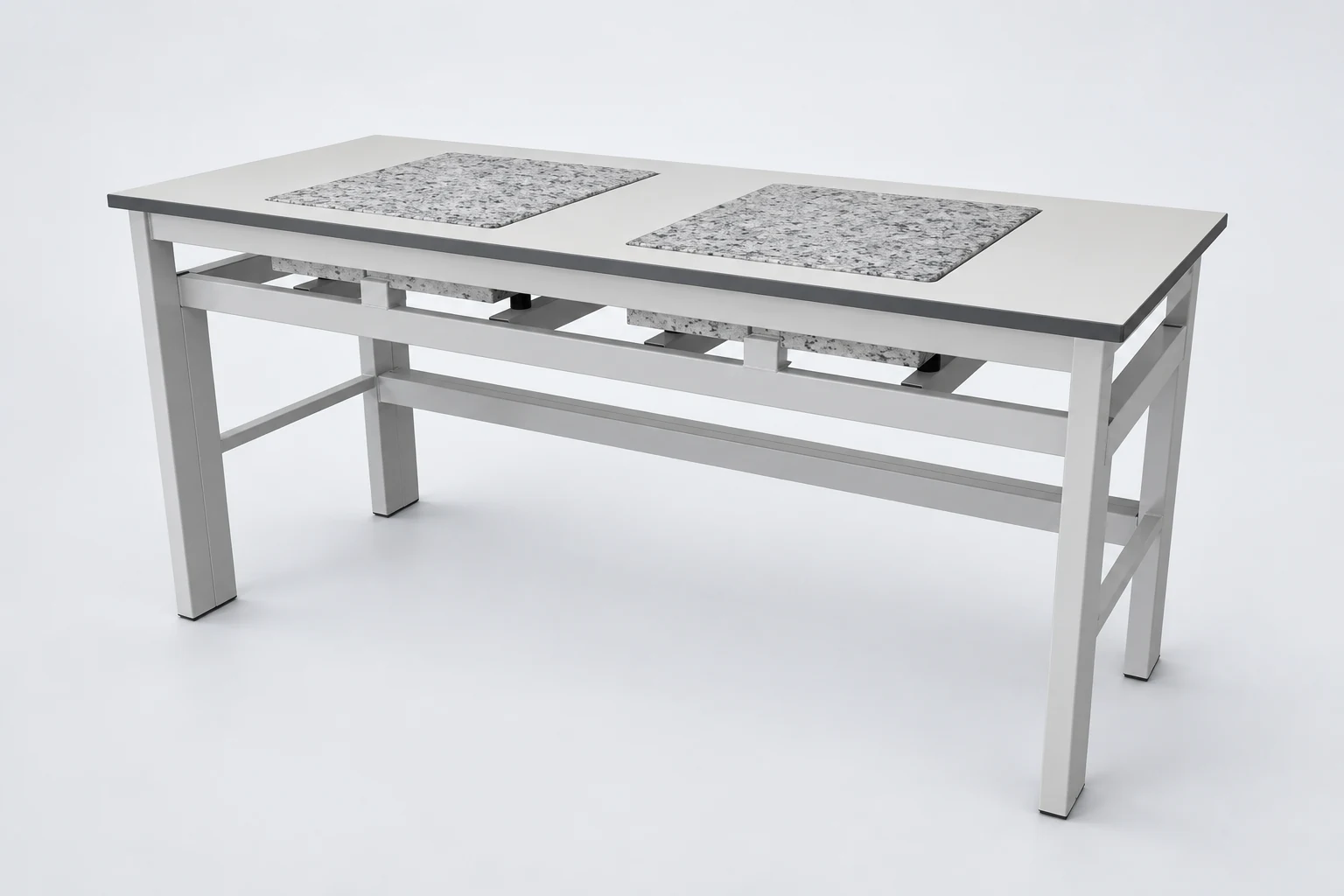
In more advanced systems, granite slabs and active air springs powered by compressed air are used, which compensate for both low and high vibration frequencies. This minimizes the resonance effect and improves the precision of observation.
Material Specification of Worktops and Insulation Systems
Worktops used in microscope stations must combine high mechanical stability with chemical resistance, which is why they are most often made of granite, large-format ceramics or epoxy resin. The key parameter isthe load capacity of the table, which determines the safety of working with heavy optics and additional accessories.
Granite is distinguished by its high hardness and abrasion resistance, which ensures stability for many years of intensive use. Large-format ceramics, on the other hand, offer better resistance to aggressive chemicals and easier cleaning, which is important in laboratory environments with a high hygiene regime.
In advanced configurations, ESD protection systems are also used, protecting sensitive electronics and optics with digital cameras from electrostatic discharge.
B2B procurement and personalization of laboratory stations
Specialized workstations for microscopes are most often ordered by research institutes and hospitals in the B2B model, where compliance with ISO 9001:2015 standards and spatial analysis of the cleanroom are crucial. Each electronically height-adjustable microscope table is designed individually.
The process includes the selection of configurations for room conditions, tender procedures and certification requirements such as ISO 14001 or ISO 37301 and ECOVADIS assessments. In practice, this allows the design to be adapted to limited space and specific laboratory procedures.
Ergonomic elements such as armrests are also often included in designs, which improve the operator's comfort and stabilize the position during long-term observations.
Frame load capacity and installation of heavy optical devices
The load capacity of a microscope station is a key parameter when selecting equipment, as it directly affects image stability and work safety. Standard designs carry loads of up to approx. 150 kg, while reinforced versions carry up to 300 kg, allowing for the installation of heavy microscopes, computers and measuring systems.
Additional stabilizing accessories such as integrated lighting systems and motor drives for precise positioning play an important role. The wiring is routed through sealed cable glands, which eliminates the risk of interference and improves ergonomics.
The strength tests of B2B manufacturers also analyze the impact of vibrations and dynamic loads, especially in laboratory environments where equipment works alongside installations such as fume hoods and other ventilation systems.
Criteria for choosing furniture for histology, cytology and metallurgy
The selection of an electron microscope table depends on the specifics of work in fields such as materials science and microbiology, where different requirements for stability, grounding and protection of clean zones are crucial. In histology and cytology, cleanliness and contamination control are prioritized, while in metallurgy – resistance to loads and vibrations.
For SEM and TEM microscopes, reinforced designs with anti-vibration systems and precise grounding are used, while for simpler stereoscopic microscopes, lighter measuring tables with a motor drive or manual positioning are sufficient. Modular solutions are also important, allowing adaptation to the test protocols in force in 2026.
Installation errors when planning space for optics
One of the most common installation mistakes is to position the station too close to vibration sources such as ventilation or laboratory centrifuges, which generates mechanical resonance and interferes with the precision of the measurements. Such installation errors lead to a loss of image stability and reduced quality of analysis.
Another problem is the integration of LED lighting on a common, non-isolated table frame, which additionally transmits vibrations to the optical system. The conclusions from B2B audits show that the correct separation of the vibration-free zone is crucial for the long-term stability of the workstation.
Comparison of Anti-Vibration Table with Standard Laboratory Worktop
The anti-vibration table with a stone top is designed to cut off the optical station from vibrations coming from the ground and the building structure. In standard laboratory furniture , this type of insulation does not occur, so microvibrations are directly transferred to the microscope, which impairs image stability and repeatability of measurements.
The structural difference results from the materials used and the supporting system. The anti-vibration tables use massive granite slabs and elastomer shock absorbers that dampen vibrations over a wide range of frequencies. In practice, this means more stable working conditions, especially at high magnifications, where even small vibrations cause blurred images and interpretation errors.
Standard laboratory tables, on the other hand, are lighter and more versatile, but do not provide dynamic isolation. They work well in general work, but in the environment of precise optics, their limitations become visible even with longer observations.
In terms of operation, the anti-vibration tables also reduce eye fatigue for operators, as the microscopic image remains stable without continuous focus corrections. In testing and accredited laboratories, this translates into higher data quality and fewer repetitions of measurements.
Cost calculation and valuation of the test stand
B2B pricing of a microscope station is an individual process, carried out in the RFQ model, because each project differs in configuration and technical requirements. The key factors affecting the cost are the load-bearing capacity of the structure (usually 150-300 kg), the type of vibration isolation used, and the degree of integration with optical and computer equipment.
The price is also influenced by the choice of components: active anti-vibration systems, massive stone countertops, additional arms for wiring or extensive workspace organization modules. Each microscope table is treated as an engineering design, not a catalog product.
The approximate cost of the basic granite table is approx. PLN 4628 net, but the final price may increase significantly with the expansion of the vibration damping system and modular configuration. This makes it possible to precisely adjust the station to the requirements of a specific laboratory and type of test.
FAQ
1. How long does it take to make a custom-made microscope table?
Implementation usually takes 4-6 weeks, depending on the complexity of the project and vibration damping systems. Each project involves dimension matching and delivery to the lab by the technical team.
2. What accessories can be integrated into the table?
For m.in, armrests, shelves for PCs, monitor arms and LED lighting are possible. All elements are mounted in such a way that they do not transmit vibrations to the worktop.
3. What is the difference between a passive table and an active table?
The passive dampens vibrations through granite and elastomers, while the active uses air cushions to reduce low frequencies. The choice depends on the type of microscope and the conditions in the building.
4. What is the warranty?
Normally 24 months with the possibility of extension. It includes construction, damping systems and height adjustment, along with service and access to spare parts.