Anti-vibration table: how to choose the design and protect the measurement
The correct construction of an anti-vibration table is essential wherever the reading precision must remain intact. A vibration isolation table is a specialized piece of furniture whose main task is to isolate sensitive measuring equipment from mechanical vibrations generated by the building and its surroundings. The wide application of the anti-vibration table includes modern analytical, industrial, and research laboratories.
 Renggli TeamEditorial team
Published: Updated Reading time: 6 min read
Contents
Anti-vibration table: how to choose the design and protect the measurement
A professional anti-vibration table eliminates micro-vibrations of the ground, enabling precise laboratory measurements. The use of a granite plate with a min. thickness of 40 mm reduces reading disturbances for balances with an accuracy of up to 0.001 mg. The Polish factory Renggli designs and manufactures dedicated weighing stations adapted to standard requirements.
Design of the anti-vibration table and situations requiring stabilization#
The correct construction of an anti-vibration table is essential wherever the reading precision must remain intact. A vibration isolation table is a specialized piece of furniture whose main task is to isolate sensitive measuring equipment from mechanical vibrations generated by the building and its surroundings. The wide application of the anti-vibration table includes modern analytical, industrial, and research laboratories. A standard laboratory anti-vibration table is characterized by precise overall dimensions: a width of 900 mm, a depth of 600 or 750 mm, and a height in the range of 750 to 800 mm. The load-bearing capacity of such a structure usually allows for a safe static load of up to 150 kg, which is a fully sufficient value for most advanced research devices. The safety of use is confirmed by appropriate adaptation to the rigorous requirements that professional laboratory furniture must meet.
For a granite anti-vibration table to effectively fulfill its function, it requires proper installation. This process begins with placing the furniture in the target location, and then precisely leveling the frame. Adjustable leveling feet terminated with protective rubber are used for this, which additionally prevents slipping and acts as the first barrier to floor vibrations.
Why does sensitive equipment need an anti-vibration table?#
Low-frequency micro-vibrations generated by building systems destabilize the readings of measuring equipment. Uncontrolled vibrations transmitted through the building structure are the main cause of measurement errors. This is caused, among others, by the low frequency of vibrations coming from air conditioning, working elevators, or intensive traffic in the corridors. Under such conditions, an analytical balance and mass comparators are unable to achieve the desired stability and repeatability of measurements. That is why a professional laboratory anti-vibration table is a fundamental requirement for precise work.
The vibration damping mechanism in an anti-vibration table#
Physical vibration damping is based on the use of high-density materials with energy-absorbing properties. A classic two-top anti-vibration table uses an independent external frame that protects the system against direct contact, and a separate internal load-bearing frame. A massive shock-absorbing block is stably mounted on the latter, the key element of which are elastomeric vibration isolators and dedicated damping rubber spacers. Such a multi-layer mechanism, separating the workspace from the weighing top, makes weighing and anti-vibration tables effectively eliminate low-frequency vibrations, ensuring complete vibration isolation.
How does a stable weighing station improve the repeatability of readings?#
A properly selected damping plate guarantees an absolutely stable baseline and eliminates the risk of errors during precise analytical work. The effective elimination of measurement drift from the environment directly improves the repeatability and consistency of results, which is critical when a sensitive microbalance is used in the laboratory. A properly isolated station facilitates research procedures and allows maintaining the reading accuracy declared by the manufacturer at a level from 0.1 mg to even 0.001 mg. Such a working environment is of immense importance not only for microbalance procedures but also in the area of sensitive optical microscopy.
What is the difference between a balance table and a standard worktop?#
A professional weighing station differs from a regular countertop by the physical separation of the measuring top and the use of a heavy stone top weighing up to 50 kg. Ordinary laboratory furniture, equipped with standard worktops made of materials such as MDF or phenolic resin (HPL), tend to transmit acoustic and mechanical vibrations from the environment. Meanwhile, a specialized analytical balance table completely absorbs these disturbances. Advanced laboratory equipment dictates the necessity of using such independent structures, especially when the required measurement accuracy of the balances oscillates within the limits of 0.1 mg to 0.001 mg.
In laboratory practice, two leading vibration stabilization systems are classified: passive and active. Passive systems, based on a massive granite plate, reduce vibrations by utilizing the large dead weight of the top and the damping properties of elastomers. They are mainly used for analytical balances, mass comparators, and standard microbalances. Their huge advantage is low maintenance costs, quick installation, and the lack of a need to connect a power supply. On the other hand, active pneumatic systems rely on ongoing vibration compensation through special cushions with compressed air. This is a solution dedicated to highly advanced analytics, which uses, for example, an electron microscope table (SEM and TEM). However, the implementation of active technology involves higher purchase costs and a strict requirement to provide constant access to a compressed air installation.
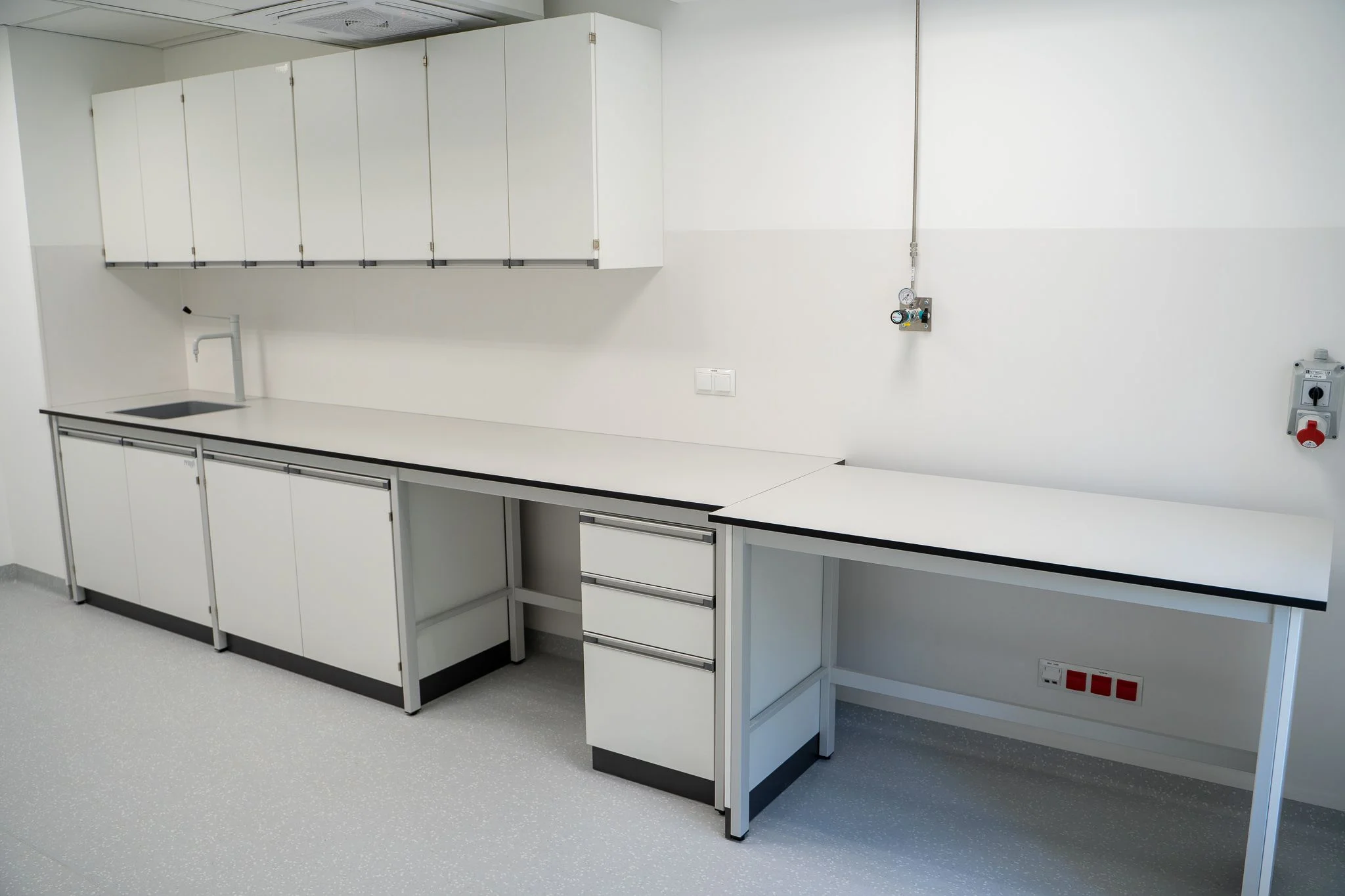
Importantly, a professional anti-vibration table is often more than just a granite plate. Fully equipped measurement stations, such as a single-station weighing table, can offer practical amenities: two spacious, lockable cabinets, a pull-out keyboard shelf, and an ergonomic place for a monitor. Regardless of whether the investment concerns a piece of furniture built into a line, or a freestanding weighing table, coherent integration is a priority. An example is the modular RL6 system, in which maintaining expansion joints between the table and the furniture line allows for optimal separation of vibrations. When planning the layout of equipment, the weighing table should always be placed against load-bearing walls, away from communication routes, doors, and air vents. The same rigorous architectural guidelines apply to specialized tables intended for mass comparators.
How does the two-top design protect the measurement and the lab technician's work?#
Separating the external frame structure (having a worktop) from the internal skeleton equipped with a damping plate perfectly protects the delicate weighing process. Even accidental touching of the external structure by the operator does not interfere with the measurement. Such a well-thought-out design improves the ergonomics of the research personnel performing highly repeatable procedures, while increasing the overall safety of use. This solution is a response to the restrictive requirements imposed by standards for pharmaceutical, technological, and medical facilities.
Anti-vibration table from the Polish manufacturer Renggli#
The Renggli company designs and manufactures advanced weighing stations. As a renowned manufacturer of anti-vibration tables, the brand continues a technological tradition dating back to 1927, and since 2013 has successfully based its production in a modern factory in Białystok. Each dedicated project is carried out strictly in the B2B model, which includes individual consulting, pricing, and precisely selected dimensions of the anti-vibration table, optimized for the infrastructure of the research facility. Our laboratory furniture is created from materials with outstanding mechanical and chemical resistance, such as acid-resistant stainless steel and natural, high-density granite. The Renggli engineering team has extensive experience in passive vibration isolation and analysis of inertial forces and resonant frequencies, which is evidenced by implementations for industry leaders such as Novartis, Celon Pharma, or Grupa Azoty.
We invite you to contact the technical and commercial department (+48 85 710 18 77) - our experts will help to safely integrate the weighing stations with the advanced RL6 system.