Flammable storage cabinet: which type to choose?
A flammable storage cabinet has a type that shows how long it protects liquids in a fire. How to match it to your stock and lab, and what goes in the order?
 Renggli TeamEditorial team
Published: Updated Reading time: 7 min read
Contents
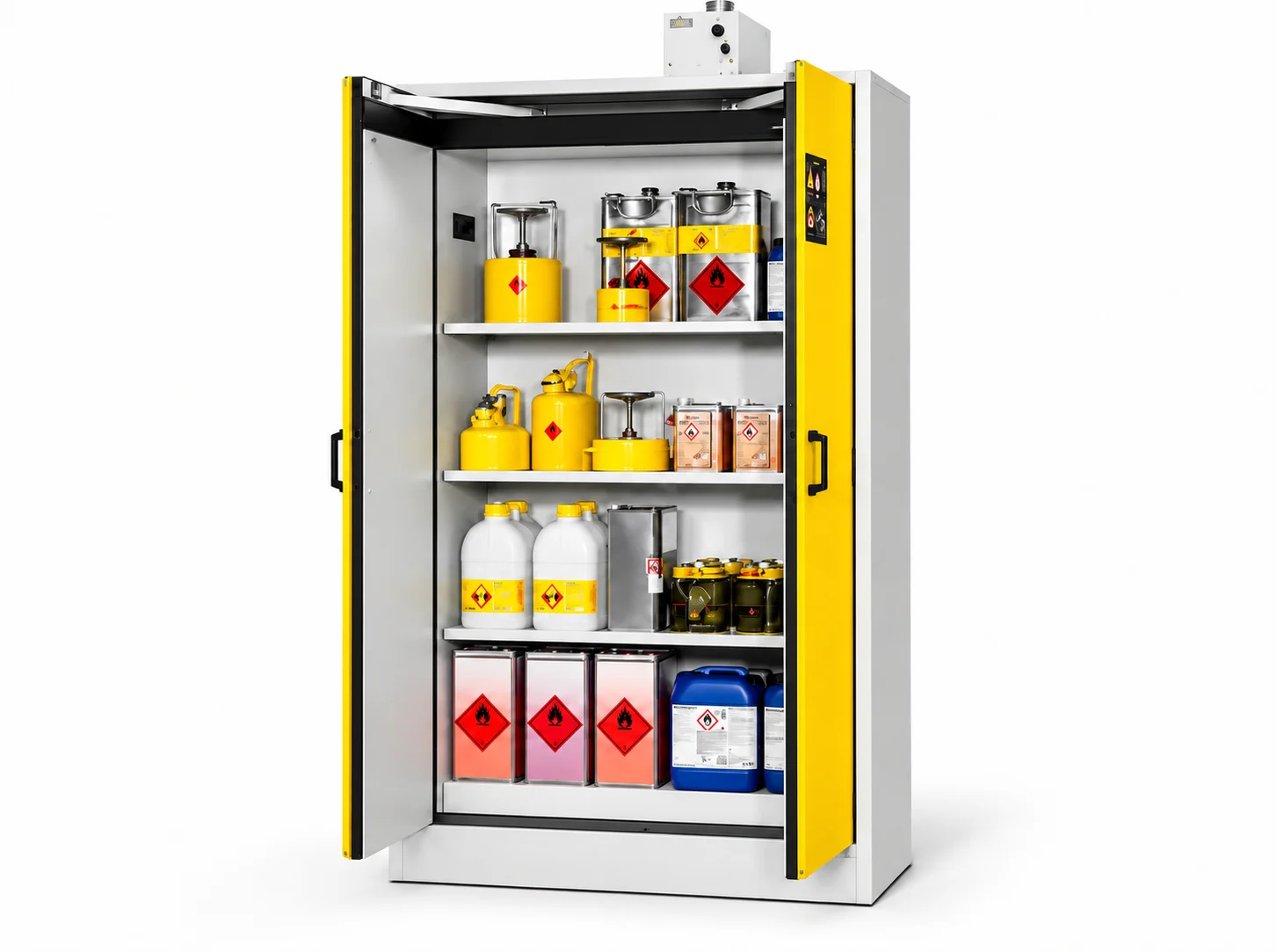
A flammable storage cabinet of type 30 or 90 is, in practice, a fire safety storage cabinet for flammable liquids that complies with EN 14470-1. The number in the type is the time in minutes for which the cabinet protects its contents from an external fire in the test to this standard. The type is chosen on the basis of the site's risk assessment: what counts is the hazards in the safety data sheets, the quantity of liquids and where the cabinet stands in the building.
How do the types of flammable liquid cabinets differ?#
The types of cabinets for flammable liquids differ in how long they protect in a fire. Renggli offers two types to EN 14470-1. The 30-minute cabinet has 30 minutes of fire resistance. The 90-minute cabinet has 90 minutes of fire resistance and stronger insulation in its walls and doors, so it gives more time for evacuation and firefighting. Which type to choose follows from the site's risk assessment and where the cabinet stands in the building.
The cabinets with the longer protection time come in versions with pull-out drawers, with shelves or with a collecting sump on which large containers stand. Their series (K, Q and S) differ in interior layout and in how the doors open.
Both types are built in a similar way. Each of these cabinets has double walls, a spill sump at the bottom and doors that close automatically in a fire. The body of either type can be connected to an extraction system.
What does the standard EN 14470-1 cover?#
The standard EN 14470-1 covers fire safety storage cabinets for flammable liquids, which the title of the standard calls storage cabinets. Its title in the PKN catalogue (opens in a new tab) reads, in translation: “Fire-resistant storage cabinets. Part 1: Safe cabinets for storing flammable fluids”. The catalogue entry refers to the edition PN-EN 14470-1:2023-12.
Which liquid counts as flammable is set by the CLP Regulation (EC) No 1272/2008 (opens in a new tab) on the classification, labelling and packaging of substances and mixtures (legal status as of 6 November 2026). The criterion is the flash point, and the label shows the hazard as a hazard statement (H statement), for example H224 “Extremely flammable liquid and vapour”. The H statements of each liquid are in its safety data sheet (SDS).
The fire safety storage cabinets for flammable liquids in the Renggli range have fire resistance to EN 14470-1. The fire resistance type is on the cabinet's rating plate, and the number of the standard is in the cabinet's documentation. The buyer checks both.
How do you choose a flammable storage cabinet for a laboratory?#
A flammable storage cabinet is chosen for the hazards of the stored liquids, their quantity and its place in the building. The Central Institute for Labour Protection (CIOP-PIB) (opens in a new tab) states that chemicals may be kept in portable stores, that is cabinets, which must be matched to the hazards of the chemicals stored.
List the liquids and their H statements
The hazard data are in the safety data sheet.
Estimate the stock of liquids in the cabinet
The quantity of liquids is one of the inputs to the site's risk assessment.
Check where the cabinet will stand
The cabinet's place in the building is also part of the risk assessment, and the cabinet type is chosen on that basis.
Decide on ventilation
The body of the flammable liquid cabinets in the Renggli range can be connected to an extraction system. Whether the connection is necessary is decided by the risk assessment for the stored substances.
Write the requirements into the tender specification
The standard, the type, the construction and the documents. A sample wording is in the table in the section on ordering.
Can acids and solvents be kept in one cabinet?#
Flammable solvents are kept in a fire safety storage cabinet to EN 14470-1, and acids and alkalis in a cabinet for non-flammable chemicals. Reagents are separated by hazard, and the data on the hazards are in the safety data sheet.
For acids, alkalis and other non-flammable chemicals, Renggli offers cabinets for non-flammable chemicals to EN 16121 and EN 16122. The requirements for this group are described in the post on the acid and alkali cabinet.
What goes in the order for a flammable liquid cabinet?#
The tender specification states the standard, the type of cabinet, its construction and the documents in which the buyer checks the fire resistance. A sample wording based on the parameters from the product pages:
| Item in the specification | Sample wording |
|---|---|
| Standard | fire safety storage cabinet complying with EN 14470-1 or equivalent |
| Type | protection time according to the site's risk assessment and the cabinet's location |
| Doors | closing automatically in a fire, with a cylinder lock |
| Base | spill sump at the bottom of the cabinet |
| Ventilation | ventilation connection for an extraction system |
| Documents | fire resistance type on the rating plate and number of the standard in the cabinet's documentation |
A buyer who writes the standard into the tender specification can ask for the document from the fire resistance test to EN 14470-1.
How Renggli solves it#
We offer fire safety storage cabinets in both lines, 30-minute and 90-minute, in the K, Q and S series (see the cabinet questions in the Renggli FAQ). The safety components are mounted outside the chamber, which protects them from corrosion. The doors have a cylinder lock and a closed-status indicator.
For placing under a countertop, we offer the 90-minute K-UB-90 cabinet.
Frequently asked questions#
A cabinet with a longer protection time has stronger insulation in its walls and doors, so it gives more time for evacuation and firefighting. The type needed in a given place is chosen on the basis of the site's risk assessment: what counts is the hazards of the liquids, their quantity and where the cabinet stands in the building.
The body of the fire safety storage cabinets for flammable liquids in the Renggli range can be connected to an extraction system in both types. Whether the connection is necessary is decided by the risk assessment for the stored substances.
The number in the cabinet type is the time in minutes for which the cabinet protects its contents from an external fire in the test to EN 14470-1. The higher the number, the longer this time.
The fire resistance type is on the cabinet's rating plate, and the number of the standard is in the cabinet's documentation. The buyer writes compliance with EN 14470-1 into the tender specification and checks both on delivery. The fire safety storage cabinets for flammable liquids in the Renggli range have fire resistance to this standard.