EN 13150: editions and how to check table compliance
EN 13150 covers laboratory tables. Which editions are in the PKN catalogue, how does a declaration differ from a test report, and how do you check compliance?
 Renggli TeamEditorial team
Published: Reading time: 7 min read
Contents
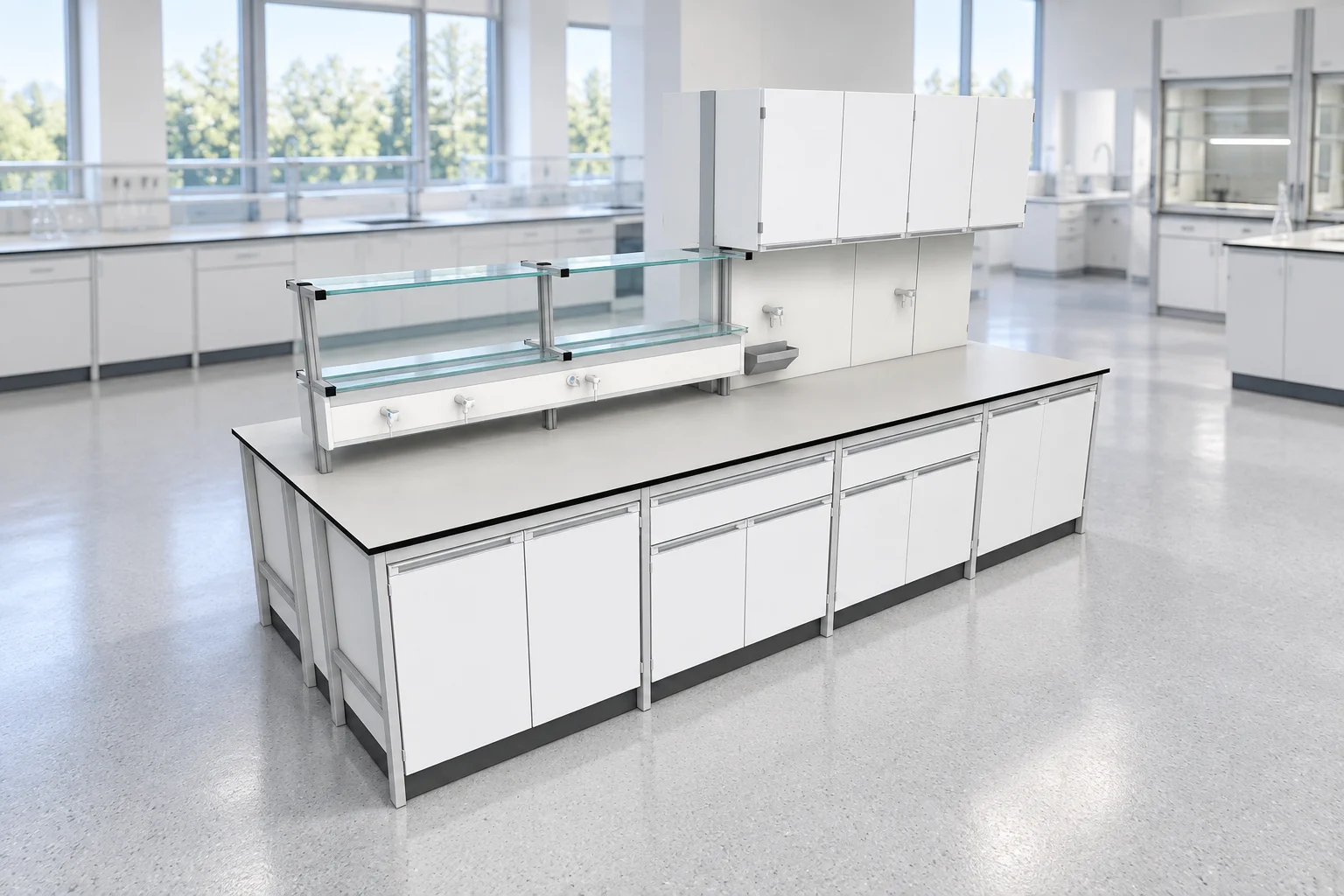
PN-EN 13150, the Polish edition of EN 13150, specifies the dimensions, safety requirements and test methods for laboratory tables. Renggli laboratory furniture complies with it. A contracting authority checks the compliance of a given table in the test documents, because the safety of furniture is confirmed by tests to the standard, not by the manufacturer's declaration of conformity alone.
What does the EN 13150 standard specify?#
PN-EN 13150 specifies the dimensions, safety requirements and test methods for workbenches for laboratories. On the PN-EN 13150:2004 page in the PKN catalogue (opens in a new tab) the title of the standard reads: “Workbenches for laboratories. Dimensions, safety requirements and test methods”. The latest edition, PN-EN 13150:2020-07 (opens in a new tab), applies to workbenches, mobile workbenches and workbench shelves intended for use in educational institutions and similar laboratories.
The prefix PN-EN means a Polish Standard adopted from a European standard. For each edition the PKN pages give the European equivalent marked IDT (identical): EN 13150:2001 for the 2002 and 2004 editions, EN 13150:2020 for the 2020-07 edition.
The standard sets out requirements and test methods. The results for a given table are in the test report to this standard.
What editions of EN 13150 are there?#
The PKN catalogue lists three editions of PN-EN 13150: from 2002, 2004 and 2020. The latest, PN-EN 13150:2020-07, was published by PKN on 8 July 2020, and on the same day PKN withdrew the 2004 edition, which the new one replaced.
| Edition | Language version | European equivalent | Published | Withdrawn |
|---|---|---|---|---|
| PN-EN 13150:2002 | English | EN 13150:2001 | 2002-08-15 | 2004-03-22, replaced by PN-EN 13150:2004 |
| PN-EN 13150:2004 | Polish | EN 13150:2001 | 2004-03-22 | 2020-07-08, replaced by PN-EN 13150:2020-07 |
| PN-EN 13150:2020-07 | English | EN 13150:2020 | 2020-07-08 | latest edition |
The dates and replacements come from the PKN pages: PN-EN 13150:2002 (opens in a new tab), PN-EN 13150:2004 (opens in a new tab) and PN-EN 13150:2020-07 (opens in a new tab). The 2004 edition has a Polish version.
Is the EN 13150 standard mandatory?#
Compliance with EN 13150 shows that a table has passed safety tests to the methods of the standard. A contracting authority requires it by naming the standard in the tender description.
Regulation (EU) No 1025/2012 (opens in a new tab) defines a standard as a technical specification adopted by a recognised standardisation body for repeated or continuous application.
On its company page Renggli lists EN 13150 among the standards it meets. Laboratory furniture affects the safety of the people who work at it, so its compliance is checked by tests to the standard, not on the basis of the manufacturer's declaration of conformity.
How do you check that a laboratory table complies with EN 13150?#
Compliance is checked in the test report to EN 13150 issued for the offered table. Under the EU Regulation (EC) No 765/2008 on accreditation (opens in a new tab), testing a table and issuing the report is part of conformity assessment, the process demonstrating whether specified requirements have been fulfilled.
Ask for the test report to EN 13150
The report is attached to the offer or to the acceptance documents, next to the technical data sheet of the table.
Check that the report describes the offered table
Compare the furniture system name in the offer (for example RL1), the construction and the laboratory countertop material with those given in the report.
Read the edition of the standard
The number with the date, for example PN-EN 13150:2004 or PN-EN 13150:2020-07, shows which edition the table was tested to. This makes it clear whether the reports from different offers refer to the same edition.
Check the laboratory in the PCA register
The register of testing laboratories of the Polish Centre for Accreditation (opens in a new tab) covers accredited bodies together with their current scopes of accreditation.
Compare the report with the manufacturer's declaration of conformity
The manufacturer's declaration of conformity says what the manufacturer states, and the report says what the tests showed.
How does a manufacturer's declaration of conformity differ from a test report?#
A manufacturer's declaration of conformity is its own statement, and a test report is the result of tests carried out to the methods of the standard. The EU Regulation (EC) No 765/2008 on accreditation (opens in a new tab) describes a conformity assessment body as a body that performs, among other things, testing and certification. One example of such a body is a testing laboratory.
Under the same regulation, accreditation is an attestation by a national accreditation body that a conformity assessment body is competent to carry out specific activities. In Poland accreditation is granted by the Polish Centre for Accreditation (PCA), and the scope of accreditation lists the tests that the laboratory performs under accreditation.
| Document | Who issues it | What it shows |
|---|---|---|
| Manufacturer's declaration of conformity | manufacturer | the manufacturer's statement that the table meets the standard |
| Test report | testing laboratory | results of tests of the table to the methods of EN 13150 |
| Certificate | certification body | the certification body's attestation that the product meets the requirements |
| Scope of accreditation | national accreditation body, in Poland PCA | tests that the laboratory performs under accreditation |
How do you write the EN 13150 requirement in a tender description?#
The requirement is written with the number of the standard. An example wording for laboratory tables:
Laboratory tables compliant with the standard EN 13150 or an equivalent one, on a powder-coated steel structure, with a laboratory countertop selected for the reagents at the workstation. The laboratory countertop material is specified according to the work done at the workstation. Renggli's range of laboratory countertops includes ceramic, epoxy resin, phenolic resin, glass, polypropylene and laminate. According to the Renggli range, ceramic is resistant to concentrated acids and high temperature, and polypropylene to hydrofluoric acid.
How does Renggli solve this?#
We design laboratory tables in line with EN 13150. We make them in modular systems, from RL1 with fixed cabinets on a plinth to RL7 with services from a ceiling-mounted installation. The base is a powder-coated steel frame, and we select the laboratory countertop for the substances at the workstation.
According to our Frequently asked questions page (as of 12 November 2026), the steel structures of our systems are profiles with a cross-section of at least 60 × 30 mm, powder-coated with epoxy resin. Our crew installs the furniture, and after installation we issue a handover protocol.
Frequently asked questions#
It is a European standard from 2001, adopted in Poland twice. In 2002 the English version (PN-EN 13150:2002) was issued, and in 2004 the Polish version (PN-EN 13150:2004). PKN adopted the newer standard EN 13150:2020 as PN-EN 13150:2020-07.
In the PKN catalogue the Polish version is the PN-EN 13150:2004 edition. The latest edition, PN-EN 13150:2020-07, was published by PKN in English.
In the register of testing laboratories of the Polish Centre for Accreditation, which gives current scopes of accreditation. In the scope you look for tests to the standard named in the report.
Yes, Renggli designs laboratory tables in line with EN 13150. Among the standards it meets, the company also lists EN 14175 for fume hoods and ISO 9001 for production.