Gas cylinder colours: the shoulder shows the hazard
Gas cylinder colours for technical gases (EN 1089-3:2011): red shoulder means flammable, light blue oxidising, light green inert, yellow toxic or corrosive.
 Renggli TeamEditorial team
Published: Reading time: 12 min read
Contents
Gas cylinder colours hint at the hazard a gas carries, but they do not tell you what is inside. The occupational health and safety instruction of Maria Curie-Skłodowska University (opens in a new tab) (UMCS) from April 2026 recommends treating the colours of technical gas cylinders as an additional source of information. Besides the colours of 4 hazard groups, the instruction gives, in a separate table, its own shoulder colour for seven gases, including oxygen, argon and acetylene. At the workstation, the choice of laboratory taps and valves also depends on the gas group, because valves for flammable and non-flammable gases are separate products.
What do gas cylinder colours mean?#
The colour of the shoulder, the rounded top part of the cylinder, shows the hazard group of the gas. The UMCS instruction quotes the table from EN 1089-3:2011 as a recommendation for university laboratories: a flammable gas has a red shoulder and an oxidising gas a light blue one. Inert gases have a light green shoulder, and toxic and corrosive gases a yellow one.
| Gas group | Shoulder colour | Colour name in the RAL register |
|---|---|---|
| toxic and/or corrosive gases | yellow | zinc yellow |
| flammable gases | red | flame red |
| oxidising gases | light blue | light blue |
| inert gases | light green | yellow green |
The instruction also gives examples for three of the groups: flammable gases, inert gases, and toxic and corrosive gases; there is no example of an oxidising gas. Hydrogen and methane are flammable gases, xenon and krypton are inert, and ammonia, chlorine and sulphur dioxide are toxic or corrosive. According to the Air Liquide Polska brochure (opens in a new tab), air and mixtures of inert gases also have a light green shoulder.
What colour is an oxygen, nitrogen, argon or acetylene cylinder?#
In the standard these gases have a colour of their own, independent of the group. The table of individual markings in the UMCS instruction covers seven gases, of which 4 have a second permitted colour.
Acetylene has a chestnut shoulder, oxygen a white one and nitrous oxide a blue one. Argon, nitrogen, helium and carbon dioxide have a colour of their own or the light green of inert gases. An argon cylinder may therefore have a dark green or a light green shoulder, and both comply with the table.
| Gas or mixture | Shoulder colour | Second permitted colour |
|---|---|---|
| acetylene | chestnut | none |
| argon | dark green | light green |
| nitrogen | black | light green |
| helium | brown | light green |
| oxygen | white | none |
| nitrous oxide | blue | none |
| carbon dioxide | grey | light green |
Two nitrogen cylinders can therefore stand side by side in a laboratory, one with a black shoulder and the other with a light green one, and both are marked correctly. The shoulder colour narrows the choice but does not settle the name of the gas.
Shoulder or cylindrical part: why is oxygen both white and blue?#
Because the standard colours only the shoulder. The Air Liquide Polska brochure says so outright: “Colour marking has been regulated only for the cylinder shoulder”. The UMCS instruction adds that the standard does not strictly define the colour of the cylindrical part of technical gas cylinders.
The colour of the cylindrical part was set by gas companies in Poland. Technical oxygen has a blue cylindrical part and a white shoulder, hence two descriptions of the same cylinder.
| Type of gas | Colour of the cylindrical part | RAL colour |
|---|---|---|
| medical gases and breathing mixtures | white | alpine white |
| gases for the food industry | light green | pale green |
| acetylene | chestnut | oxide red |
| technical oxygen | blue | medium blue |
Does EN 1089-3 cover propane cylinders and fire extinguishers?#
No. According to the Air Liquide Polska brochure, the standard does not apply to cylinders with liquefied petroleum gas (LPG) or to gases used for cooling. Portable and stationary extinguisher cylinders are also excluded. A red extinguisher therefore says nothing about a flammable gas.
The exclusion of LPG is also visible in the title of the standard on the SS-EN 1089-3:2011 card in the SIS catalogue (opens in a new tab): “Gas cylinder identification (excluding LPG)”. The card for this Swedish edition shows the status “Valid” and indicates that it replaced SS-EN 1089-3:2004. The European standard EN 1089-3 itself appeared in 1997, as the UMCS instruction recalls, and that instruction describes the colour marking of LPG cylinders separately.
Which valves suit flammable gases and which non-flammable ones?#
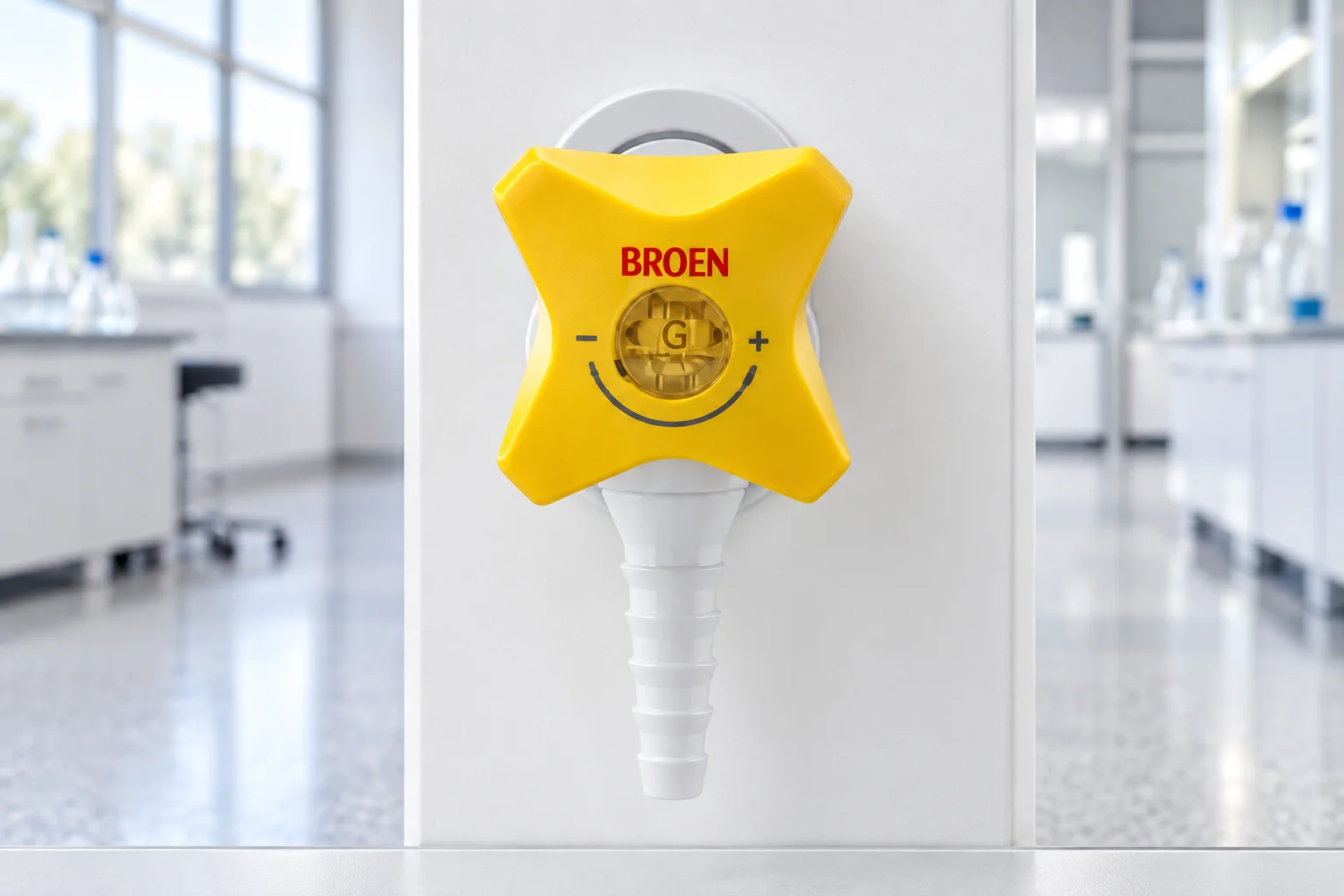
Flammable gases are connected to valves for flammable gases, and oxygen, nitrogen, argon, helium and carbon dioxide to valves for non-flammable gases. The valve card for flammable gases lists 3 media: hydrogen, methane and propane.
The CLP Annex VI entry for each of these three gases carries hazard statement H220, extremely flammable gas, as can be seen, for example, in the first of these entries read in PubChem (opens in a new tab). In the UMCS table, hydrogen and methane have the red shoulder of flammable gases. Propane in a cylinder is one of the liquefied LPG gases that EN 1089-3 does not cover, so the standard's table gives no colour for it.
The valve card for non-flammable gases lists oxygen, nitrogen, carbon dioxide, argon, helium, compressed air and vacuum among the media. Non-flammable does not mean inert, however. The Annex VI entry for oxygen as a gas carries hazard statement H270, may cause or intensify fire; oxidiser, and its PubChem entry (opens in a new tab) shows the same.
Nitrogen, carbon dioxide, argon and helium as gases have no harmonised entry in Annex VI, so there is no flammable gas statement for them. Vacuum has no cylinder, and according to the Air Liquide brochure compressed air has a light green shoulder.
| Medium | Renggli valve card | Cylinder shoulder colour | Annex VI entry for the gas |
|---|---|---|---|
| hydrogen | Valves for flammable gases | red (example of flammable gases) | H220, extremely flammable gas |
| methane | Valves for flammable gases | red (example of flammable gases) | H220, extremely flammable gas |
| propane | Valves for flammable gases | LPG, outside EN 1089-3 | H220, extremely flammable gas |
| oxygen | Valves for non-flammable gases | white (individual marking) | H270, oxidising gas |
| nitrogen | Valves for non-flammable gases | black or light green | no harmonised entry |
| carbon dioxide | Valves for non-flammable gases | grey or light green | no harmonised entry |
| argon | Valves for non-flammable gases | dark green or light green | no harmonised entry |
| helium | Valves for non-flammable gases | brown or light green | no harmonised entry |
| compressed air | Valves for non-flammable gases | light green (supplier example) | not applicable |
| vacuum | Valves for non-flammable gases | no cylinder | not applicable |
Gas cylinder colours at the workstation: a checklist#
Before a cylinder goes to the workstation, the shoulder colour and the label tell you which valve to connect it to. The list is based on the documents cited above and on the valve cards.
Read the cylinder label
The name of the gas and the warning stickers decide what the cylinder contains. The Air Liquide Polska brochure calls the label the only binding marking.
Check the shoulder colour
The shoulder shows the group: flammable, oxidising, inert, or toxic and corrosive. For nitrogen, argon, helium and carbon dioxide, two colours are correct.
Do not judge the gas by the cylindrical part
Its colour was set by gas companies, and the standard does not strictly define it. A blue cylindrical part with a white shoulder is technical oxygen.
Match the valve to the gas group
Hydrogen, methane and propane go to valves for flammable gases. Oxygen, nitrogen, argon, helium, carbon dioxide and compressed air go to valves for non-flammable gases, remembering that oxygen is an oxidiser.
For an LPG cylinder, ask the supplier about the marking
EN 1089-3 does not cover LPG, so the colour of such a cylinder cannot be read from the standard's table.
Where to keep cylinders near the laboratory is described in the article on the cabinet for technical gas cylinders, and the design of the whole network in the article on technical gas installations.
Technical gas cylinder colours: method and data#
We did not read the text of EN 1089-3:2011, because it is paid. We transcribed the colour tables from two open documents that summarise it: the UMCS occupational health and safety instruction from April 2026 (pages 13 to 16) and the Air Liquide Polska brochure from 2024. Both documents were read on 19 October 2026.
The table below covers 16 different gases. It has more rows, because a gas with two permitted colours takes two, and a gas from a group example has the colour of that group. Propane as LPG stands in the table without a colour, because the standard does not cover it.
| Gas or mixture | Basis of the colour | Shoulder colour | Source and page |
|---|---|---|---|
| acetylene | individual | chestnut | UMCS, p. 14 |
| argon | individual, colour 1 | dark green | UMCS, p. 14 |
| argon | individual, colour 2 | light green | UMCS, p. 14 |
| nitrogen | individual, colour 1 | black | UMCS, p. 14 |
| nitrogen | individual, colour 2 | light green | UMCS, p. 14 |
| helium | individual, colour 1 | brown | UMCS, p. 14 |
| helium | individual, colour 2 | light green | UMCS, p. 14 |
| oxygen | individual | white | UMCS, p. 14 |
| nitrous oxide | individual | blue | UMCS, p. 14 |
| carbon dioxide | individual, colour 1 | grey | UMCS, p. 14 |
More rows: 10
| Gas or mixture | Basis of the colour | Shoulder colour | Source and page |
|---|---|---|---|
| carbon dioxide | individual, colour 2 | light green | UMCS, p. 14 |
| ammonia | example of toxic and corrosive gases | yellow | UMCS, p. 15 |
| chlorine | example of toxic and corrosive gases | yellow | UMCS, p. 15 |
| sulphur dioxide | example of toxic and corrosive gases | yellow | UMCS, p. 15 |
| hydrogen | example of flammable gases | red | UMCS, p. 15 |
| methane | example of flammable gases | red | UMCS, p. 15 |
| xenon | example of inert gases | light green | UMCS, p. 15 |
| krypton | example of inert gases | light green | UMCS, p. 15 |
| air | supplier example | light green | Air Liquide Polska, p. 2 |
| propane (LPG) | outside the standard | none in the standard's table | UMCS, p. 16 |
The media from the valve cards are recognised by a closed vocabulary of names in the text of the product cards in the CMS. The classification of the gases was read from PubChem as CLP Annex VI entries, without company notifications to ECHA. Nitrogen, carbon dioxide, argon and helium have no such entry.
Frequently asked questions#
The shoulder is white and the cylindrical part is blue. The white shoulder of oxygen is given by the table of individual markings, and the blue cylindrical part was set by gas companies in Poland.
The shoulder is grey or light green, because the table permits both colours.
No. A red shoulder means a flammable gas only on a cylinder covered by EN 1089-3, and the standard does not cover extinguishers or LPG cylinders.
No. Propane-butane is liquefied LPG gas, and EN 1089-3 does not apply to LPG cylinders, so the supplier and the label tell you how such a cylinder is marked.
No. The shoulder colour is additional information about the hazard, and the contents of the cylinder are settled by the label with its warning stickers.